Research Results Utilizing Motion Capture Technology at Tokyo University
Assisting Muscle Interaction and Sequential Movements
The mystery of why babies kick inside their mother's womb has been solved. It has been found that this behavior leads to muscle interactions that develop the sensorimotor system.
On the 26th (local time), according to 'Study Finds' and others, a research team from the University of Tokyo in Japan analyzed the random limb movements of newborns and infants and published their findings in the Proceedings of the National Academy of Sciences (PNAS). Babies appear to kick and wriggle continuously without external stimuli from the prenatal stage through infancy. Most pregnant women begin to feel fetal movements between 16 and 24 weeks. Scientists have long tried to identify the cause of this behavior, and now a clue has finally been provided.
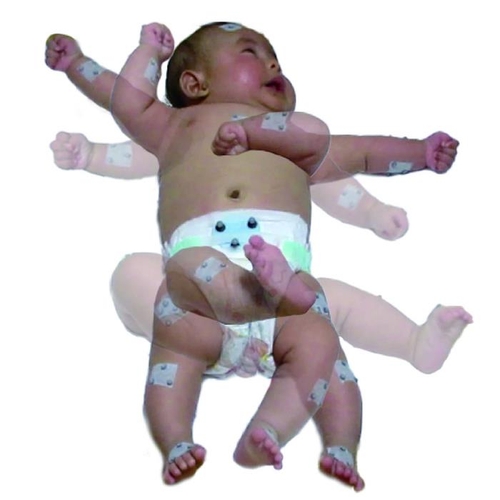
In this study, the research team used motion capture technology to record joint movements of 12 newborns less than ten days old and 10 infants aged three months. They utilized a musculoskeletal computer model tailored to the bodies of newborns and infants to measure muscle activity and sensory input signals, and analyzed the spatiotemporal characteristics of the interaction between muscle activity and sensory input signals using computer algorithms. Previous research on sensorimotor development focused only on kinematic properties such as muscle activity that moves joints or body parts, but this study paid attention to communication between sensory inputs and muscles throughout the entire body.
The results showed that when newborns and infants wave their limbs around in a 'wandered' behavior, various patterns of interaction between sensorimotor functions appear. The team analyzed that based on babies' random exploratory behavior, muscle interaction patterns develop, which later help enable sequential movements. Dr. Hoshinori Kanazawa from the Graduate School of Information Science and Technology, who led the study, stated, "By combining musculoskeletal models and neuroscientific methods, we discovered that spontaneous movements that seem to lack clear tasks or goals contribute to the harmonious development of sensorimotor functions."
The research team named this behavior 'sensorimotor wandering.' Expanding understanding of this could provide insights into the origins of human movement and contribute to developing treatments for various neurodegenerative diseases, including seizures, multiple sclerosis, spinal cord injuries, motor neuron disease, and cerebral palsy. Dr. Kanazawa explained, "Sensorimotor development usually occurs when sensorimotor interactions are repeated, so it was believed that the more the same behavior is repeated, the more it is learned and remembered. However, this time, the results showed that babies not only repeat the same behavior but also repeat 'various behaviors.'" He added, "This means that babies develop their sensorimotor system based on exploratory behavior or curiosity."
The study also found that 'sensorimotor wandering' increases coordinated whole-body movements. Furthermore, the infant group showed more common patterns and sequential movements compared to the random movements of the newborn group. The research team plans to analyze how 'sensorimotor wandering' affects later developmental stages such as walking and reaching, as well as more complex behaviors and cognitive functions.
© The Asia Business Daily(www.asiae.co.kr). All rights reserved.


















