2023 Government Budget Confirmed at 9.0183 Trillion Won
Incorporating Key Issues Including Establishment of 'Shared Semiconductor Education Center'
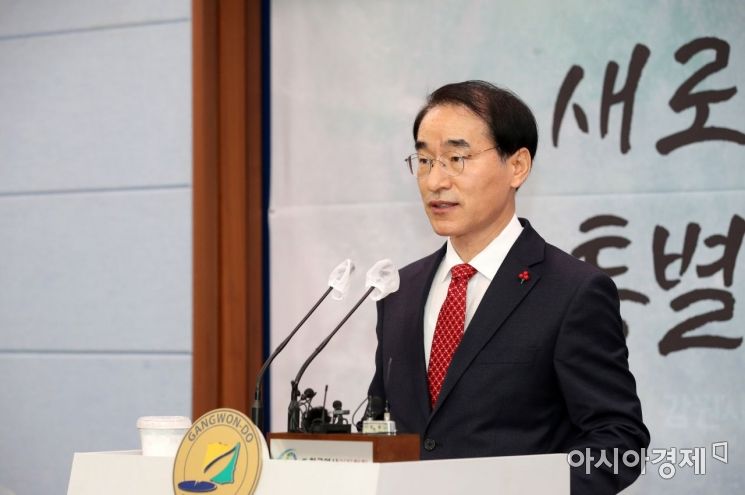 Kim Myung-seon, Deputy Governor of Gangwon Province, held a press conference at the provincial office on the 26th and stated, "In 2023, the inaugural year of the Gangwon Special Self-Governing Province, Gangwon Province has entered the era of the first-ever 9 trillion won in national funding." [Gangwon Province]
[Asia Economy Reporter Ra Young-cheol] From the inaugural year of the special self-governing province next year, the 8th term Gangwon Provincial Government, entering the era of 9 trillion won in national funding, will push forward key policies such as the establishment of a semiconductor cluster.
The province plans to focus its capabilities on 10 core projects among 35 major pending projects, having secured an additional 242.5 billion won from the National Assembly on top of the original national budget of 8.7758 trillion won.
For the top priority project, the semiconductor cluster establishment, 20 billion won out of the 46 billion won budget for the 'Shared Semiconductor Education Center Construction' will be allocated for equipment purchases.
Additionally, the province plans to lay the foundation for the Wonju semiconductor cluster and foster 10,000 semiconductor specialists required by companies by 2031.
The total project cost for the construction of Seomyeon Bridge, a long-awaited project for residents in the Chuncheon area, is 99.8 billion won, of which 69.9 billion won is national funding, including 1 billion won for design services.
Once Seomyeon Bridge is completed in 2028, the travel time from Seomyeon to the city center will be reduced from over 30 minutes to within 5 minutes.
The railway construction project between Chuncheon and Sokcho initially included 206.8 billion won in the government budget, but with an increase of 20.7 billion won, the opening of the East-West High-Speed Railway in 2027 is expected to accelerate.
An additional 2.15 billion won has been newly allocated for the third phase of the abandoned mine area tourism industry revitalization project, with a total project cost of 45 billion won, of which 22.5 billion won will be national funding. The third phase focuses on software development.
In particular, the revitalization of the abandoned mine area economy is a key project of Governor Kim Jin-tae, who plans to promote a wide-area tourism program linking four cities and counties in the abandoned mine area (Taebaek, Samcheok, Yeongwol, Jeongseon).
A new allocation of 300 million won for the preliminary feasibility study of the Yangyang Airport inbound pilot airport project has also been made, and a detailed investigation for facility expansion such as the installation of parallel taxiways at Yangyang International Airport will be conducted.
Due to the absence of parallel taxiways, there is a risk of safety accidents when two aircraft take off and land simultaneously, so the province plans to work with related agencies to prepare countermeasures and continuously request the government to improve facility infrastructure.
An additional 5 billion won in national funding has been allocated to three projects related to the 'e-mobility industry promotion.' 2 billion won has been budgeted for the 'Mountain Road-Based Autonomous Driving Demonstration Evaluation Infrastructure Construction' project developing autonomous driving technology.
1.5 billion won will be invested in the 'Bio Twin-Based Future Car Parts Advancement Foundation' project, which simultaneously monitors biometric information and various body data to check the driver's health.
The 'Core Parts and Vehicle Safety Foundation for Electric and Hydrogen Vehicles' project has been increased by 1.5 billion won to cover the shortfall. The province expects that with the synergy effect of the e-mobility industry infrastructure, Hoengseong County will solidify its position as a hub for the e-mobility industry.
A new allocation of 700 million won for design services has been made for the 'Gwangdeok Tunnel Road Construction' connecting the northern Gyeonggi region and Gangwon Yeongseo region.
The total project cost for the Gwangdeok Tunnel road construction, which involves expanding and widening the 4.7 km section between Gwangdeok-ri in Hwacheon County and Dopyeong-ri in Pocheon City, Gyeonggi Province, and constructing the 3,805 m long Gwangdeok Tunnel, is estimated at 163.2 billion won, with 114.2 billion won in national funding required.
Preliminary feasibility study costs of 300 million won each have also been newly allocated for the 'Gangwon Inland Expressway' connecting Yeongwol, Jeongseon, Pyeongchang, Hongcheon, Inje, and Yanggu, and the 'Pocheon-Cheorwon Expressway' project.
The total project cost for the Gangwon Inland Expressway (136 km), which passes through the inland border area and abandoned mine areas of Gangwon, is 6.5416 trillion won, and the Pocheon-Cheorwon Expressway (40 km) is 1.9433 trillion won.
In addition, 1 billion won has been budgeted for a research service to maximize forest utility such as preservation and effective use of cultural heritage in Gariwangsan, 1 billion won for design services for the creation of a tourism and leisure-type RE100 New Deal Town, and 300 million won for research on expanding biological resource conservation infrastructure.
Also, 200 million won for a feasibility study on establishing an agricultural product storage base in Gangwon, 300 million won for training specialized personnel tailored to on-site in vitro diagnostics, and 1 billion won for the creation of themed border hub areas were newly reflected as new projects during the National Assembly budget review.
After the government budget proposal, large-scale national funding public projects (Urban Regeneration New Deal Project 39 billion won, Comprehensive Flood Damage Living Area Maintenance Project 11.6 billion won) were selected from central government ministries in October-November, securing an additional 50.6 billion won in national funding for next year.
Kim Myung-seon, Deputy Governor of Gangwon Province, stated, "We selected 10 core pending projects based on necessity, provincial government operation vision, and contribution to regional balanced development, concentrating the province's capabilities."
© The Asia Business Daily(www.asiae.co.kr). All rights reserved.

















