Boryeong Advances in Space Business Including CIS Challenge
Active Research on New Drugs and Organs Using Microgravity
 A SpaceX Falcon 9 rocket that launched from Launch Pad 39A at Kennedy Space Center in Cape Canaveral, Florida, USA, last April, is captured arcing into space from nearby Merritt Island. [Image source=Yonhap News]
[Asia Economy Reporter Chunhee Lee] As the era of private space exploration opens, interest in space from the pharmaceutical and bio industries is growing. Amid increasing attention to 'space healthcare' that enables a healthy life even in space, the possibility of new drug development utilizing the unique characteristic of microgravity is also being suggested.
According to the industry on the 27th, Boryung has recently positioned space healthcare as its next-generation growth engine and is promoting the 'Care In Space (CIS)' project. Since April, it has been conducting the 'CIS Challenge' in collaboration with NASA, Harvard University, and the Massachusetts Institute of Technology (MIT) to explore various healthcare issues in space and seek commercialization opportunities. On October 6, six teams were selected as the final winners and will be given the opportunity to conduct experiments on the space station.
This is said to reflect the proactive will of Kim Jeong-gyun, the third-generation owner and CEO of Boryung, who has actively stepped into the business frontline this year. When Kim visited NASA's Johnson Space Center in Houston, USA, in 2020, he reportedly asked, "Can sick people go to space?" but received the answer "We don't know yet" from NASA. Seeing this as an opportunity, he formed a task force to concretize related plans and has been steadily making preparations. Boryung has shown interest in space business in the past as well, providing three stem cell lines in 2008 and sending them to space with Korea's first astronaut, Yi So-yeon.
Boryung is going a step further by revealing plans for the space business itself. On the 21st, Boryung made a strategic investment of $50 million (approximately 64.9 billion KRW) in Axiom Space, a private commercial space station company. This is the second investment following $10 million earlier this year. Axiom is contracted with NASA to build the commercial space station 'Axiom Station' aimed to replace the International Space Station (ISS) by 2028.
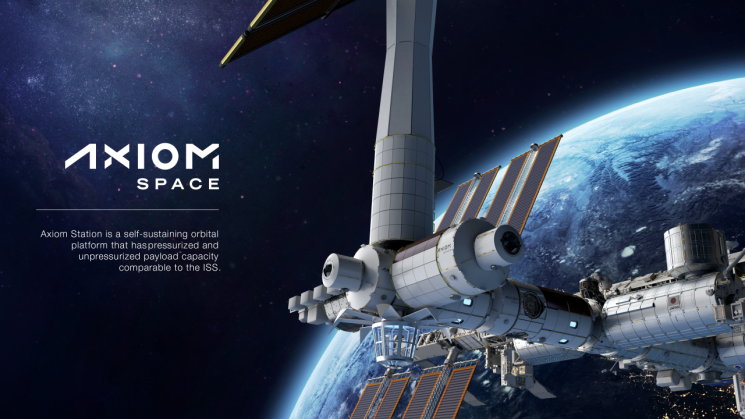 Axiom Space's planned construction of the world's first commercial space station, 'Axiom Station' (Photo by Boryeong)
Attempts related to new drug development are also ongoing. In microgravity, protein crystals do not settle, allowing for the production of higher purity drugs. Merck conducted an experiment in 2017 manufacturing the blockbuster immuno-oncology drug 'Keytruda' on the space station. Additionally, AstraZeneca is researching new drug delivery methods and materials using nanoparticles and microgravity, and Eli Lilly is also developing anticancer drugs utilizing microgravity.
Furthermore, the U.S. company Techshot has created heart muscle using a 3D printer on the space station. On Earth, strong gravity causes cells to attach to the bottom and grow, making it difficult to form three-dimensional tissues, but in microgravity, it is possible to organize tissues three-dimensionally. The company aims to produce transplantable human heart tissue within 10 years.
Domestically, Enzychem Lifesciences is developing space radiation therapeutics. Selected for NASA's 'Human Research Program (HRP)' research project, it is conducting related studies using the new drug candidate 'EC-18.' NASA's HRP also researches medical projects on the space station and human health. Since the space environment has weak gravity, the heart, muscles, and bones may weaken, and there are significant risks from ultraviolet and space radiation exposure, so these issues are being reviewed in advance. Enzychem has also established the Space Radiation Medical Research Institute and is conducting joint research with Inha University's Aerospace Medicine Research Institute.
The government is also promoting the 'Space Medicine Research Platform Project' through the Ministry of Health and Welfare and the Korea Disease Control and Prevention Agency. The plan is to invest about 45 billion KRW over five years starting next year to secure national competitiveness in space medicine for the future space era. Utilizing this, active support will be provided for frontier medical science research using the space environment, technology development to respond to space conditions, and support for space medicine research.
© The Asia Business Daily(www.asiae.co.kr). All rights reserved.
![Clutching a Stolen Dior Bag, Saying "I Hate Being Poor but Real"... The Grotesque Con of a "Human Knockoff" [Slate]](https://cwcontent.asiae.co.kr/asiaresize/183/2026021902243444107_1771435474.jpg)












