Simulation of Changing Tax Rates... Comprehensive Real Estate Tax for Two-Homeowners Reduced by More Than Half
Corporate Tax for Large Companies Decreases by Hundreds of Billions... Estimated 640 Billion Won Tax Relief for Samsung Electronics
[Asia Economy Reporters Minyoung Kim, Hyunjin Jung, Sejong=Junhyung Lee] As the Yoon Seok-yeol administration's tax reform plan passes the National Assembly, some tax burdens such as comprehensive real estate tax and corporate tax are expected to be significantly eased starting next year. It is estimated that the comprehensive real estate tax burden for multi-homeowners owning two houses in regulated areas such as Seoul will be reduced to less than half compared to this year. Major domestic corporations like Samsung Electronics are expected to reduce their corporate tax burden by several hundred billion won starting next year.
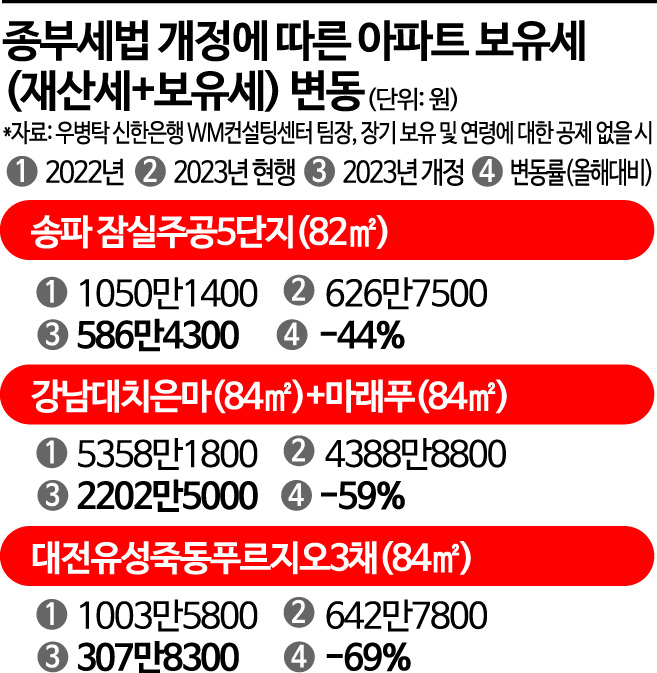
According to a holding tax simulation requested by Asia Economy from Woobyungtak, head of the Shinhan Bank Investment Advisory Center, under the revised Comprehensive Real Estate Tax Act, the 2023 holding tax for a two-homeowner with an 84㎡ unit in Mapo Raemian Prugio in Ahyeon-dong, Mapo-gu, Seoul, and an 84㎡ unit in Eunma, Daechi-dong, Gangnam-gu, Seoul, will be 22.02 million won, a 58.89% decrease from the 2022 holding tax of 53.58 million won. Under the current system, a two-homeowner holding Mapo Raemian Prugio and Eunma Apartments would have to pay 43.89 million won in holding tax next year. This figure applies a 75.3% official price realization rate and a 45% fair market value ratio for property tax next year.
The corporate tax burden for large corporations will also decrease significantly. Samsung Electronics, the largest domestic company, paid 13.4444 trillion won in corporate tax last year. Samsung Electronics' pre-tax corporate profit last year was 53.3518 trillion won. Applying the reduced highest corporate tax rate of 24% (down by 1 percentage point) simply to this pre-tax profit results in 12.8044 trillion won, about 640 billion won less than the corporate tax Samsung Electronics paid last year (13.4444 trillion won). However, since the taxable base for corporate tax is calculated by adjusting for carryforward losses, non-taxable income, and undergoing tax adjustments, there is a difference between the figure obtained by applying the tax rate to pre-tax profit and the effective tax rate.
Approximately 150,000 individual investors will be exempt from the financial investment income tax (Fin-Income Tax) that was scheduled to take effect next year. The passed tax reform plan includes a two-year postponement of the Fin-Income Tax implementation from next year to 2025. The Fin-Income Tax is a system that levies taxes on financial investment products such as stocks and bonds when certain income thresholds are exceeded, such as more than 50 million won in domestic listed stocks. About 150,000 people holding listed stocks are subject to this tax, but they will be exempt from taxation for the next two years.
© The Asia Business Daily(www.asiae.co.kr). All rights reserved.


















