2021 University (Graduate) Graduates Employment Rate 67.7%
Rebound After 3 Years... Recovery to Pre-COVID Level
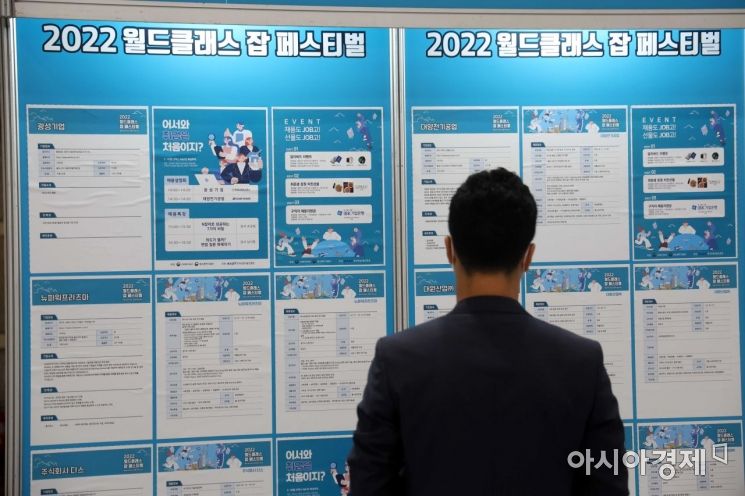 On the 19th, citizens searching for jobs visited the '2022 World Class Job Festival,' a job fair specialized for small and medium-sized enterprises hosted by the Ministry of Trade, Industry and Energy and the Ministry of SMEs and Startups, held at COEX in Gangnam-gu, Seoul. Photo by Moon Honam munonam@
[Asia Economy Reporter Yoo Byung-don] Last year, the employment rate of university and graduate school graduates showed a rare increase to 67.7%. However, it still remained at around 60%, indicating a serious employment crisis.
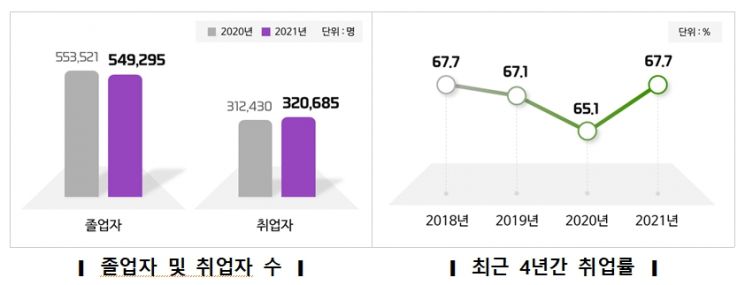
On the 26th, the Ministry of Education and the Korea Educational Development Institute announced the results of the '2021 Higher Education Institution Graduate Employment Statistics Survey.' The survey targeted 549,295 graduates nationwide from universities and general graduate schools (graduates of February 2021 and August 2020) to determine their employment status as of the end of last year.
Among 473,342 employment-eligible graduates, excluding those enlisted in the military or who advanced to domestic or overseas studies, 320,685 were employed, resulting in an employment rate of 67.7%. This is an increase of 2.6 percentage points compared to the previous year (2020: 65.1%). The number of graduates employed at small and medium enterprises, mid-sized companies, large corporations, public institutions, state and local governments (based on health insurance workplace subscribers) increased from 284,359 to 289,809, an increase of 5,450. The number of one-person startups rose from 5,317 to 5,954, and freelancers increased from 18,139 to 20,841. Conversely, overseas employment decreased from 1,131 to 834.
By major, employment rates of graduates showed slight increases across the board: humanities (4.7 percentage points), arts and physical education (4.4 percentage points), social sciences (3.0 percentage points), engineering (2.2 percentage points), and natural sciences (2.7 percentage points). By educational system, employment rates were 82.6% for general graduate schools, 71.0% for junior colleges, and 64.1% for universities. Except for vocational colleges (which saw a 0.8 percentage point decrease), employment rates at all higher education institutions rose by 1.1 to 6.8 percentage points compared to the previous year.
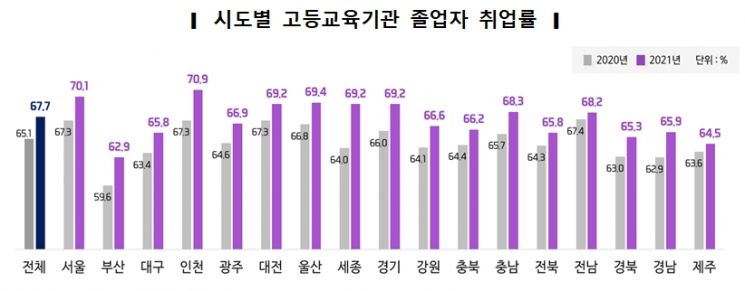
The employment rate for male graduates (69.5%) increased by 2.4 percentage points from the previous year, while that for female graduates (66.1%) rose by 3.0 percentage points, narrowing the gender gap to 3.4 percentage points. The employment rate in the metropolitan area was 69.8%, while it was 66.3% in non-metropolitan areas, showing some regional differences. Among the 17 cities and provinces, eight regions including Seoul (70.1%) and Incheon (70.9%) had employment rates higher than the overall rate, and the region with the largest increase compared to the previous year was Sejong, with a 5.2 percentage point rise.
Based on health insurance workplace subscribers, the average starting salary for graduates was 2,752,000 KRW per month, an increase of 123,000 KRW from the previous year. University graduates earned 2,562,000 KRW, while general graduate school graduates earned 4,676,000 KRW. The employment preparation period was in the order of pre-graduation employment (30.4%), within 3 months after graduation (25.1%), 9 months (16.8%), 6 months (16.7%), and over 10 months (11.0%). The proportion of employed graduates who took within 3 months (25.1%) and within 6 months (16.7%) to find employment increased by 2.4 percentage points and 1.8 percentage points respectively compared to the previous year (22.7%, 14.9%).
By company type, the employment distribution was as follows: small and medium enterprises (45.1%), non-profit corporations (16.9%), large corporations (9.9%), national and local governments (9.9%), mid-sized companies (7.7%), others (5.6%), and public institutions and public enterprises (4.9%). The number of employees in large corporations and mid-sized companies increased by 1.4 percentage points and 0.3 percentage points respectively compared to the previous year (8.5%, 7.4%).
© The Asia Business Daily(www.asiae.co.kr). All rights reserved.



















