Income Tax Act Amendment Passed... Two-Year Postponement of Financial Investment Tax Implementation
Major Shareholder Threshold Maintained at 1 Billion KRW per Stock
Joint Liability Controversy Leads to Abolition of Other Shareholder Aggregation Rule
[Asia Economy Reporter Jeong Hyunjin] The implementation of the financial investment income tax (금투세) on stock investment income has been postponed again for two years, and the criteria for major shareholders who pay stock transfer tax remain at 1 billion KRW per stock. However, the rule that combines family shares such as spouses, parents, and children for calculation will be abolished.
According to the National Assembly on the 25th, the ruling and opposition parties held a plenary session on the 23rd and passed an amendment to the Income Tax Act to postpone the implementation of the financial investment income tax from 2023 to 2025 by two years. This is the third postponement since related discussions began.
Currently, small shareholders receive tax exemptions, and only major shareholders holding stocks above a certain scale pay stock transfer tax. Due to this postponement, the majority of individual investors will not pay taxes on capital gains from stock transfers as before.
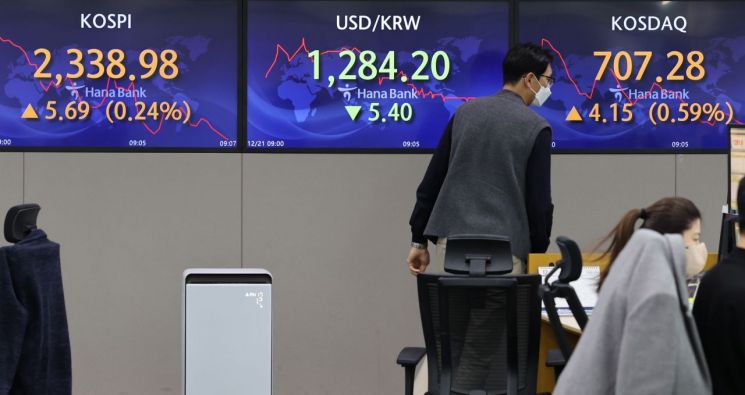
If the financial investment income tax is introduced, anyone who earns investment income must pay taxes regardless of whether they are a major shareholder. The financial investment income tax is a system that taxes a certain level of profit generated from all financial investment products such as stocks, bonds, funds, and derivatives. The taxable population for the financial investment income tax is estimated to be 150,000 people based on listed stocks.
The current taxation system for other financial products will also be maintained for two years. Capital gains from bond transfers will continue to be tax-exempt under the existing system. Capital gains from stock-type exchange-traded funds (ETFs), equity-linked securities (ELS), and derivative-linked securities (DLS) will also remain tax-exempt.
The criteria for major shareholders subject to stock transfer tax will remain as the current system of "1 billion KRW" or "1-4% share" per stock. The government had intended to raise the major shareholder threshold from 1 billion KRW to 10 billion KRW, but it was decided to maintain the current standard.
However, the rule that combines family shares to determine major shareholder status will be abolished starting next year.
Since family combined taxation is stipulated in the Enforcement Decree of the Income Tax Act, the government can pursue improvement measures without the consent of the National Assembly. The government plans to revise the enforcement decree within this year so that family combined taxation will not be applied from next year.
© The Asia Business Daily(www.asiae.co.kr). All rights reserved.
![Clutching a Stolen Dior Bag, Saying "I Hate Being Poor but Real"... The Grotesque Con of a "Human Knockoff" [Slate]](https://cwcontent.asiae.co.kr/asiaresize/183/2026021902243444107_1771435474.jpg)
















