Caddie Fees Soar to 150,000 Won Over 10 Years
Increase in Caddie Selection System, Hiring of Foreign Nationals Next Year a Variable
A golf course in Gangwon-do recently announced a recruitment notice for new and experienced caddies, setting the basic caddie fee at 150,000 KRW. In July, when recruiting caddies, the notice specified a caddie fee of 140,000 KRW, but the basic amount was raised by 10,000 KRW in just five months. In fact, the basic caddie fee at golf courses in the metropolitan area is solidifying at 150,000 KRW. If certain conditions such as foreign language proficiency are met, an additional 20,000 to 30,000 KRW must be paid. As the caddie fee, which golf course users must pay in full, rises rapidly, there are concerns that it is becoming an obstacle to the popularization of golf.
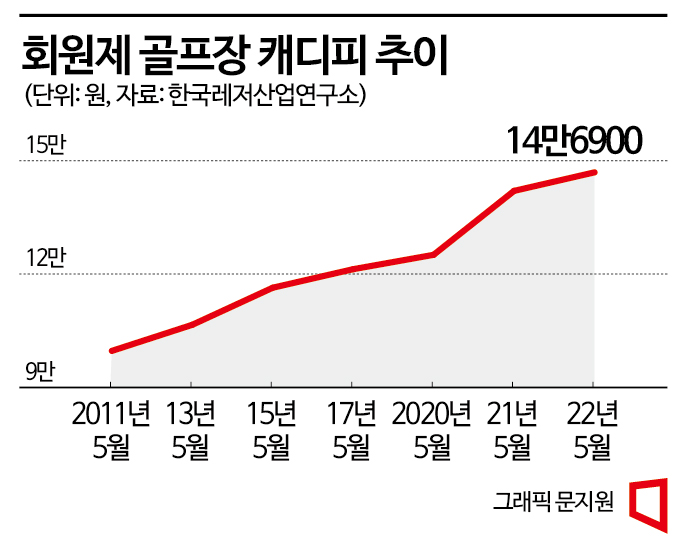
According to the Korea Leisure Industry Institute on the 26th, as of May this year, the average caddie fee at domestic membership golf courses was 146,900 KRW. Triggered by the spread of COVID-19, the average caddie fee, which was 125,100 KRW in May 2020, has increased by more than 20,000 KRW in two years. A golf industry official said, "Due to social distancing and confirmed cases, the absolute number of caddies has become insufficient, but the golf population has greatly increased since COVID-19," adding, "To meet the rapidly increasing demand for caddies, golf courses have no choice but to competitively raise caddie fees to hire them."
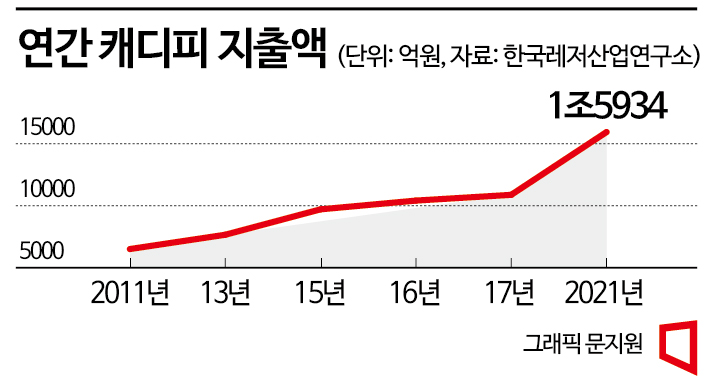
The annual expenditure on caddie fees in the domestic golf market is also rapidly increasing. As of last year, it was 1.5934 trillion KRW. Considering that the domestic golf population was 5.64 million last year, this means that each golfer spent an average of 283,000 KRW annually on caddie fees. The annual caddie fee scale this year is expected to exceed 1.6 trillion KRW significantly. Previously, it increased by 1 trillion KRW over about ten years from 651.6 billion KRW in 2011.
Seo Cheon-beom, director of the Korea Leisure Industry Institute, pointed out, "Most golfers accompany caddies and start golf with them, so it has become a sport where this is a must," adding, "Social perception of caddies is low, so the number of applicants is decreasing, but people are needed, and since it is money paid by users from the golf course's perspective, caddie fees are being raised recklessly."
Director Seo also emphasized, "Although the domestic golf population reaches 5.64 million, we cannot simply welcome the increase in participants," and said, "True popularization of golf can be achieved by creating a culture where the middle class can enjoy golf more by reducing the cost burden."
Earlier, in the '2022 Golf Industry Planning Survey' conducted by consumer opinion research company Embrain targeting 3,000 people who experienced golf fields within the past year, respondents cited high green fees (58.4%), mandatory four-player rounds (37.2%), and caddie fees (30.6%) as elements that golf courses need to improve.
As the number of caddies is insufficient and the burden of caddie fees increases, the number of golf courses implementing a caddie selection system such as no-caddie, driving caddie, and marshal caddie (who mainly drives electric carts, informs remaining distances, facilitates smooth game progress, prevents safety accidents, and receives only half the caddie fee) increased to 201 as of last October. This accounts for 36.7% of all golf courses and is a 70.3% increase compared to 118 courses at the end of 2019 before COVID-19.
Starting next year, caddie work will be included in the employment-permitted industries for visiting employment compatriots (H-2) managed and supervised by the Ministry of Employment and Labor. Foreign nationals aged 18 or older from China, Uzbekistan, Kazakhstan, Ukraine, Kyrgyzstan, Tajikistan, and Turkmenistan will be able to work as golf course caddies. The golf industry is paying attention to whether this will have a positive effect by resolving the caddie shortage and reducing the burden of caddie fees for users.
© The Asia Business Daily(www.asiae.co.kr). All rights reserved.


















