Delays in Approvals, Rising Raw Material Prices and Interest Rates, Increase in Unsold Units
Rising Delinquency Rates on Real Estate PF Loans in Secondary Financial Sector
High Risk of Default Due to Many Loans to Small and Medium-Sized Businesses for Residential and Commercial Buildings
[Asia Economy Reporter Sim Nayoung] The delinquency rate on real estate project financing (PF) loans in the secondary financial sector has increased. While the real estate market has cooled since the start of the interest rate hike period, construction raw material prices have risen, which is a major cause. In particular, the fact that most of the real estate PF loans in the secondary financial sector are concentrated in small and medium-sized businesses such as residential and commercial buildings is also increasing the risk of defaults.
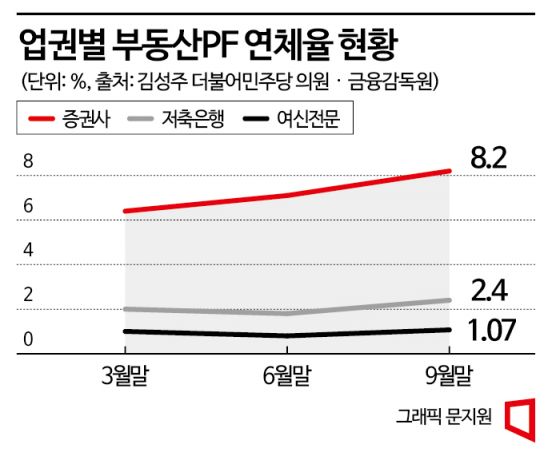
Securities Firms' PF Loan Delinquency Rate: 6.4% → 7.1% → 8.2%
According to the 'Delinquency Rate Status of Real Estate PF by Industry' submitted by the Financial Supervisory Service to Rep. Kim Sung-joo of the Democratic Party on the 23rd, the default rate among securities firms in the secondary financial sector has increased most noticeably. As of the end of September, the delinquency rate on securities firms' PF loans (balance of 4.5 trillion KRW) was 8.2% (about 370 billion KRW). The delinquency rate for securities firms rose from 6.4% at the end of March to 7.1% at the end of June, and exceeded 8% in the third quarter.
The situation is similar in other secondary financial sectors. In the case of savings banks, the PF loan balance was about 10.7 trillion KRW, of which 2.4% (about 260 billion KRW) was delinquent. The delinquency rate showed a trend of 2.0% → 1.8% → 2.4% during the same period. The delinquency rate of specialized credit finance companies (balance of 27.1 trillion KRW) also showed an upward trend (1.0% → 0.8% → 1.07%).
A Financial Supervisory Service official explained, "Delays in local government permits and approvals, recent increases in raw material prices and interest rates leading to higher construction costs, an increase in unsold units, and a worsening outlook for the real estate market are expected to cause difficulties in project progress, resulting in delinquencies."
Secondary Financial Sector’s PF Loan Clients Also Vulnerable
Another issue is that the clients of PF loans in the secondary financial sector are more vulnerable compared to banks or insurance companies. The Financial Stability Report released by the Bank of Korea the day before stated, "While banks and insurance companies handle PF related to apartment construction, the secondary financial sector mainly deals with PF loans related to housing other than apartments and commercial facilities," adding, "As of the end of June this year, the proportion of apartment PF loans was 66% for banks, but only 21.6% for securities firms and 15.1% for savings banks."
Looking at loan sizes, banks and insurance companies focus on large-scale projects, whereas the secondary financial sector centers on small and medium-sized projects. The average PF loan amount per case was much smaller in the secondary financial sector compared to banks (27 billion KRW): specialized credit finance companies (11 billion KRW), securities firms (6.1 billion KRW), and savings banks (2.5 billion KRW). This indicates that the business viability of PF in the secondary financial sector is lower, increasing the likelihood of defaults. In fact, the delinquency rates for real estate PF loans at banks and insurance companies were 0.03% and 0.4%, respectively, as of the end of September, much lower than those in the secondary financial sector.
The report analyzed, "With increased risk aversion due to past learning effects from real estate PF loan defaults, the linkage between the capital market and real estate PF loans has strengthened, and the expansion of non-bank loans with insufficient capital could pose a shock to the financial system."
© The Asia Business Daily(www.asiae.co.kr). All rights reserved.
![Clutching a Stolen Dior Bag, Saying "I Hate Being Poor but Real"... The Grotesque Con of a "Human Knockoff" [Slate]](https://cwcontent.asiae.co.kr/asiaresize/183/2026021902243444107_1771435474.jpg)

















