Counterpoint Market Monitor Service
Apple, the Only Brand Among Top 5 with Shipment Growth
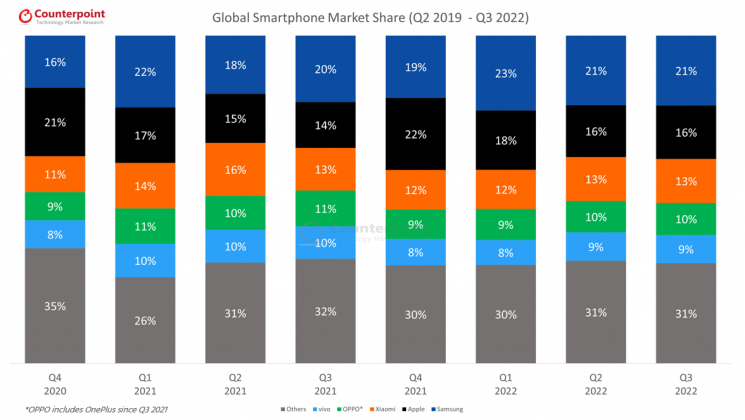
[Asia Economy Reporter Oh Su-yeon] In the third quarter, amid a stagnant smartphone market, Samsung Electronics maintained its position as the market share leader, but showed signs of instability as both sales and shipments declined compared to the same period last year. Meanwhile, Apple was the only major smartphone company to continue its growth, buoyed by the strong performance of the iPhone 14 series.
According to Counterpoint Market Monitor Service on the 23rd, global smartphone shipments in the third quarter reached 310 million units, marking a 2% increase from the previous quarter but a 12% decrease compared to the same period last year. Sales declined by 3% year-on-year. Although shipments and sales decreased in the third quarter, the average selling price (ASP) rose by 10% compared to the same period last year.
This growth in the smartphone market was led by Apple. Apple's smartphone sales in the third quarter grew by 10% year-on-year, with ASP increasing by 7%. Harmit Singh Walia, Senior Analyst at Counterpoint, explained, "Apple contributed to the overall increase in global smartphone ASP, thanks to strong sales of the iPhone 14 series and its predecessor (iPhone 13)."
In terms of shipments alone, Apple was the only brand among the top five (Samsung, Apple, Xiaomi, Oppo, Vivo) to increase shipments compared to the same period last year. Apple's smartphone shipments in the third quarter were 49.2 million units, up 2.5% from 48 million units in the same period last year. Based on shipment volume, Apple's market share was 16%, ranking second.
Apple launched the iPhone 14 series in the first wave on September 16, and sales began domestically on October 7. Despite production disruptions caused by the COVID-19 outbreak at Foxconn's largest assembly plant in Zhengzhou, China?which produces over 85% of the iPhone 14 Pro series?Apple has continued the strong performance of its predecessor. Since the third week of September, following the iPhone 14 launch in China, Apple has maintained the top sales position for 12 consecutive weeks.
On the other hand, Samsung Electronics maintained the number one position in market share with 21% based on shipments and ranked second in sales, but both figures shrank compared to the same period last year. According to Counterpoint, despite the Galaxy Z series shipments nearly doubling year-on-year in the third quarter, the ASP increased by only 2% compared to the same period last year. Total shipments were 64.3 million units, down 7.2% from 69.3 million units in the same period last year, and sales decreased by 4% year-on-year.
Chinese smartphone brands such as Xiaomi, Oppo, and Vivo saw significant shipment declines compared to the same period last year due to lockdown measures. Xiaomi shipments decreased by 4.9 million units, Oppo by 9.9 million units, and Vivo by 9.9 million units. Xiaomi's smartphone sales increased by 4%, but with a rise in mid-to-low-end sales, its shipment share for devices priced above $300 fell by 1.5%.
The fourth quarter, traditionally a strong period for iPhones before the launch of new Galaxy S series models, is expected to see Apple regain the top spot. Despite ongoing issues at the Foxconn Zhengzhou plant affecting iPhone 14 supply, forecasts suggest Apple will surpass Samsung Electronics in the fourth quarter. Market research firm TrendForce predicts fourth-quarter smartphone market shares of 24.6% for Apple and 20.2% for Samsung Electronics, indicating a reversal.
Meanwhile, 5G devices shipped more than five times the volume of non-5G devices, driving ASP increases and overall market growth. Senior Analyst Walia stated, "5G device sales accounted for 80% of total sales, reaching an all-time high, up from 69% in the same period last year. The transition from LTE (4G) to 5G was led by Apple. Over 95% of Apple's total phones support 5G, and Apple accounts for more than half of the total 5G device revenue."
© The Asia Business Daily(www.asiae.co.kr). All rights reserved.
![Clutching a Stolen Dior Bag, Saying "I Hate Being Poor but Real"... The Grotesque Con of a "Human Knockoff" [Slate]](https://cwcontent.asiae.co.kr/asiaresize/183/2026021902243444107_1771435474.jpg)
















