Export of ADC Technology to 5 Targets
Total Amount $1.2475 Billion
This Year's Largest Tech Export Surpassing ABL Bio's $1.06 Billion in January
'Cruise Missile' ADC Fighting Cancer
Technology Competition Intensifies with 'Enhertu' Announcement
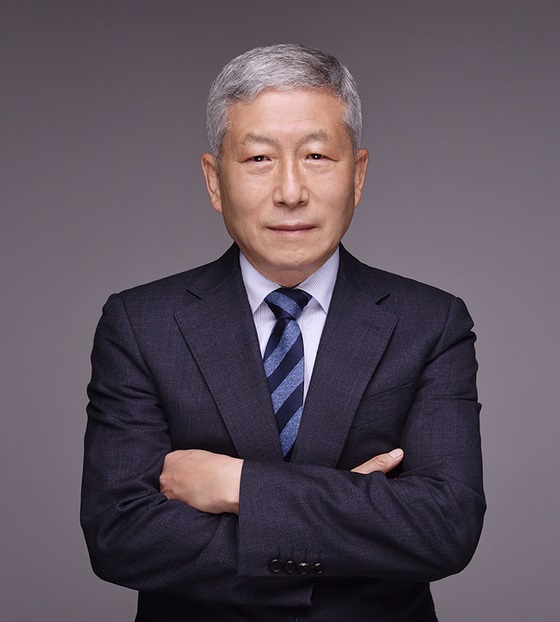
[Asia Economy Reporter Lee Chun-hee] Ahead of the year-end, the largest technology export contract in the pharmaceutical and bio industry this year has been announced. LegoChem Biosciences disclosed on the 23rd that it signed a contract worth a total of 1.6 trillion KRW with Amgen in the United States to license its antibody-drug conjugate (ADC) technology.
This technology export contract involves transferring global technology development and licensing rights for ADC platform technology targeting a total of five targets. The total contract amount is $1.2475 billion (approximately 1.605 trillion KRW). It consists of upfront payments and milestone payments based on development stages. Royalties will be paid quarterly according to an agreed percentage based on net sales. The detailed amounts and royalty payment rates are agreed to remain undisclosed. LegoChem explained, "Upfront payments and milestones are scheduled to be paid within 45 days after each invoice issuance," and "Milestones and royalties are non-refundable."
This is the largest technology export deal by total contract size announced this year. Previously, in January, ABL Bio signed a technology transfer contract with Sanofi for the bispecific antibody candidate 'ABL301' for treating Parkinson's disease and other degenerative brain diseases, totaling $1.06 billion (approximately 1.3599 trillion KRW), which was the largest technology export contract before this. At that time, ABL Bio's contract included an upfront payment of $75 million and milestone payments totaling $985 million (including short-term milestones of $45 million). This new contract surpasses that amount and is the second technology export contract this year exceeding $1 billion.
LegoChem Biosciences is currently developing ADC drugs such as 'LCB14' and 'LCB73' using the 'ConjuALL' platform. LCB14, a breast cancer treatment, showed a significant objective response rate (ORR) of 67% in Phase 1 trials conducted by its Chinese partner Fosun Pharma, and LCB73, a treatment for non-Hodgkin lymphoma, is undergoing Phase 1 clinical trials after technology transfer to the UK company Exscientia.
As the name suggests, ADCs are drugs that conjugate antibodies and drugs. By linking antibodies that bind to cancer antigens with cytotoxic payloads that kill cancer cells via a linker, ADCs can deliver toxins specifically to cancer cells like a missile, earning the nickname "cruise missile" for cancer treatment and attracting attention as next-generation anticancer technology.
This year, the Nobel Prize in Chemistry was awarded to Professor Carolyn Bertozzi of Stanford University and others, largely related to ADCs. They were recognized for inventing "click chemistry." Applying click chemistry to organisms is called "bioorthogonal chemistry," where different functional groups interact only with their designated partners without interacting with other proteins or organic molecules. ADCs were developed based on this principle.
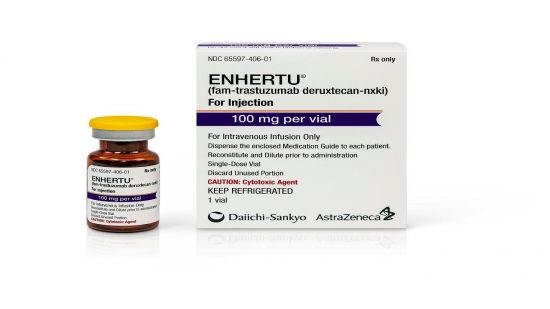
In particular, the ADC "Enhertu," jointly developed by Daiichi Sankyo and AstraZeneca, demonstrated innovative results targeting HER2-low expression patients, who account for half of metastatic breast cancer cases. It received a standing ovation at the American Society of Clinical Oncology (ASCO) in June, and with successive innovative achievements, market attention has significantly increased.
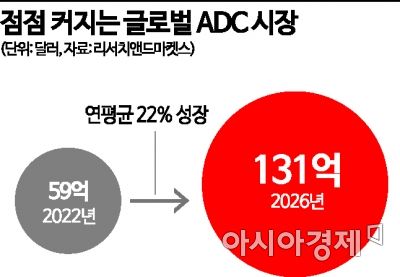
According to market research firm Research and Markets, the global ADC drug market is expected to grow from $5.9 billion (approximately 7.5697 trillion KRW) this year at an average annual growth rate of 22%, reaching $13.1 billion (approximately 16.8073 trillion KRW) by 2026. Enhertu, which has been approved by the U.S. Food and Drug Administration (FDA) and the Korean Ministry of Food and Drug Safety, is expected to generate sales of $7.741 billion (approximately 10 trillion KRW) by 2028.
In South Korea, competition in ADC technology development is underway, such as Celltrion partnering with Pinobio in October to secure ADC technology. At that time, Celltrion decided to develop solid tumor-targeting ADC anticancer drugs using the 'Pino-ADC' platform with Pinobio. They secured technology licensing options for a total of 15 targets. If all options are exercised, the total contract size could increase to up to $1.2428 billion (approximately 1.7758 trillion KRW).
© The Asia Business Daily(www.asiae.co.kr). All rights reserved.
![Clutching a Stolen Dior Bag, Saying "I Hate Being Poor but Real"... The Grotesque Con of a "Human Knockoff" [Slate]](https://cwcontent.asiae.co.kr/asiaresize/183/2026021902243444107_1771435474.jpg)


















