Ongoing 28GHz Projects
"Will Replace with 3.5GHz to Ensure No Disruptions"
Despite Government's Firm Frequency Allocation Cancellation Measures
Little Resistance... Low Profitability
[Asia Economy Reporter Cha Min-young] KT and LG Uplus, which received a notification from the government to cancel the allocation of the 5G 28 GHz frequency band, stated that the ongoing 28 GHz-related projects can be replaced with 3.5 GHz. Although more than 600 billion KRW in large-scale funds were invested based on the combined total of the three telecom companies to secure frequency usage rights, the companies seem to quietly welcome the government's decision due to poor profitability.
According to data submitted by the Ministry of Science and ICT to Assemblyman Kim Young-sik's office on the 23rd, KT and LG Uplus responded to the impact of the current 28 GHz frequency allocation cancellation by saying, "We will replace it with 3.5 GHz to ensure that related projects proceed without disruption." SK Telecom, which was only penalized with a shortened frequency usage period, must return the frequency if it does not build 15,000 devices by May next year.
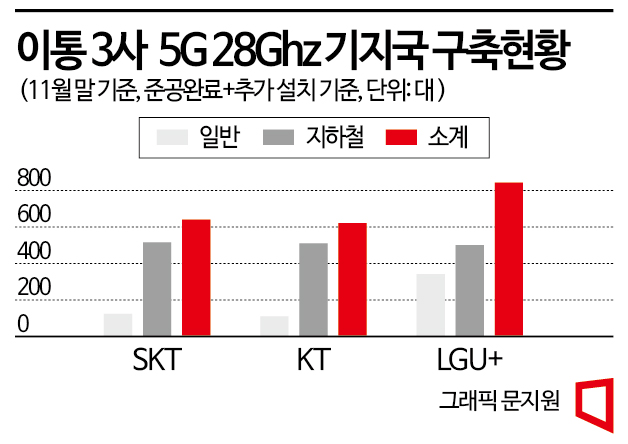
The projects currently utilizing 28 GHz include the subway Wi-Fi project, where a shared network is being constructed, and some general projects. The subway Wi-Fi is jointly built by the three companies and all have been recognized as achievements. As of the end of November, the number of completed subway base stations totaled 1,526 combined for the three companies, but the actual number is about one-third, approximately 500 units. For general project base stations such as demonstration projects, SKT has 124 units, KT has 111 units, and LG Uplus has about 342 units. Since 2021, the three telecom companies have conducted demonstration projects using the 28 GHz frequency at 10 locations nationwide, including COEX in Seoul, Wizpark in Suwon, and Jeongnimsaji in Buyeo. Most of these have ended, with LG Uplus being the only company maintaining the project.
Technically, it is not difficult to use 3.5 GHz for projects that previously utilized the 28 GHz band. An industry insider said, "You just need to replace the base stations using 28 GHz with those using 3.5 GHz," adding, "It will be necessary to carry out optimization work to suit the changed frequency." In the subway Wi-Fi project based on 5G 28 GHz backhaul, where 5G 28 GHz acts as a wired optical cable, the backhaul network can be replaced with 3.5 GHz. However, since the government previously stated regarding subway Wi-Fi that "we hope the two operators with a high possibility of allocation cancellation will take a progressive stance in fulfilling promises made to the public," there is a high possibility that the 28 GHz frequency will continue to be used exceptionally.
The main reason telecom companies do not show much regret over the frequency allocation cancellation is the lack of investment incentives. Unlike the 3.5 GHz band, which is widely used for general consumers, the 28 GHz band lacks demand for business-to-consumer (B2C) services, and unlike overseas markets, there is little demand for business-to-business (B2B) services such as fixed wireless access (FWA). Due to the strong directivity and short reach of 28 GHz, its advantage is high speed, but it requires dense base station investment. From the demand side, the absence of content and lack of supported devices make profitability difficult. This is also why, contrary to the government's plan to allocate one of the returned frequency bands to new operators, the likelihood of new operators emerging is considered low.
There are also criticisms that it is difficult to blame the telecom companies alone for returning the 28 GHz frequency. Kim Yong-hee, an Open Route specialist, said, "It cannot be said that the government's policy direction, which encourages telecom companies to invest in networks first to induce content services, is wrong," but added, "In a situation where demand discovery has failed, it is not easy to find appropriate alternatives. It seems more necessary to show a willingness to work together with operators to discover demand."
Meanwhile, the government conducted a hearing procedure for two operators this month. Based on this, a final disposition will be announced soon. Next month, the government will also release the basic direction to promote the entry of new operators into the 28 GHz band. To encourage new entrants, policy support measures will be prepared, including new frequency allocation methods, interconnection, and facility provision to support new operators' network construction and business operations.
© The Asia Business Daily(www.asiae.co.kr). All rights reserved.

















