Majority Opinion: "The Degree of Restriction on Private Interests Is Excessively Harsh"
Minority Opinion: "It Is to Protect the Trust of the People"
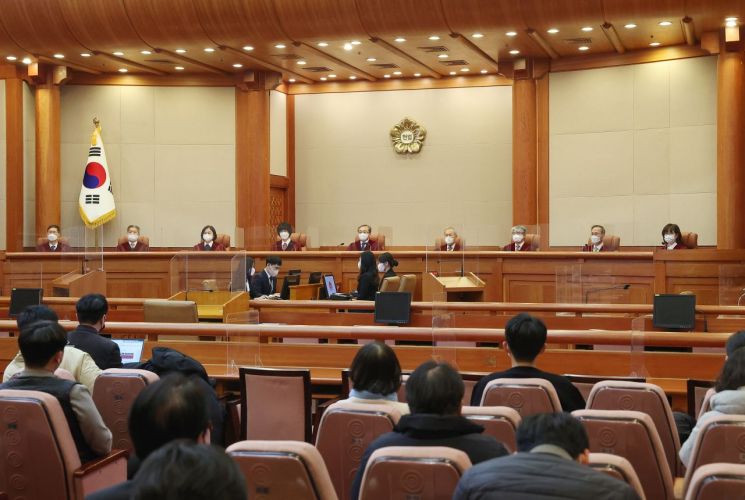 Chief Justice Yoo Nam-seok of the Constitutional Court (center) and other justices entered the Grand Bench of the Constitutional Court in Jongno-gu, Seoul, on the afternoon of the 22nd and took their seats.
 [Image source=Yonhap News]
[Asia Economy Reporter Heo Kyung-jun] The Constitutional Court has ruled that the provision in the National Public Service Act requiring automatic retirement for public officials who become legally incompetent due to mental disabilities violates the Constitution.
On the 22nd, the Constitutional Court delivered a ruling of unconstitutionality by a 6 (unconstitutional) to 3 (constitutional) vote in a constitutional review case concerning the clause on "legally incompetent adults" in the former National Public Service Act Article 69, Paragraph 1.
The petitioners were the spouse and children of Kim, who worked as a prosecutor and passed away. In 2015, while working at the Busan District Prosecutors' Office East Branch, Kim experienced chest pain and difficulty breathing and was transported to a hospital. However, due to cardiac arrest, he suffered hypoxic brain injury, making it impossible to return to work, and he took a medical leave of absence for two years.
Kim’s spouse filed a petition for adult guardianship with the Busan Family Court to manage financial transactions on behalf of her bedridden husband, and the court appointed her as the adult guardian. Subsequently, Kim’s spouse applied for honorable retirement according to her husband’s wishes. During this process, the Prosecutor General learned of the guardianship commencement and, in April 2018, notified that Kim was ineligible for honorable retirement and that he had been automatically retired under Article 69 of the National Public Service Act as a legally incompetent adult.
In response, Kim’s spouse filed a lawsuit against the Republic of Korea seeking payment of wages and other benefits that Kim would have received if he had not been automatically retired. She argued that the provision mandating automatic retirement for legally incompetent public officials violated the principles of proportionality and equality rights, and requested a constitutional review, which the court accepted.
The Constitutional Court noted that under the current National Public Service Act Article 71 and related provisions, appointing authorities can order a leave of absence for up to two years for public officials unable to perform duties due to mental disabilities. If the leave expires and the official still cannot return or perform duties, dismissal procedures can be initiated, thus sufficiently achieving the legislative purpose of the challenged provision.
The Court stated, "The challenged provision imposes excessive restrictions on private interests compared to cases where adult guardianship has not been initiated but the public official suffers from an equivalent degree of mental disability," adding, "Even if adult guardianship has commenced, it can be terminated if the mental disability improves, and considering that the court can adjudicate termination of guardianship, the extent of restriction on private interests is excessively harsh."
On the other hand, Justices Lee Seon-ae, Lee Eun-ae, and Lee Jong-seok dissented, stating, "The challenged provision aims to ensure smooth performance of public officials’ duties and protect public trust in individual officials and public service, and its legislative purpose is legitimate," and "Automatically retiring a public official upon becoming a legally incompetent adult is an appropriate means."
© The Asia Business Daily(www.asiae.co.kr). All rights reserved.
![Clutching a Stolen Dior Bag, Saying "I Hate Being Poor but Real"... The Grotesque Con of a "Human Knockoff" [Slate]](https://cwcontent.asiae.co.kr/asiaresize/183/2026021902243444107_1771435474.jpg)
















