Avoidance of Essential Medical Care Deepens... Survey of 300 Doctors
Reasons Include Economic Concerns, Bleak Future, and Burden of Medical Accidents
[Asia Economy Reporter Lee Gwan-joo] Amid growing concerns over the collapse of essential medical services such as pediatrics, current physicians identified increased and improved medical fees and legal protection as necessary measures.
Medical academic portal KIMEDI announced on the 22nd that it conducted a survey titled 'Demand for Measures to Expand Essential Medical Services' targeting 300 physician members from the 2nd to the 5th of this month, revealing these results.
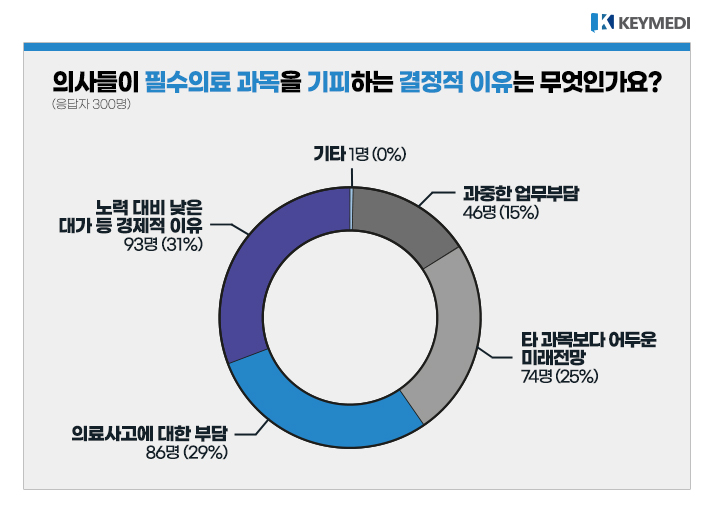
Regarding the reasons for avoiding essential medical fields, physicians most frequently cited 'economic reasons such as low compensation relative to effort' (31%). This was followed by 'burden of medical malpractice' (29%), 'bleak future prospects compared to other specialties' (25%), and 'excessive workload' (15%). It can be interpreted that a combination of economic issues, medical malpractice concerns, and future outlook all contribute to the avoidance of essential medical services.
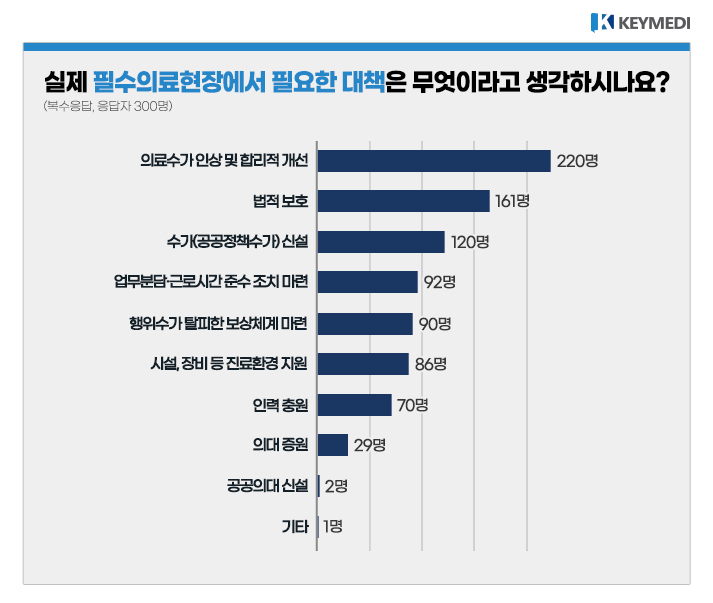
When asked about necessary measures for essential medical fields (multiple responses allowed), more than two-thirds, 220 respondents, answered 'increase and rational improvement of medical fees.' More than half, 161 physicians, selected 'legal protection' against medical malpractice. While improvements in working conditions received strong support, measures related to staffing such as increasing personnel (70 respondents), expanding medical school admissions (29 respondents), or establishing public medical schools (2 respondents) received lower support.
Physicians showed a largely skeptical view toward the government's currently discussed 'Comprehensive Measures for Essential Medical Services' (survey conducted before the public hearing on essential medical support measures on the 8th). When asked if they expected improvements through these measures, the most common response was 'not expected at all' at 32%. Negative views such as 'somewhat worried' (17%) and 'so-so' (28%) were relatively high.
A KIMEDI official stated, "This was an opportunity to hear the thoughts of physicians currently working amid high social concerns about the collapse of essential medical services," adding, "We hope that cooperation among the government and various organizations will help protect the public's right to health."
© The Asia Business Daily(www.asiae.co.kr). All rights reserved.
![Clutching a Stolen Dior Bag, Saying "I Hate Being Poor but Real"... The Grotesque Con of a "Human Knockoff" [Slate]](https://cwcontent.asiae.co.kr/asiaresize/183/2026021902243444107_1771435474.jpg)

















