At the All-Army Key Commanders Meeting... Revival of the 'Eagle Exercise' Abolished 6 Years Ago Starting Next Year
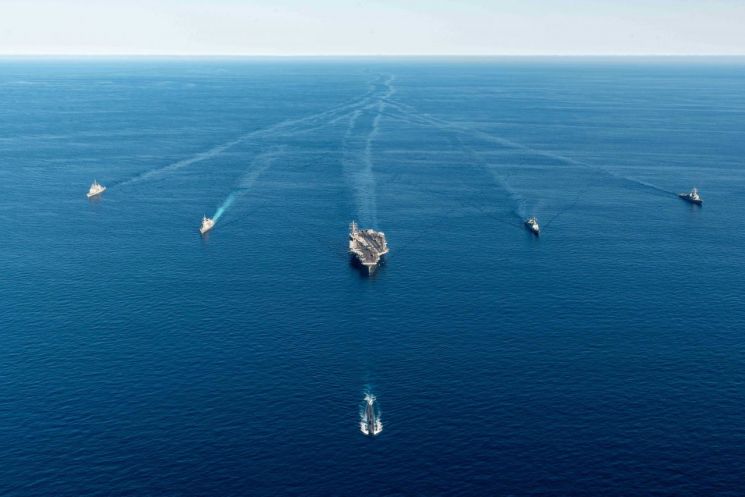
[Asia Economy Yang Nak-gyu, Military Specialist Reporter] Starting next year, South Korea and the United States will apply a new operational plan considering North Korea's nuclear and missile threats and conduct joint exercises. The joint exercises will be intensively conducted with about 20 exercises at the level of the past Foal Eagle (FE) exercises only in the first half of the year.
On the 21st, the Ministry of National Defense held the '2022 Second Half Major Commanders Meeting' chaired by Minister Lee Jong-seop to evaluate this year's achievements in the defense sector and discuss tasks for next year.
On this day, Minister Lee mentioned that the new scenario is planned to be created considering the advanced North Korean nuclear and missile threats, and to deepen and develop the theater-level joint exercise execution system. In connection with the first half joint exercises, the scale and types of joint field maneuver exercises will also be expanded. It is expected that once the new operational plan is completed, South Korea and the U.S. will prepare a joint exercise plan for nuclear attack response based on it. The training plan is expected to be subdivided into areas such as surveillance of North Korea's nuclear facilities and bases, detection of signs of nuclear use, and destruction in case of actual use.
South Korea and the U.S. agreed to establish a new joint operational plan at the Security Consultative Meeting (SCM) between the two countries' defense ministers in December last year. The existing operational plan was evaluated by the South Korean and U.S. military authorities as needing improvement because it did not properly reflect North Korea's increasingly advanced nuclear and missile capabilities.
The revision of the operational plan proceeds in the order of approval of the Strategic Planning Guidance (SPG), which serves as a kind of comprehensive guideline, agreement on the Strategic Planning Directive (SPD), and then drafting of the operational plan. The SPD agreement was completed by the end of March, and the drafting work has officially begun.
The new operational plan is expected to be finalized by this year. It will likely include content such as regularly updating the list of top-priority strike targets, including North Korea's strategic and tactical nuclear storage facilities and nuclear warhead missiles. Since the operational plan is classified as top secret, detailed contents will not be disclosed, but efforts to closely monitor North Korea's new operational plan trends and reflect them in South Korea's plan may also be carried out simultaneously.
Additionally, the Ministry of National Defense presented six major defense operation focuses: ▲ Establishment of defense posture and expansion of response capabilities ▲ Cultivation of advanced science and technology forces through Defense Innovation 4.0 ▲ Leap-forward development of the South Korea-U.S. military alliance and deepening and expansion of defense cooperation ▲ Safe, transparent, and civil-military coexistence defense operations ▲ Creation of a defense culture suitable for future generations ▲ Development of the defense industry as a national strategic industry.
Specifically, about 20 exercises including the Ssangryong joint amphibious landing exercise will be intensively conducted at the level of the past Foal Eagle exercises. Considering the inter-Korean reconciliation atmosphere, this can be seen as a de facto revival of the Foal Eagle exercises, which were suspended after 2018 during the Moon Jae-in administration. Also, to expand the Korean-style 3-axis system capabilities responding to North Korean nuclear and missile threats, from next year, investments in advanced technology to improve high-power and ultra-precision strike capabilities will be expanded. The development of advanced high-power missiles will be accelerated.
The Joint Chiefs of Staff's Nuclear and WMD Response Headquarters, which is the foundation of the Strategic Command, will start operations in the new year and verify the Strategic Command's operational concept and system through joint and combined tabletop exercises (TTX) and training, concretely establishing the creation plan. Furthermore, based on the soon-to-be-completed 'Defense Innovation 4.0 Basic Plan,' from next year, a phased transition to AI-based manned-unmanned complex systems, establishment of a Korean-style power enhancement process, and strengthening of operational capabilities in space, cyber, and electromagnetic domains will be pursued.
To strengthen the international competitiveness of the defense industry, the Ministry of National Defense plans to expand the participation scope of the Defense Industry Development Council, composed of the Ministry of National Defense, Ministry of Trade, Industry and Energy, and Ministry of Foreign Affairs, to include the Ministry of SMEs and Startups and each military branch, developing it into a national strategic consultative body. Defense innovation companies and defense space specialized companies have been designated as focused support targets.
Meanwhile, considering the ongoing security situation with North Korea's provocations, some commanders attended this second half major commanders meeting via video conference.
Minister Lee Jong-seop praised the commanders who fulfilled their duties in their respective positions amid North Korea's blatant nuclear threats and urged them to complete a combat-ready immediate response posture against any provocations. He also emphasized actively promoting the six major defense operation focuses in the new year to realize 'peace through strength.'
The meeting was attended by key officials from the Ministry of National Defense, Joint Chiefs of Staff, and each military branch and agency, including Kim Seung-gyeom, Chairman of the Joint Chiefs of Staff; Park Jeong-hwan, Army Chief of Staff; Lee Jong-ho, Navy Chief of Staff; Jeong Sang-hwa, Air Force Chief of Staff; and Kim Gye-hwan, Marine Corps Commander. Considering the ongoing provocations by North Korea, some commanders participated via video conference.
© The Asia Business Daily(www.asiae.co.kr). All rights reserved.

















