Bank of Korea "Consumer Prices Around 5% for the Time Being"
Unstable Core Inflation Rise
Next Year's Inflation Rate Expected to Show High-Low Trend
"High Uncertainty in Inflation Slowdown Speed"
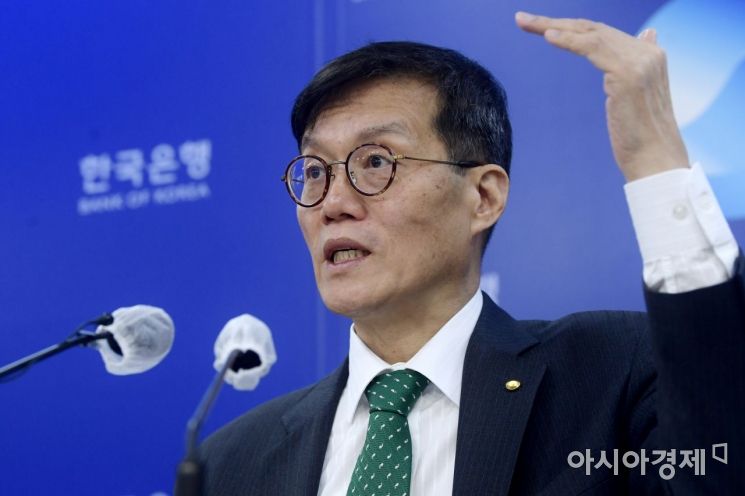 Bank of Korea Governor Lee Chang-yong is explaining the "2022 Second Half Inflation Target Operation Status" at the Bank of Korea press room in Jung-gu, Seoul, on the 20th. Photo by Joint Press Corps
[Asia Economy Reporters Seo So-jeong and Moon Je-won] The Bank of Korea indicated that it will continue its interest rate hike stance as it forecasts that consumer prices will maintain an increase rate around 5% for the time being. On the 20th, Lee Chang-yong, Governor of the Bank of Korea, stated, "Although the inflation rate is expected to show a high-to-low trend next year and gradually decrease, it will remain at a high level exceeding the 2% inflation target," adding, "It is necessary to continue monetary policy focused on price stability."
Consumer prices rose by 5.1% year-on-year from January to November this year, significantly exceeding the price stability target of 2%. This is the highest level since 1998 (7.5%), surpassing the 2008 financial crisis level (4.7%). In particular, core inflation, which reflects the underlying trend of prices, has increased its rate of rise for four consecutive months, raising concerns about the prolonged high inflation situation.
◆ Core Inflation Rate in the 4% Range = On the 20th, the Bank of Korea released the ‘Price Stability Target Operation Status Review Report’ containing this inflation outlook. The Bank stated, "Consumer prices will continue to rise around 5% for the time being," but added, "However, as the increase in petroleum prices narrows and downward pressure on the domestic and international economy grows, the upward trend is expected to gradually slow."
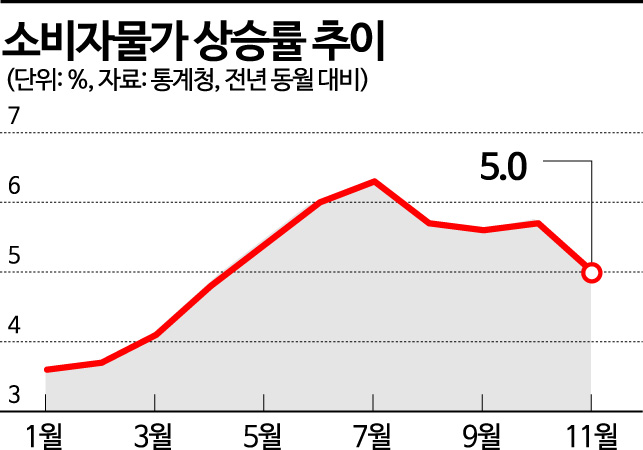
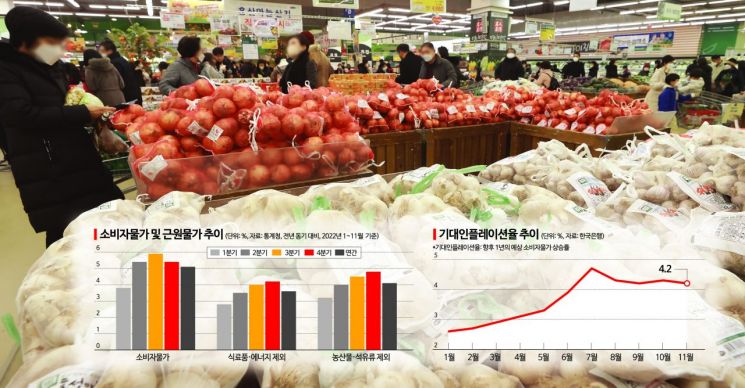
The consumer price inflation rate has somewhat slowed, dropping from a peak of 6.3% in July to 5.7% in August, 5.6% in September, 5.7% in October, and 5.0% in November. However, the core inflation rate (excluding food and energy) has continued to rise, from 3.9% in July to 4.0% in August, 4.1% in September, 4.2% in October, and 4.3% in November. The annual core inflation rate for this year is expected to reach the level seen during the price surge in 2008 (3.6%). The rise in core inflation, which excludes agricultural products and petroleum products affected by external factors such as seasons, indicates that high inflation may continue.
Especially, if not for government intervention, the rise in core inflation would be even greater. The core inflation rate excluding administered prices?price indices for items directly or indirectly influenced by the government?rose from 4.7% in July to 4.8% in August and September, and further to 5.1% in October. Administered prices include 46 items such as electricity, city gas, water charges, and communication fees.
The Bank of Korea said, "There is high uncertainty regarding future inflation paths related to oil prices and exchange rate trends, the extent of public utility fee increases such as electricity charges, and the degree of domestic and international economic slowdown," adding, "In the short term, upward pressure from public utility fee hikes and downward pressure from falling international oil prices are likely to largely offset each other."
Governor Lee said, "Consumer prices will continue to rise around 5% for the time being, but as downward pressure on the domestic and international economy increases, the upward trend will gradually slow, showing a high-to-low trend and gradually declining next year," while noting, "However, there is significant uncertainty regarding the pace of this slowdown due to factors such as future domestic and international growth and oil price trends."
Regarding future monetary policy direction, Governor Lee stated, "We will discuss this in more detail at the Monetary Policy Committee meeting next month," emphasizing, "Given the significant uncertainty about the pace of inflation slowdown, we will examine the impact of past policies on the domestic economic slowdown through upcoming data releases and respond precisely while also considering recent policy rate changes by major countries such as the U.S. Federal Reserve (Fed)."
He added, "We will also pay close attention to the possibility of real estate price adjustments due to rising interest rates and the resulting deterioration in financial stability, as well as any unexpected side effects that may affect various sectors of our economy."
Furthermore, Governor Lee explained, "If there is confidence that the inflation rate will significantly decrease from 5% and converge toward the price stability target in the medium to long term, it is natural for a central bank’s monetary policy approach to consider both price stability and financial stability even before reaching the 2% target."
◆ "3.5% Final Rate Not a Policy Commitment" = Governor Lee stated, "At the November Monetary Policy Committee meeting, many members mentioned 3.5% as the final rate level for this rate hike cycle, but this was for communication with the market and not a policy commitment," adding, "It can change anytime if the economic situation changes."
He forecasted, "It is important for overall policy consistency that the government pursues a tightening stance by reducing the fiscal deficit next year compared to this year, and this will actually help manage aggregate demand."
Regarding the recent inversion of short- and long-term interest rates, Governor Lee pointed out that it is premature to interpret it as a sign of recession. He said, "In the U.S., many years of research have accepted an inverted yield curve as an important indicator predicting future recessions, but in Korea, there is still much debate in academia," adding, "I believe that short-term rates, which rose recently, will fall soon." He explained that the recent rate increase was largely due to supply-side factors such as energy, and once supply instability stabilizes, rates will inevitably decline in the long term.
However, he said, "As of last November, the growth forecast for next year was 1.7%, and especially the first half of the year is expected to be very difficult, so I predict that our economy is on the borderline of whether it will enter a recession or not."
In its revised economic outlook last month, the Bank of Korea projected next year’s consumer price inflation at 3.6%, specifically expecting it to fall to 4.2% in the first half and 3.1% in the second half of the year.
When asked whether the inflation outlook for next year would be revised upward due to a large increase in electricity rates, Governor Lee responded, "When we made the forecast in November, we expected electricity rates to rise as much as they did this year, but now I think they might increase even more," adding, "However, international oil prices are falling more than previously expected, so the decline in oil prices and the increase in electricity rates are likely to offset each other."
© The Asia Business Daily(www.asiae.co.kr). All rights reserved.



















