36 Injured in Passenger Plane Turbulence... Increasingly Turbulent Skies
Researchers Predict "Future Increase in Turbulence Frequency and Duration"
Designed to Withstand Turbulence but... "Safety Regulations Must Be Strengthened"
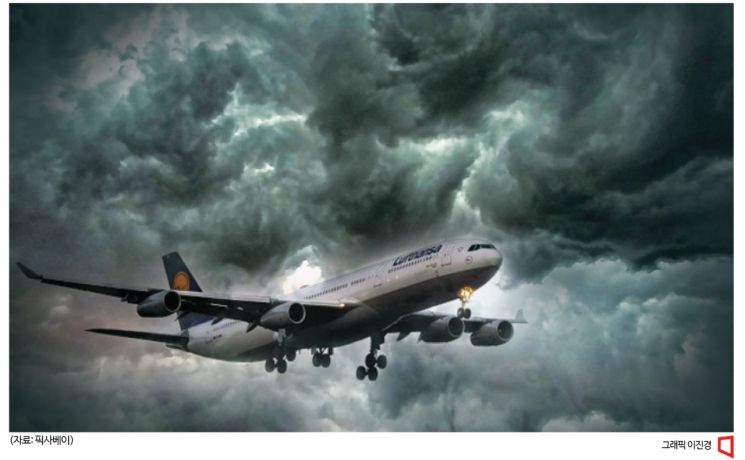
As extreme weather events such as heavy snowfall and severe cold caused by climate change occur worldwide, the aviation industry is also facing emergencies due to climate change. Passenger plane accidents caused by turbulence are continuing, and there is even analysis suggesting that turbulence could increase two to three times in the future due to climate change.
Turbulence refers to irregular airflows with unpredictable directions and speeds, where the wind shakes like rough waves. Turbulence can cause sudden altitude changes in cruising aircraft, posing a threat and leading to calls for strengthening in-flight safety regulations.
According to foreign media including the AP News and Hawaii News Now on the 26th, on the 18th (local time), a Hawaiian Airlines (HA35) passenger plane bound for Honolulu, Hawaii, encountered severe turbulence about 30 minutes before landing at an altitude of approximately 10,000 meters, injuring at least 36 passengers.
Among the injured, 11 were seriously hurt, and a 14-month-old baby was also reported to be among the injured. Hawaii News Now reported that some passengers were thrown from their seats due to the turbulence, with some sustaining head injuries. The aircraft had taken off from Phoenix, Arizona, carrying 278 passengers and 10 crew members.
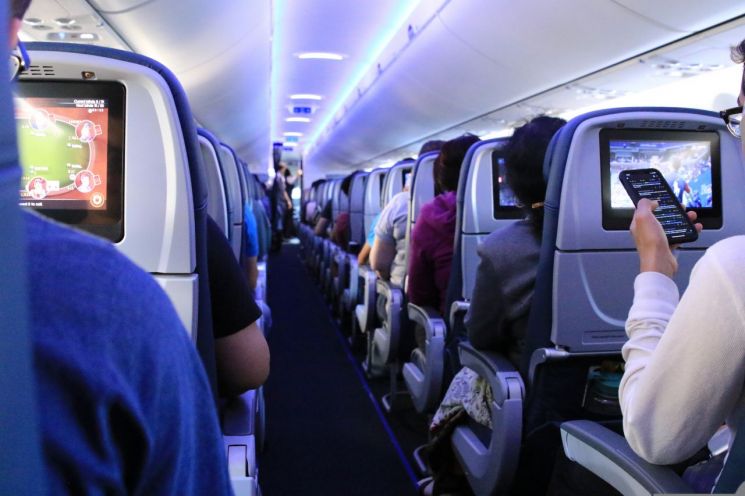
Photos posted on social networking services (SNS) showed parts of the plastic ceiling panels inside the cabin had fallen off or broken, creating small holes. One passenger, who said they were traveling with their mother, stated that turbulence occurred just as they sat down, and their mother had not fastened her seatbelt in time. "My mom was thrown and hit the ceiling," they said.
According to the National Weather Service, strong turbulence occurred at about 36,000 feet (approximately 10,973 meters) altitude. A weather official explained to Hawaii News Now, "It seems the aircraft passed through a storm, which could have caused the strong turbulence." The aircraft landed at its destination around 10:50 a.m. on the same day after passing through the turbulence.
Incidents where turbulence impacts aircraft causing accidents have been continuously occurring. In October, a passenger plane traveling from Spain to Argentina encountered severe turbulence, injuring about 12 passengers. In May, a passenger plane in India was caught in turbulence, injuring at least 15 passengers. In 2019, a passenger plane flying from Canada to Australia experienced a sudden drop due to turbulence, injuring 35 people including passengers.
Due to these circumstances, concerns about turbulence-related accidents are growing. In the United States, about 65,000 aircraft experience moderate turbulence annually, and about 5,500 encounter severe turbulence. According to the U.S. National Transportation Safety Board, among 7 million passengers who flew in the U.S. last year, there were six cases of serious injuries caused by turbulence, and eight cases were recorded up to November this year.
There is also analysis suggesting that the likelihood of encountering extreme turbulence during flights will increase due to climate change. Paul Williams, a professor at the University of Reading in the UK who studies atmospheric science, predicted, "Computer simulations show that extreme turbulence will increase two to three times over the next few decades."
He particularly focused on clear-air turbulence, which occurs on clear days without visible signs, making it difficult to avoid and considered the most dangerous type of turbulence. Professor Williams forecasted that such clear-air turbulence will increase significantly worldwide between 2050 and 2080. He explained, "Typically, flights crossing the Atlantic can expect about 10 minutes of turbulence, but this could increase to 20 or 30 minutes within a few decades."
He attributed the increase in frequency and duration of turbulence to climate change. Professor Williams has been researching the impact of climate change on turbulence since 2013.
However, experts including Professor Williams say there is no need to be overly concerned about turbulence. Morgan Smith, a Boeing pilot, told The New York Times, "According to reports, most people only experience the lowest level of turbulence, and severe turbulence is very rare. Turbulence often feels worse than it actually is, so the actual changes in altitude and speed are often not as severe."
The U.S. news magazine Time explained, "It is extremely rare for turbulence to cause a plane crash. Most commercial aircraft are designed to withstand very severe turbulence, fly at altitudes high enough to avoid turbulence, and maintain safe flights through various equipment and programs."
Nevertheless, as the frequency of severe turbulence increases, there are calls to strengthen in-flight safety regulations. Sarah Nelson, president of the Association of Flight Attendants in the U.S., said, "Flight attendants are exposed to danger because they continue working in the aisles even during mild turbulence," adding, "Many flight attendants have already been injured by turbulence and have quit their jobs."
She further emphasized, "Regulations should be strengthened so that children under two years old can sit in dedicated seats rather than on their parents' laps, and efforts to transition aircraft fuel to eco-friendly alternatives should be accelerated to address the climate crisis."
© The Asia Business Daily(www.asiae.co.kr). All rights reserved.


















