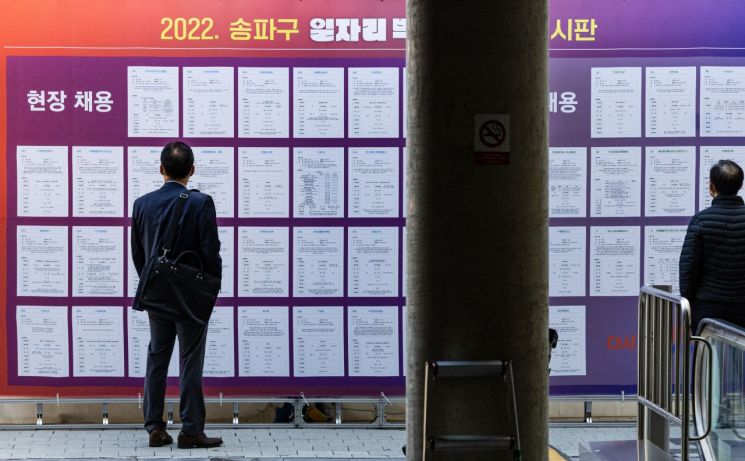
 At the 2022 Songpa-gu Job Fair held at the Sunken Plaza of Munjeong Culture Valley in Munjeong-dong, Songpa-gu, Seoul, senior job seekers are looking at the employment information board. [Image source=Yonhap News]
A study has found that South Korea's labor market and inflation trends still maintain a close relationship. The Bank of Korea explained that if the vacancy rate?defined as the proportion of job openings currently vacant or that can be newly filled within one month?increases by 1 percentage point, the consumer price inflation rate is estimated to rise by 0.56 percentage points.
On the 20th, the Bank of Korea revealed this in its BOK Issue Note titled "Estimation of the Phillips Curve Using Regional Data." According to the report, the slope of the Phillips curve, which represents the relationship between the unemployment rate and wage growth rate, became steeper when supply shocks were controlled for. A steeper slope indicates a stronger correlation between the labor market and inflation.
Song Sang-yoon, head of the Employment Analysis Team at the Bank of Korea's Research Department and the author of the report, explained, "A steeper Phillips curve slope means that inflation responds sensitively to changes in economic conditions, so the magnitude of the Phillips curve slope carries significant implications for central banks conducting monetary policy."
Analyzing data from about 10 years?from 2013 to the first half of this year?covering the semiannual vacancy rates and inflation rates in 16 regions excluding Sejong, the Bank of Korea found that when the vacancy rate rises by 1 percentage point, the inflation rate increases by 0.56 percentage points. A higher vacancy rate means it is difficult to find workers, which can lead to a greater rise in consumer price inflation through wages and other factors.
When only year fixed effects were considered, a 1 percentage point increase in the vacancy rate corresponded to a 0.35 percentage point rise in consumer price inflation. In contrast, when neither regional nor year fixed effects were considered, or when only regional fixed effects were accounted for, the Phillips curve slope was very flat and statistically insignificant.
Song stated, "Research on the determinants of the Phillips curve slope is actively being conducted mainly in academia and international organizations," adding, "It is known to be influenced by various factors beyond identification issues, so continuous research is required."
© The Asia Business Daily(www.asiae.co.kr). All rights reserved.

















