Core Inflation Rate Rises to 4% Range
Impact of Revenge Spending and Supply Bottlenecks
Domestic and Global Economic Downward Pressure Increases
Core Inflation Growth Expected to Slow
Cost-Side Inflation Factors Remain
If Electricity and Gas Price Hikes Increase
They May Offset Downward Inflation Pressure from Economic Slowdown
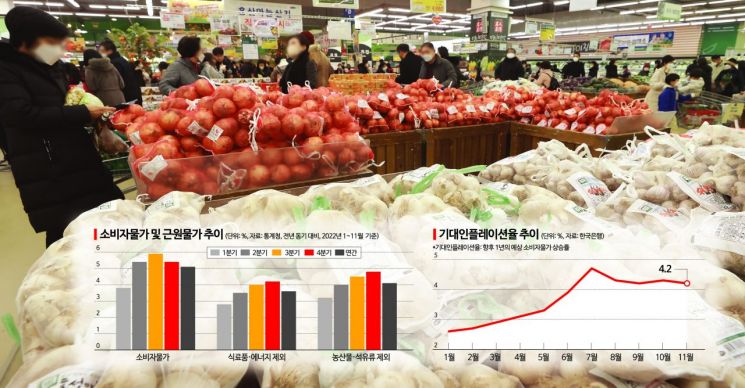
[Asia Economy reporters Seo So-jeong and Moon Je-won] The Bank of Korea forecasts that consumer prices will continue to rise at around 5% for the time being, indicating that the fear of high inflation will persist into next year. Unlike the consumer price inflation rate, which peaked in July and has since shown signs of slowing, the core inflation rate?which reflects the underlying trend of prices?is expanding, raising concerns that inflation instability may worsen next year. The high inflation situation in the 5% range is expected to continue until early next year, maintaining the Bank of Korea’s stance on raising the base interest rate.
The indicator that the Bank of Korea is particularly focusing on is core inflation. According to the Bank of Korea on the 20th, while the consumer price inflation rate peaked at 6.3% in July and has gradually slowed, core inflation has been rising recently. The core inflation index, which excludes food and energy prices, was 3.9% in July, just below 4%, but entered the 4% range in August (4.0%) and has expanded to 4.1% in September, 4.2% in October, and 4.3% in November. This is due to a combination of factors including increased pent-up demand during the COVID-19 recovery, supply bottlenecks caused by the Ukraine war, and rising raw material prices.
◆Dining Out and Personal Services Driving Core Inflation Up= Lee Chang-yong, Governor of the Bank of Korea, stated, "Demand-side price pressures have intensified due to the lifting of social distancing measures, and accumulated cost pressures from wage increases and rising raw material prices have been reflected in the prices of other goods and services." He added, "In particular, dining-out prices rose sharply, with the inflation rate in September reaching 9.0%, the highest level in about 30 years." The broad-based rise in prices of personal services such as dining out has led the expansion of core inflation. The prices of goods within core inflation have also steadily increased this year due to secondary effects from supply disruptions and rising raw material prices.
There is significant concern that without government intervention, the rise in core inflation would have been even greater. The core inflation index excluding administered prices, food, and energy rose from 4.6% in June to 4.7% in July, then 4.8% in August and September, and further to 5.0% in October and 5.1% in November. This means that without government price management measures such as suppressing public service fee hikes, core inflation would have surpassed 5%. With the possibility of electricity and city gas rate hikes next year being about twice as large as this year’s, inflationary pressures could intensify further.
The Bank of Korea expects that going forward, downward pressures on the domestic and global economy will gradually reduce the upward trend in core inflation. The base interest rate has been raised by 2.75 percentage points from August last year to November this year, which is expected to dampen consumer sentiment. Additionally, the rapid deterioration of overseas conditions due to global tightening makes a domestic economic slowdown inevitable. Historically, after economic peaks, core inflation tends to slow down with a time lag.
Since the second half of this year, rising loan interest rates and reduced transaction volumes have led to a decline in jeonse (long-term lease) prices, which is also a factor in slowing core inflation. According to the Korea Real Estate Board, jeonse prices have continued to fall this year, and monthly rents also showed a slight decrease in November. Since jeonse and monthly rents have a large weight in the consumer price index, a downturn in the real estate market significantly impacts price declines.
However, cost-side upward pressure on core inflation is expected to persist. The Bank of Korea emphasized, "Price increases in non-core items such as food and energy can raise cost pressures on core items, acting as upward pressure on prices," adding, "Processed food prices, which affect dining-out costs, continue to rise sharply."
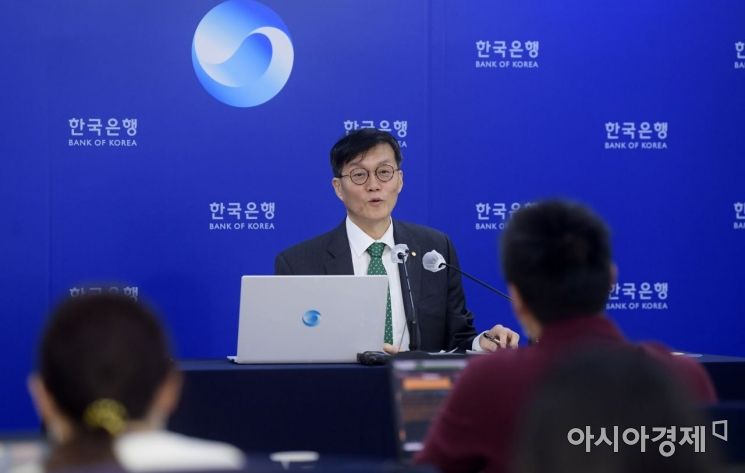 Bank of Korea Governor Lee Chang-yong is explaining the "2022 Second Half Inflation Target Operation Status" at the Bank of Korea press room in Jung-gu, Seoul on the 20th. Photo by Joint Press Corps
◆Electricity and City Gas Rate Hikes, Upward Inflation Pressure= In particular, if the increase in electricity and city gas rates?which broadly affect core inflation?expands, cost-side upward pressure could significantly rise, offsetting the downward inflation pressure caused by economic slowdown. Since accumulated cost pressures on electricity and city gas rates are substantial, significant rate hikes are expected next year.
Ongoing global supply disruptions are also problematic. South Korea is currently facing high cost burdens due to rising logistics costs, exchange rates, and raw material prices, and supply shortages in semiconductors are increasing price pressures on automobiles, mobile phones, and other products. Domestic container import freight rates remain high on intra-Asian routes, and this is gradually being passed on to consumer prices.
The intensification of US-China conflicts and the prolonged Russia-Ukraine war are leading to a reorganization of economic zones and supply chains around friendly countries, weakening global supply chains and potentially increasing production and price volatility. As the US continues to restrict China, especially in advanced technologies like semiconductors, the international division of labor system may weaken, potentially increasing inflationary pressures in the medium to long term.
Governor Lee stated, "Consumer prices will continue to rise at around 5% for the time being, but as domestic and international economic downward pressures increase, the upward trend will gradually slow, showing a pattern of high early and low later next year, and then gradually decline." He added, "However, there is significant uncertainty regarding the pace of this slowdown due to factors such as domestic and international growth and oil price trends." He emphasized, "Even if the inflation rate shows a high-early, low-later pattern and gradually decreases next year, it is expected to remain at a high level above the 2% inflation target, so it is necessary to continue monetary policy focused on price stability."
© The Asia Business Daily(www.asiae.co.kr). All rights reserved.


















