CNN Reports on the "2022 Survey on Solitary Deaths" Released by the Ministry of Health and Welfare
Government and Local Authorities Respond to the Rising Issue of Godoksa in South Korea
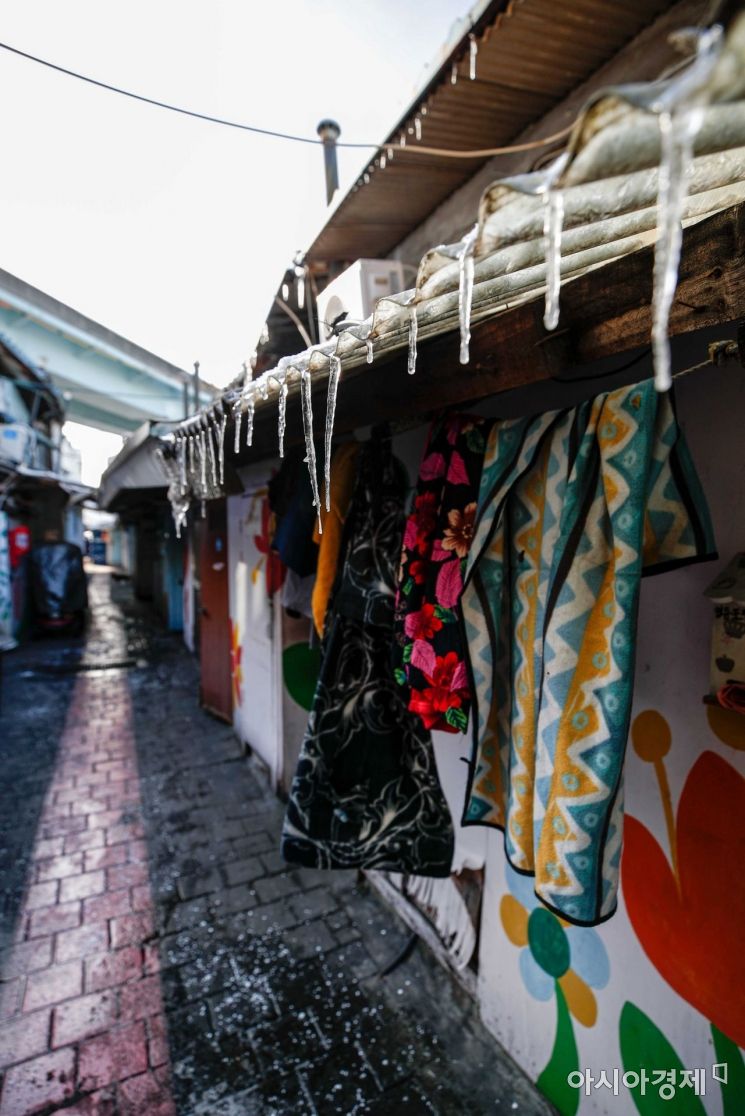 On the 16th, during the ongoing severe winter cold wave, icicles hung from the eaves of the shantytown in Yeongdeungpo-gu, Seoul. Photo by Kang Jinhyung aymsdream@
[Asia Economy, reporter Kim Hyunjung] CNN has also turned its attention to the increasingly serious issue of solitary deaths among middle-aged men in South Korea.
On December 18 (local time), CNN published an article titled "Middle-aged South Korean men are dying alone," citing the results of the "2022 Survey on Solitary Deaths" released by the Ministry of Health and Welfare on December 14. The report provided detailed coverage of solitary deaths in South Korea, poverty among the elderly, and the measures being taken by the government and local authorities.
CNN used the term "godoksa," the romanized Korean pronunciation of solitary death, and translated it into English as "lonely death." The outlet described godoksa as "a widespread phenomenon as South Korean society rapidly ages," and explained, "According to South Korean law, godoksa refers to cases where a person who has been cut off from family or acquaintances dies alone-whether by suicide or illness-and whose body is only discovered after a certain period of time has passed."
In the opening sentence, CNN stated, "South Korea has a problem. Thousands of lonely middle-aged men die alone every year. Often, they are not found for days or even weeks after their deaths." CNN went on to report, "The rise in solitary deaths over the past decade has prompted government action," and noted that "behind godoksa lie the country's demographic crisis, social welfare gaps, poverty, and social isolation, all of which have become even more pronounced since the COVID-19 pandemic."
CNN also introduced a study from last year by Song Inju, Senior Research Fellow at the Seoul Welfare Foundation Policy Research Office, who analyzed nine cases of solitary death.
Among these cases were a 64-year-old man who, after failing to receive a proper education and working various manual labor jobs, lost his job due to a disability and died of liver disease within a year; and an 88-year-old woman who passed away after the free meal center she relied on closed due to COVID-19, following the death of her son.
CNN reported that most of the individuals in the study lived in cramped and dirty spaces such as jjokbang (small single-room dwellings) or banjiha (semi-basement apartments), using the romanized Korean terms "jjokbang" and "banjiha." The report specifically explained that banjiha refers to underground living spaces, such as those where an entire family was trapped and unable to escape during the heavy rains in Seoul last summer.
Finally, CNN highlighted the efforts of the government and local authorities to address the issue of solitary deaths. These included Seoul's 2018 "Neighbor Watcher" program for single-person households in vulnerable areas, and the launch of mobile applications in cities such as Seoul, Ulsan, and Jeonju that automatically send messages to emergency contacts if a person living alone does not use their phone for a set period of time. CNN also described last year's enactment of the Act on the Prevention and Management of Solitary Deaths (Solitary Death Prevention Act) as the most comprehensive and recent measure, and noted that the South Korean government is currently preparing an integrated strategy to prevent solitary deaths.
Last year, there were 3,378 cases of solitary death in South Korea, a significant increase from 2,412 cases in 2017. Of those who died alone last year, 1,760 were men in their 50s and 60s, accounting for 52.1% of the total. The number of male solitary death victims was 2,817, and men in their 50s and 60s made up 62.5% of these cases. Among people in their 40s-a middle-aged group-there were 436 solitary death victims, followed by those in their 70s (314), those aged 80 and above (135), those in their 30s (120), those in their 20s (37), and one case among teenagers. In addition, the number of solitary deaths among men in South Korea has consistently been more than four times higher than among women each year, and last year, this gap widened to 5.3 times.
© The Asia Business Daily(www.asiae.co.kr). All rights reserved.
![Clutching a Stolen Dior Bag, Saying "I Hate Being Poor but Real"... The Grotesque Con of a "Human Knockoff" [Slate]](https://cwcontent.asiae.co.kr/asiaresize/183/2026021902243444107_1771435474.jpg)
















