Ministry of Land, Infrastructure and Transport Establishes 16 Tasks Across 3 Major Strategies for Regional Development
Southern Inland Railway Passing Through Western Gyeongnam to Begin Construction in 2024
Hamyang-Ulsan Expressway Connecting East and West Scheduled to Open in 2026
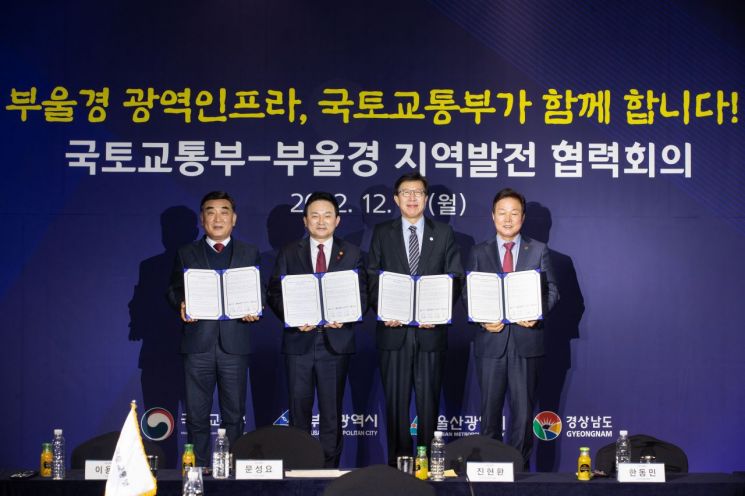 On the morning of the 19th, at Nurimaru APEC House in Haeundae-gu, Busan, Kim Doo-kyum, Mayor of Ulsan (from the left), Won Hee-ryong, Minister of Land, Infrastructure and Transport, Park Hyung-joon, Mayor of Busan, and Park Wan-su, Governor of Gyeongnam Province, signed a "Mutual Cooperation Agreement for Balanced Regional Development and Joint Growth of the Busan-Ulsan-Gyeongnam Super Metropolitan Area" during the Ministry of Land, Infrastructure and Transport-Busan-Ulsan-Gyeongnam Regional Development Cooperation Meeting and took a commemorative photo.
 [Photo by Ministry of Land, Infrastructure and Transport]
[Asia Economy Reporter Cha Wanyong] The government has decided to combine the Busan, Ulsan, and Gyeongnam (Bu-Ul-Gyeong) regions to create a regional living zone comparable to the Seoul metropolitan area for balanced national development. Additionally, it plans to develop the area into a Northeast Asia logistics hub linking the new airport and new port. Once the so-called ‘Bu-Ul-Gyeong super metropolitan’ development plan is completed, a 'second metropolitan area' centered on Busan is expected to emerge.
On the 19th, the Ministry of Land, Infrastructure and Transport (MOLIT) announced that it held a MOLIT-Bu-Ul-Gyeong regional development cooperation meeting at Nurimaru in Haeundae, Busan, together with Park Hyung-joon, Mayor of Busan, Kim Doo-gyeom, Mayor of Ulsan, and Park Wan-su, Governor of Gyeongnam. This cooperation meeting was organized by MOLIT to support the mutual growth of Bu-Ul-Gyeong.
At this cooperation meeting, MOLIT presented three major strategies and 16 tasks to support the mutual growth of Bu-Ul-Gyeong and signed a 'Mutual Cooperation Agreement for Balanced Regional Development and Bu-Ul-Gyeong Super Metropolitan Mutual Growth' with Busan City, Ulsan City, and Gyeongnam Province.
The three major strategies proposed by MOLIT are ▲completion of a one-hour living zone in Bu-Ul-Gyeong ▲development of specialized industrial hubs in Bu-Ul-Gyeong ▲attracting and successfully hosting the 2030 World Expo. In particular, MOLIT plans to present a concrete roadmap for completing the one-hour living zone in Bu-Ul-Gyeong and to proceed with rapid project implementation.
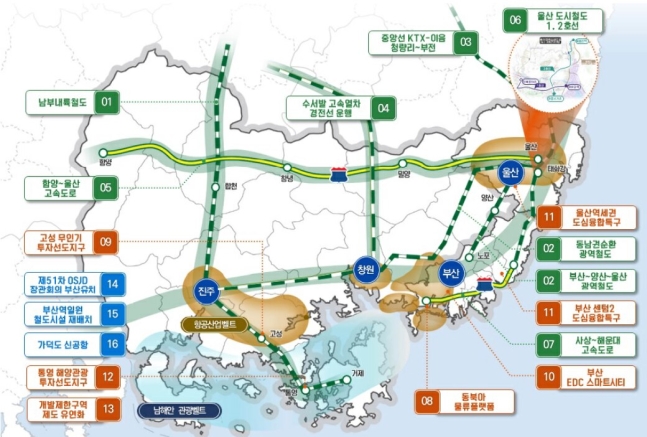 Major Promotion Tasks for the Busan-Ulsan-Gyeongnam Super Metropolitan Area in Land, Infrastructure, and Transport. [Source=Ministry of Land, Infrastructure and Transport]
To complete the one-hour living zone in Bu-Ul-Gyeong, construction of the Southern Inland Railway (Gimcheon-Jinju-Tongyeong-Geoje), which passes through western Gyeongnam, will begin in 2024. Procedures such as the preliminary feasibility study for the Busan-Yangsan-Ulsan metropolitan railway and the Southeast Circular Metropolitan Railway, which connect Bu-Ul-Gyeong as one, will also proceed without delay.
Additionally, the high-speed railway central line section from Andong to Bujeon, operated by the KTX-Eum (EMU), a semi-high-speed train with a maximum speed of 260 km/h, will be extended and opened in 2024 to complete the entire Seoul (Cheongnyangni)-Andong-Busan route. KTX-Eum will stop at major regional hubs such as Ulsan Taehwagang Station. The stations where it will stop will be decided in 2024.
The Hamyang-Ulsan Expressway, connecting east and west from Hamyang in northwest Gyeongnam to Ulsan, is scheduled to open in 2026. Upon opening, it is expected to significantly enhance the main arterial functions within the Gyeongnam region. For the establishment of a new urban railway in Ulsan, a feasibility reassessment for Line 1 and a preliminary feasibility study for Line 2 are currently underway.
Development of specialized industrial hubs in Bu-Ul-Gyeong will also be promoted. The first task identified is the ‘Establishment of a National Smart Logistics Platform.’ Plans include building a national smart logistics platform linking Gadeokdo New Airport and Busan-Jinhae New Port.
Railway facilities around Busan North Port will begin construction before 2024 to ensure no delays in Expo preparations, and efforts will be made to construct Gadeokdo New Airport as early as possible. To this end, various design and construction-related measures to shorten the construction period will be broadly reviewed, and measures will be prepared in anticipation of the passage of the ‘Gadeokdo New Airport Construction Special Act’ amendment in the National Assembly, which includes immediate land compensation after establishing the basic plan.
The unmanned aerial vehicle (UAV) investment leading zone in Goseong, Gyeongnam, designated in September this year, will be developed as a research and production hub specialized in UAVs in connection with the nearby Gyeongnam Aviation National Industrial Complex. To this end, the ongoing detailed design will be completed promptly, and construction will begin in the second half of next year.
To support the ‘Attraction and successful hosting of the 2030 World Expo,’ the International Railway Cooperation Organization Ministerial Meeting will be held in Busan in June next year. The International Railway Cooperation Organization is an international organization with 29 member countries, and the meeting will be held in Korea next year. MOLIT plans to use this opportunity to promote Bu-Ul-Gyeong to government officials visiting Busan and link this to Expo attraction promotional activities.
Minister of Land, Infrastructure and Transport Won Hee-ryong said, “The Bu-Ul-Gyeong area is a vast economic zone equipped with various industrial bases such as mobility, aviation, shipbuilding, and hydrogen, as well as extensive aviation and logistics hub functions. We will do our utmost to support its growth into a global-level super metropolitan area.”
Busan Mayor Park Hyung-joon pledged, “We will do our best to wisely resolve major local issues such as attracting the 2030 Busan World Expo, constructing Gadeokdo New Airport, and supporting the construction of the second Centum City advanced industrial complex connecting road under the support of MOLIT, to make Busan a city where people want to live again even if they are born anew.”
© The Asia Business Daily(www.asiae.co.kr). All rights reserved.


















