Differentiated Treatment Among Divisions
Group Cohesion Disrupted, Employees Stirred Up
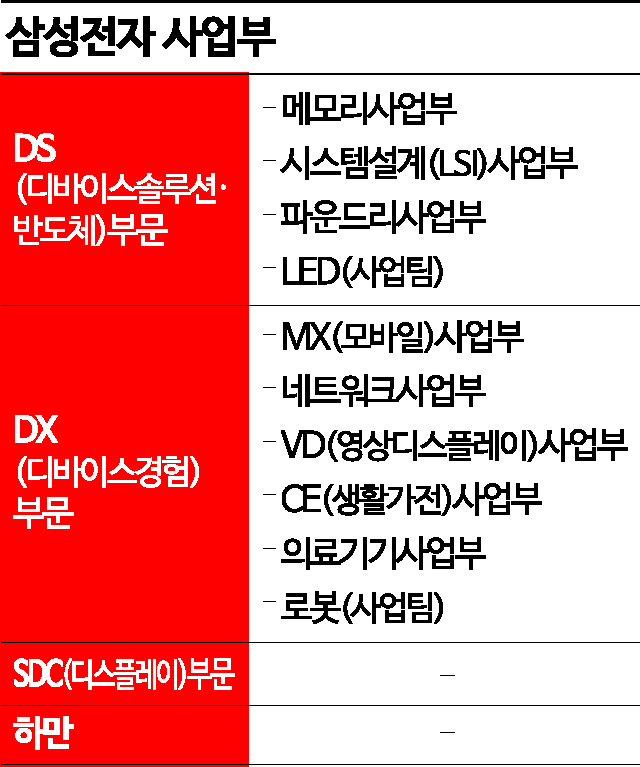
[Asia Economy Reporter Han Yeju] Samsung Electronics is in turmoil following a series of year-end news reports about differentiated salaries for new employees and internal job postings. Complaints are emerging that it does not feel like all employees are working for the same company. As the performance and corresponding compensation and treatment vary significantly by business division, some are even suggesting that the company might be splitting into separate entities such as Samsung Semiconductor, Samsung Mobile, and Samsung Home Appliances.
According to industry sources on the 19th, the internal job postings on Samsung Electronics' internal bulletin board earlier this month and employees' reactions to them clearly reflect this atmosphere. Samsung Electronics posted a job announcement stating that internal employees who transfer to the Home Appliances Division will receive a lump sum payment of 20 million KRW and, if desired, can return to their original division after three years. Additionally, employees can choose to receive either the Target Achievement Incentive (TAI, formerly PI) and Over-Profit Incentive (OPI, formerly PS) from their current division or from the Home Appliances Division, whichever is higher, during the three-year period.
Samsung Electronics pays TAI every six months and OPI once a year. When performance is good, TAI and OPI can exceed the annual salary. Since employees with the same 10 years of experience can receive significantly different bonuses depending on their performance evaluation and division, the option to choose the division for performance bonus payment is very meaningful.
Existing employees in the Home Appliances Division protested. One employee said, "This announcement publicly stigmatizes the Home Appliances Division as a place everyone avoids," expressing that hardworking members feel disheartened. The more serious issue is that even with these exceptional conditions, employees from other divisions were indifferent. While some were tempted by the '20 million KRW lump sum payment,' most responded, "Still, I won't go to Home Appliances."
The difficulty in recruiting personnel for Samsung Electronics' Home Appliances Division, which produces refrigerators, washing machines, and dishwashers, is not a new issue. Compared to other divisions, performance is lower, resulting in smaller bonuses, but the workload is heavy. The Gwangju plant, which specializes in producing Home Appliances Division products, is nicknamed 'Gwangju Electronics' among employees, implying it is treated like a different company rather than part of Samsung Electronics.
There are also criticisms that the company fosters a preference for high-performing divisions. A representative example is the DS Division's 1.5 million KRW increase in starting salary for new college graduates last November. Currently, the DS Division's starting salary for college graduates is 53 million KRW, while other divisions offer 51.5 million KRW. Although bonuses and some welfare benefits have differed by division in the past, this is the first time starting salaries have changed. New hires in the DS Division now earn more than their seniors with 2-3 years of experience in other divisions. The DS Division had planned additional compensation within the year but abandoned the plan due to opposition from other divisions.
Samsung recruits talent by division and job category. It also compiles and announces accounting results by segment, such as semiconductors, mobile phones, and TVs. Investment and expenditures have been independently decided by the division heads, who are presidents of each business. The company is an organization that handles recruitment, personnel, accounting, and expenditures collectively. Each Samsung Electronics division has effectively operated as an independent company. The last unifying factor for Samsung Electronics employees was the open recruitment system. New employees hired through open recruitment believed they were all part of the Samsung Electronics family and received equal treatment. However, now the family unit is shifting from the entire Samsung Electronics to individual divisions. Internal division-to-division job postings and differentiated starting salaries for college graduates are breaking the psychological sense of unity that Samsung Electronics was one company. An industry insider said, "Samsung Electronics appears to be in the process of abandoning its identity as a single company."
In fact, Samsung Electronics' top management has long been considering separating the business units into independent companies. This is because major customers demand it. Former Vice Chairman Choi Ji-sung said during his tenure, "Because Samsung Electronics is a comprehensive home appliance company, there are difficulties in customer management." Samsung is the only comprehensive company in the world that produces core electronic components like semiconductors and displays, as well as major finished products such as mobile phones and TVs. While being a comprehensive company is seen as a strength, it can also be a hindrance to business.
For example, Apple is both the largest customer of Samsung Electronics' semiconductor division and the biggest competitor of Samsung Electronics' mobile phone division. From Apple's perspective, it must purchase core components like semiconductors and displays from Samsung Electronics to make its products and compete against Samsung smartphones. It is difficult for Apple to feel comfortable buying Samsung parts. Most major electronics companies worldwide are both customers and competitors of Samsung. This structure makes it inevitable to consider business division separation.
Samsung has experience in separating businesses and creating new companies. In 2012, Samsung Electronics spun off its Liquid Crystal Display (LCD) business to form Samsung Display. An industry expert said, "Even if Samsung Electronics does not actually spin off, merely revealing the competition, tension, and conflict between divisions externally would please customers." It is also evaluated to have the effect of intensifying internal performance competition.
© The Asia Business Daily(www.asiae.co.kr). All rights reserved.

















