Competition Rates Rise at 10 Major Nationwide Autonomous Private High Schools
Wai-daebu High School 2.99:1, Hana High School 2.45:1, etc.
Popularity of Autonomous Private High Schools Operating Top-tier Science Classes Increases
Competition Rates Up at 52 out of 67 Autonomous Private and Specialized High Schools
[Asia Economy Reporter Han Jinju] The competition rate for autonomous private high schools (Jasulhyeong Saripgo) in the 2023 academic year has reached its highest level in the past five years. The average competition rates for nationwide autonomous private high schools, foreign language high schools, and international high schools all rose simultaneously. The popularity of autonomous private high schools that operate science tracks increased as more parents preferred these schools, and the risk of policy abolishing autonomous private high schools disappeared under the new government.
According to Jongno Academy on the 18th, the average competition rate for nationwide autonomous private high schools was 1.82 to 1. With 2,591 students being recruited across 10 schools, 4,720 applicants applied, marking a 16.5% increase from last year’s rate of 1.57 to 1.
The average competition rates for the 10 nationwide autonomous private high schools over the past five years were ▲2019 academic year 1.46 to 1 ▲2020 academic year 1.58 to 1 ▲2021 academic year 1.48 to 1 ▲2022 academic year 1.57 to 1.
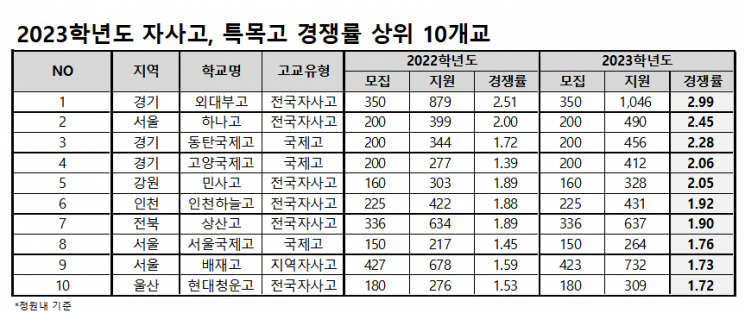
Looking at the competition rates of the top 10 nationwide autonomous private high schools for the 2023 academic year, Hankuk University of Foreign Studies High School (Hankuk Waegyo Bugo) was 2.99 to 1, Hana High School was 2.45 to 1, and Minjok Leadership Academy (Minsago) was 2.05 to 1, all showing increases compared to the previous year. Especially, Pohang Steel High School (Pohang Jecheolgo), which produced a perfect scorer on the college entrance exam this year, saw its competition rate rise from 1.05 to 1 to 1.47 to 1, and Hyundai Cheongun High School increased from 1.53 to 1 to 1.72 to 1.
Among the 67 autonomous private high schools, foreign language high schools, and international high schools that disclosed their competition rates this year, 52 schools showed an increase. Among 32 autonomous private high schools, 23 schools saw their competition rates rise, one remained the same as last year, and eight declined. Among foreign language and international high schools, 29 out of 35 schools experienced an increase in competition rates.
The average competition rate for 22 nationwide autonomous private high schools increased from 1.13 to 1 to 1.21 to 1. The number of applicants rose by 6.8% (626 people), from 9,229 to 9,855. The schools with the highest competition rates among special purpose high schools and autonomous private high schools were Hankuk Waegyo Bugo (2.99 to 1), Hana High School (2.45 to 1), and Dongtan International High School (2.28 to 1), in that order.
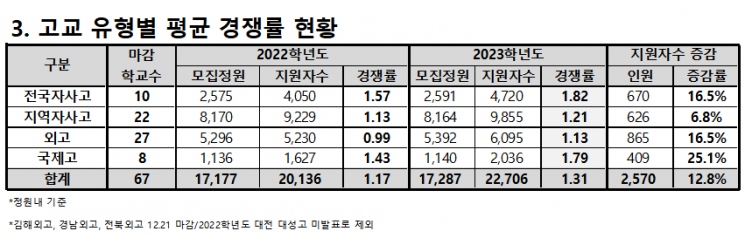
The competition rate for foreign language high schools, which had a shortage last year, also increased. The competition rate for 27 foreign language high schools nationwide rose from 0.99 to 1 to 1.13 to 1. The number of applicants increased by 16.5% (865 people), from 5,230 to 6,095. Busan Foreign Language High School had the highest rate nationwide at 1.70 to 1, followed by Myeongdeok Foreign Language High School (Seoul) at 1.59 to 1, and Bu-il Foreign Language High School at 1.52 to 1.
The competition rate for eight international high schools nationwide rose from 1.43 to 1 to 1.79 to 1. The number of applicants increased by 25.1% (409 people), from 1,627 to 2,036. Dongtan International High School had 2.28 to 1, Goyang International High School 2.06 to 1, and Minjok Leadership Academy 2.05 to 1, in that order.
The rise in competition rates for autonomous private high schools reflects a marked preference for science tracks and a trend toward expanding the proportion of regular admissions centered on major universities. The continued preference for medical and pharmaceutical fields has influenced parents’ perception that autonomous private high schools operating science tracks are advantageous for exam preparation. Since most top-tier high schools operate mainly science tracks, the popularity of foreign language and international high schools, which are mainly humanities-focused, also appears to have increased.
The disappearance of policy risks regarding autonomous private high schools under the new government is also interpreted as a factor raising admission competition rates. The Ministry of Education plans to announce a high school system reform plan within the year, and there is a prevailing expectation that the reform will maintain autonomous private and foreign language high schools following the appointment of Deputy Prime Minister Lee Ju-ho.
Lim Seong-ho, CEO of Jongno Academy, said, "Recent court rulings on special purpose and autonomous private high schools have somewhat eliminated policy risks related to abolition, which seems to be a factor in the increase in competition rates," adding, "If the grading system shifts to absolute evaluation in the future, the preference for special purpose and autonomous private high schools will increase even more."
© The Asia Business Daily(www.asiae.co.kr). All rights reserved.



















