KCCI and Ministry of Environment Jointly Hold 'Corporate Environmental Policy Council'
Vice Minister Yoo Je-cheol, Vice Chairman Woo Tae-hee, and Industry Executives Attend to Discuss Industry Issues
[Asia Economy Reporter Choi Seoyoon] #“When applying CO2 capture technology to reduce greenhouse gases, the amount of exhaust gas decreases due to CO2 removal, but the emissions of NOx (nitrogen oxides) and SOx (sulfur oxides) remain the same, causing their concentration ratios to increase and exceed emission standards. Please establish separate emission standards when applying CO2 capture technology” (Manufacturing Company A)
#“We succeeded in developing technology to recycle process by-products as concrete additives, but these by-products are classified as ‘designated waste’ and cannot be recycled. Recently, as the utilization of process by-products and other wastes has expanded through technological development, please consider recognizing them as circular resources.” (Manufacturing Company B)
Emission standards reflecting the characteristics of the CO2 capture process, a core technology for greenhouse gas reduction, will be established.
The Korea Chamber of Commerce and Industry (KCCI) announced on the 16th that it held the ‘Corporate Environmental Policy Council’ jointly with the Ministry of Environment at the KCCI building in Seoul. The Corporate Environmental Policy Council is a forum where the government and companies discuss environmental policy directions and industry issues together. It has been held annually since 1998.
At the meeting, co-chairmen Woo Taehee, Executive Vice President of KCCI, Vice Minister Yoo Jecheol of the Ministry of Environment, and key company representatives including Park Hyun of POSCO, Yoon Seokhyun of Hyundai Motor Company, and Kim Pyeonggil of S-Oil attended.
Discussion on Improvements Including Establishing Emission Standards Reflecting Characteristics of Carbon Dioxide Capture Processes
During the meeting, companies made suggestions related to environmental policies, and the Ministry of Environment expressed willingness to accept some of these proposals.
Manufacturing Company A stated, “When applying CO2 capture technology to reduce greenhouse gases, the amount of exhaust gas decreases due to CO2 removal, but emissions of other air pollutants such as NOx and SOx remain unchanged, causing their concentration ratios to increase,” and suggested, “Separate emission standards for air pollutants are needed when applying CO2 capture technology.” In response, the Ministry of Environment said, “Since CO2 capture technology is in the early stages of commercialization, we will comprehensively consider the characteristics of workplaces and processes to review improvement measures.”
Manufacturing Company B said, “Even if we try to recycle process by-products, they are classified as ‘designated waste,’ making it difficult to be recognized as circular resources,” and requested, “Please establish a method to exclude designated waste from waste regulations when the recycling value is high and utilization between workplaces is determined.” The Ministry of Environment responded, “If the by-products are directly used as raw materials in the process, we will apply chemical substance-related laws instead of waste regulations to exclude them from waste regulations.” ‘Designated waste’ refers to waste from workplaces such as waste oil and waste synthetic resin that can pollute the surrounding environment or contain hazardous substances like heavy metals.
Manufacturing Company C said, “The same workplace operates both plastic manufacturing and non-metallic mineral product manufacturing, but since plastic manufacturing became a subject of integrated environmental management permits, we had to appoint an additional integrated environmental manager,” and requested, “Please prepare improvement measures as there is a burden to appoint both environmental technicians and integrated environmental managers.” The Ministry of Environment replied, “We will prepare an exception allowing an integrated environmental manager to concurrently serve as an environmental technician when the same workplace operates multiple industries.”
Additionally, the Ministry of Environment introduced the ‘Environmental Regulation Innovation Plan’ and the ‘Emission Trading Scheme Improvement Plan to Promote Greenhouse Gas Reduction.’ A Ministry official stated, “Including the KCCI’s proposals this year, we are focusing on regulatory innovation by completing 102 out of 177 regulatory innovation tasks within the year,” and added, “We will meticulously manage to ensure that improved regulations are properly implemented on site and will reasonably improve the greenhouse gas emission trading system based on communication with the industry.”
During the subsequent discussion, various industry suggestions were made, including ▲reflecting efforts to reduce greenhouse gases in the use and recycling stages of products in low-carbon product standards and environmental labeling/advertising standards ▲clarifying exemption methods for registration of chemically contained substances with blocked leakage or spills in processes ▲establishing measures to mitigate price volatility in the greenhouse gas emission trading market, and the Ministry of Environment agreed to further review these.
KCCI’s Environmental Regulation Proposals Accepted by Government at 61%, a 19% Increase from Last Year
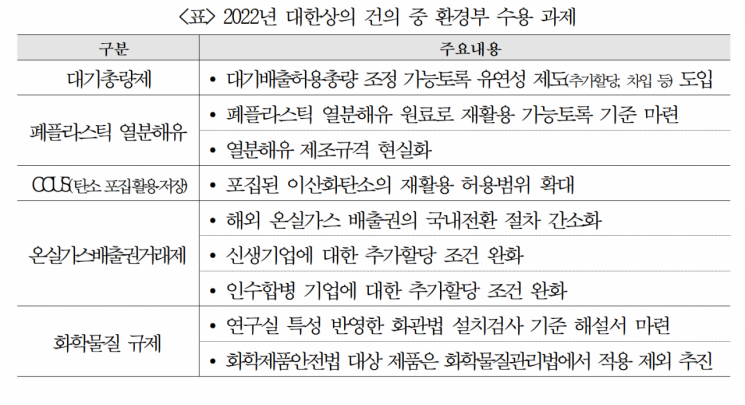
This year, the acceptance rate of environmental regulations (105 cases) proposed to the Ministry of Environment at the Corporate Environmental Policy Council was 61% (64 cases), a 19% increase from last year. Major contents include ▲introduction of a flexible total air volume system (additional allocation, borrowing, etc.) ▲establishment of standards to allow recycling of waste plastic pyrolysis oil as raw material and realistic manufacturing standards for pyrolysis oil ▲expansion of the allowable scope for recycling captured carbon dioxide.
Cho Youngjun, Director of Sustainable Management at KCCI, said, “Many proposals were accepted through communication with the Ministry of Environment this year,” and added, “We will continue to improve unreasonable regulations in the corporate field through the Corporate Environmental Policy Council, which serves as a hotline for environmental regulations.”
© The Asia Business Daily(www.asiae.co.kr). All rights reserved.


















