Decline since July... Drop Widens Gradually
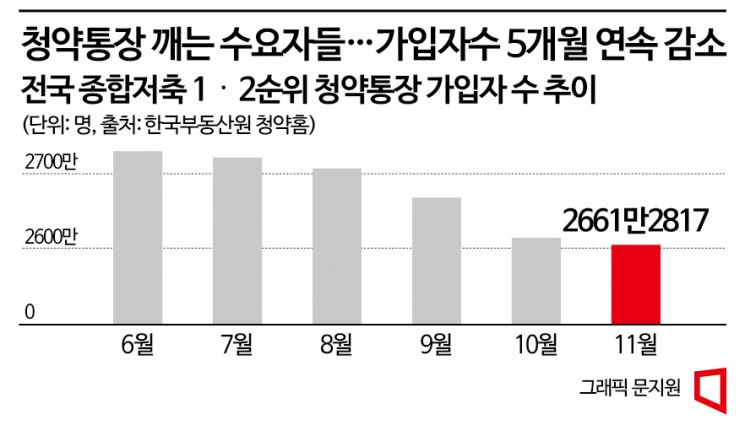
Total Subscribers in November: 26,612,817
Priority Account Conditions Eased Due to Regulatory Area Relaxation
First-Priority Subscribers Increased Significantly Compared to June
But Decline Resumes Excluding Incheon and Gyeonggi
[Asia Economy Reporter Hwang Seoyul] As real estate transaction prices decline, more subscribers are cashing out their subscription savings accounts. Although the number of first-priority subscribers seemed to increase due to the easing of first-priority conditions following the lifting of restrictions in regulated areas, the trend has turned downward again except for Gyeonggi and Incheon, which were deregulated last month.
According to Cheongyak Home on the 15th, the total number of comprehensive savings accounts nationwide in November was 26,612,817, a decrease of 210,990 compared to the previous month. The number of first-priority subscribers was 17,604,331, and second-priority subscribers numbered 9,008,486. Currently, among the four major types of subscription savings accounts (Housing Subscription Comprehensive Savings, Subscription Savings, Subscription Deposit/Installment Savings), only the Housing Subscription Comprehensive Savings allows new subscriptions.
The number of subscription savings account holders has been declining for five consecutive months since July. In July (27,019,253), the number decreased by 12,658 compared to the previous month, and in August (27,003,542), it decreased by 15,711, with the decline gradually increasing. In September (26,969,838), it decreased by 33,704, and in October (26,823,807), it dropped by 146,031.
Regarding the total number of first-priority subscribers nationwide (17,604,331), the easing of first-priority account conditions due to deregulation led to a significant increase compared to June (15,579,858), just before the decline. In non-regulated areas, first-priority eligibility is granted if one year has passed after subscribing in the metropolitan area, or six months in non-metropolitan areas, and the recognized payment amount meets the regional deposit requirement. In contrast, in speculative overheated zones and subscription overheated areas, two years must pass after subscription to meet first-priority conditions.
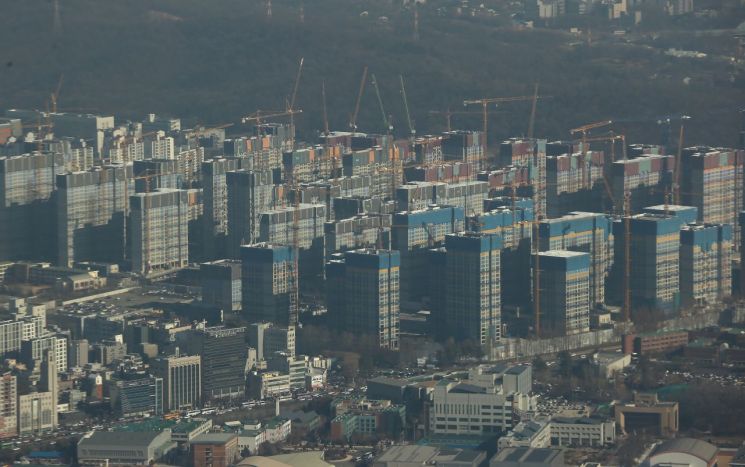
However, looking at the regions, except for Incheon and Gyeonggi, the effect of deregulation seems to have weakened. The five major metropolitan cities (3,252,611) decreased by 47,599, and other areas (4,214,629) decreased by 22,941. Seoul, which was not subject to deregulation, saw a decrease of 19,112 compared to the previous month. Gyeonggi and Incheon, where all areas except Gwacheon, Seongnam (Bundang and Sujeong), Hanam, and Gwangmyeong were deregulated last month, saw an increase of 807,353 in first-priority subscribers (6,258,968).
The number of second-priority subscribers decreased in all regions. Seoul (2,275,833) decreased by 21,932 compared to the previous month, metropolitan cities (1,951,140) by 4,536, and other areas (2,344,948) by 34,146. Incheon and Gyeonggi (2,436,565) decreased by 868,257. While some subscribers may have switched to first priority, there were also dropouts. Park Jimin, head of the Monthly Subscription Research Institute, said, "Although the number of first-priority subscribers increased significantly after deregulation, it now seems to have stopped growing further," adding, "Along with the decline in the number of subscribers, the number of dropouts is also increasing."
Professor Lim Jaeman of the Department of Real Estate at Sejong University also said, "Although the rise in market interest rates may have some effect, many subscription savings account holders join for the purpose of subscription," adding, "As housing prices fall, demanders feel there is no immediate need to jump into subscription."
© The Asia Business Daily(www.asiae.co.kr). All rights reserved.


















