Possibility of Widening Interest Rate Gap Increases Amid Prolonged US Tightening
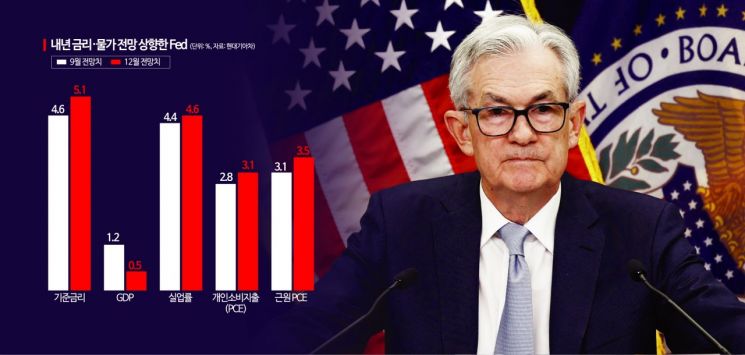
[Asia Economy Reporter Seo So-jeong, Sejong=Reporter Son Seon-hee] As the U.S. Federal Reserve (Fed) took a big step (raising the benchmark interest rate by 0.50 percentage points), the interest rate gap between South Korea and the U.S. widened to 1.25 percentage points, the largest in over 22 years. Although the Fed avoided a fifth consecutive giant step at this Federal Open Market Committee (FOMC) regular meeting, the year-end benchmark interest rate outlook for next year rose from the previous 4% range to the 5% range, increasing the likelihood of a further widening of the interest rate gap between Korea and the U.S. As U.S. tightening prolongs, the Bank of Korea’s monetary policy concerns are expected to deepen.
◆The Burden of the Largest Interest Rate Gap in 22 Years= According to the Bank of Korea on the 15th, as the U.S. Fed implemented a big step, the benchmark interest rate gap between South Korea (3.25%) and the U.S. (4.25~4.50%) widened to 1.00~1.25 percentage points. The 1.25 percentage point interest rate gap is the largest rate inversion since October 2000 (1.50 percentage points). In particular, concerns over the interest rate gap between Korea and the U.S. are growing as the upper limit of the U.S. terminal rate has been raised. The new dot plot revealed at this FOMC shows the median U.S. interest rate for next year at 5.1%, which is 0.5 percentage points higher than the 4.6% in September, suggesting a longer duration of U.S. tightening ahead. If Korea raises its benchmark interest rate by a baby step (0.25 percentage points) once more in the first quarter of next year and concludes the rate hike cycle, the terminal rate would reach 3.5%. If the Fed stops raising rates at 5.0%, the gap could widen to 1.50 percentage points.
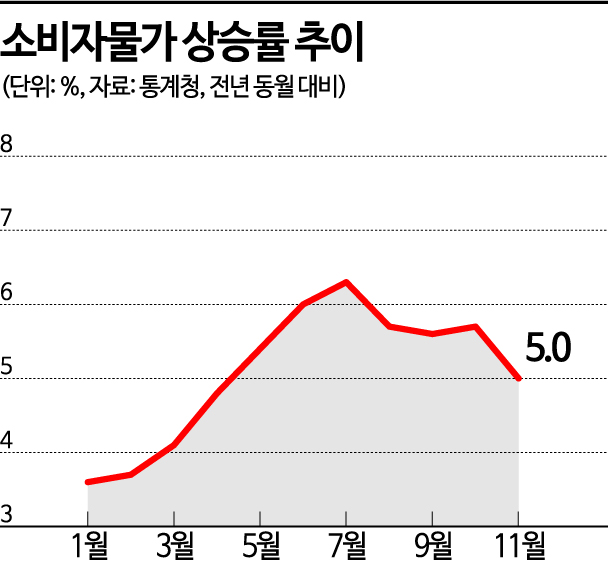
Kim Jeong-sik, Emeritus Professor of Economics at Yonsei University, said, "If the benchmark interest rate for the Korean won, which is not a key currency like the dollar, becomes significantly lower than that of the U.S., foreign investment funds may outflow and the won’s value may fall, causing the foreign exchange market, which had calmed down, to become volatile again." He expressed concern that "the rise in the exchange rate could fuel import prices, potentially reigniting inflation that had passed its peak." Professor Kim also noted, "However, the domestic liquidity crunch, mainly in the short-term financial market, has not been completely resolved, and with the domestic real estate market freezing amid the global economic recession next year, the Bank of Korea’s monetary policy concerns may deepen further." Joo Won, Head of Economic Research at Hyundai Research Institute, said, "As the Fed slows the pace of tightening, the Bank of Korea is likely to avoid a third big step," adding, "However, the possibility cannot be ruled out that the Bank of Korea will raise the benchmark interest rate for a longer period and to a higher level than initially expected, starting with a baby step in the first quarter of next year."
◆Terminal Rate and Duration as Variables= The Bank of Korea evaluated the 0.50 percentage point policy rate hike at this FOMC as in line with market expectations, but noted that uncertainty could increase depending on changes in expectations regarding the U.S. policy rate’s terminal level and duration, as well as movements in major countries’ exchange rates in domestic financial and foreign exchange markets. On the same day, Lee Seung-heon, Deputy Governor of the Bank of Korea, held a 'Market Situation Review Meeting' and said, "Although concerns about tightening have somewhat eased due to the Fed’s slowing of rate hikes, we cannot rule out the possibility of renewed volatility in financial markets due to changes in policy expectations based on inflation in the U.S. and other major countries, as well as concerns about a global economic recession." He added, "As the policy rate gap between Korea and the U.S. has widened due to the U.S. rate hikes, we will closely monitor changes in the domestic financial and foreign exchange markets, such as exchange rates and capital flows, and if market volatility expands significantly, we will promptly take market stabilization measures."
On the same day, Deputy Prime Minister and Minister of Economy and Finance Choo Kyung-ho presided over an emergency macroeconomic and financial meeting at the Bankers’ Hall in Jung-gu, Seoul, stating, "Uncertainty in financial markets remains high due to inflation and monetary tightening trends in major countries and the speed of economic slowdown, so we cannot afford to relax vigilance even for a moment," emphasizing, "We will do our best to stabilize the market." The meeting was attended by financial authorities including Lee Chang-yong, Governor of the Bank of Korea; Kim Ju-hyun, Chairman of the Financial Services Commission; and Lee Bok-hyun, Governor of the Financial Supervisory Service. Regarding the recent domestic financial market situation, Deputy Prime Minister Choo evaluated, "The market is regaining stability due to expectations of a slowdown in the U.S. rate hike pace and government market stabilization measures." He cited that corporate paper (CP) rates have fallen for three consecutive days for the first time since October, and the won-dollar exchange rate, which had surged to the 1,400 won range, recently entered the 1,200 range.
Deputy Prime Minister Choo said, "To support corporate financing, a total of 20 trillion won worth of bond market stabilization funds plans to complete a second capital call of 5 trillion won in January next year," adding, "Starting early next year, we will actively support smooth corporate bond issuance by fully launching a 5 trillion won primary collateralized bond obligation (P-CBO) program." He continued, "Following the additional expansion of the real estate project financing (PF) operator guarantee by 5 trillion won (from 10 to 15 trillion won), a 5 trillion won guarantee for unsold PF loans will also be supplied immediately from January 1 next year."
© The Asia Business Daily(www.asiae.co.kr). All rights reserved.
![Clutching a Stolen Dior Bag, Saying "I Hate Being Poor but Real"... The Grotesque Con of a "Human Knockoff" [Slate]](https://cwcontent.asiae.co.kr/asiaresize/183/2026021902243444107_1771435474.jpg)

















