Shortage of Medical Staff as Even Mild Patients Crowd In
Fever Reducers and Test Kits Run Out... Korean Association in Beijing Distributes to Residents
Mathematical Model Observations Indicate "Peak Not Yet Reached"
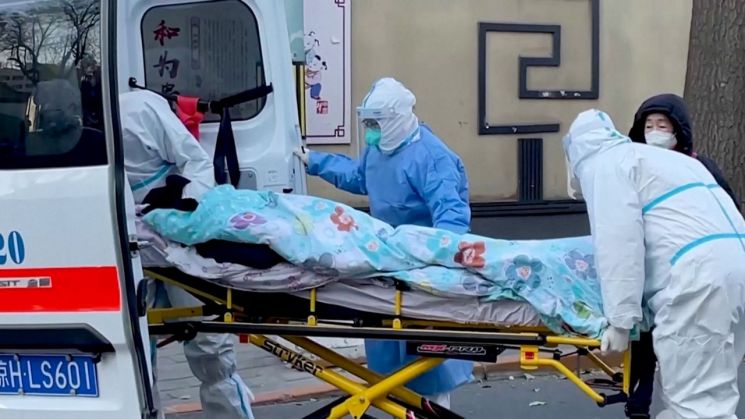
[Asia Economy Beijing=Special Correspondent Kim Hyunjung] As China accelerates its reopening process following the abolition of the 'Zero COVID' policy, the number of COVID-19 cases is surging rapidly. Amid panic buying of medicines causing shortages of antipyretics and self-diagnostic kits, the medical system is experiencing chaos, with COVID-positive medical staff being deployed on-site.
According to local media including the magazine Zhongguo Cishanjia (中?慈善家) on the 15th, many medical institutions in Beijing are requiring COVID-19 positive medical personnel to work due to severe staff shortages. Zhang Yi, chief physician at a designated COVID-19 hospital in Beijing, told the media, "Since the announcement of the 10 new epidemic prevention measures on the 7th, mass infections among medical staff have become inevitable, and at least half of the surrounding doctors have been infected." He added, "Doctors who have to treat numerous COVID-19 patients daily face higher infection risks and are caught in a vicious cycle of overwork and weakened immunity due to lack of rest." It is reported that the hospital notified doctors that "if they test positive but are asymptomatic or have tolerable symptoms, they may consider coming to work."
The actual situation on the ground is chaotic. According to the media, waiting times at some fever clinics in Beijing have exceeded six hours, and the situation is worsening as symptomatic patients, including the elderly, wait for long periods in subzero temperatures. On the 12th, Liang, spokesperson for the Beijing Municipal Health Commission, announced that as of the previous day, the total number of patients treated had increased 16-fold from the previous week to 22,000. From the 5th to the 11th of this month, cases of 'influenza-like illness' treated at secondary or higher-level hospitals reached 19,000, a 6.2-fold increase over the same period. The 24-hour call volume for the 120 emergency hotline surged to 31,000 on the 9th, six times the usual level.
On social media, a video showing patients receiving intravenous fluids inside vehicles due to lack of hospital beds in front of a clinic in Henan Province went viral. Also, a notice posted at a hospital pharmacy counter in Beijing stating, "All pharmacists are working despite illness. Please be understanding," quickly spread and was widely discussed.
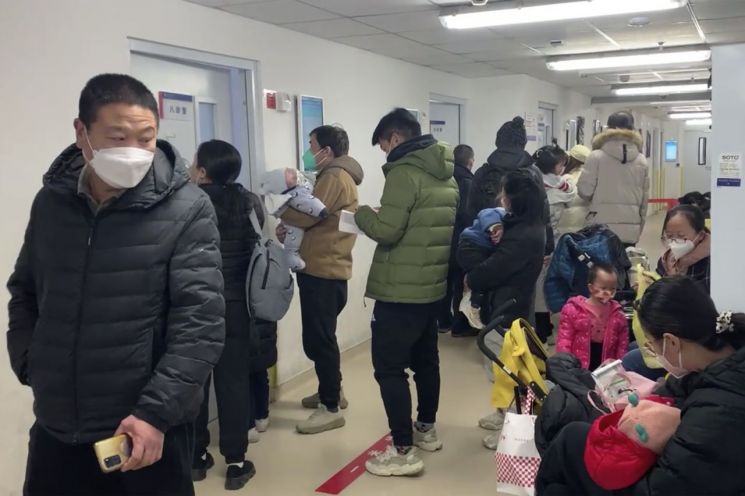
Antipyretics, cold medicines, self-diagnostic kits, and thermometers are rapidly running out due to soaring demand, causing shortages. At a briefing on epidemic prevention and control in Beijing on the 12th, authorities announced the relaxation of e-commerce sales standards for medicines and recommended the use of alternative drugs. The Korean Association in Beijing also began distributing five kits per person to support Korean residents. A pharmacy official told Zhongguo Cishanjia, "Seasonal demand for cold medicines is high, and COVID-19 has overlapped with this. Normally, pharmacies increase daily stock by 5 to 6 times in winter, but this year, supplies are severely insufficient, and some distributors may be hoarding medicines to sell at higher prices." It is known that some medicines are being prioritized for large hospitals treating severe patients.
The problem is that the current scale of COVID-19 outbreaks in China is not at its 'peak.' According to Baidu, using its 'Epidemic Search Index' and a mathematical model developed by economist Chen Qinyi, the peak of COVID-19 spread by gender is predicted to occur between late December and January in most cities. Although Beijing and Hebei were expected to peak on the 13th, two days ago, case numbers continue to rise, missing the forecast. In eastern and southern provinces such as Jiangxi, Zhejiang, Anxi, and Fujian, the peak is expected around the end of January.
Meanwhile, Chinese authorities are showing signs of focusing on economic normalization despite the rapid spread of COVID-19. According to Bloomberg News, the Central Economic Work Conference, attended by Chinese President Xi Jinping, top leadership, senior local government officials, and representatives of state-owned enterprises, is scheduled to be held on the 15th. Although there were reports that the meeting might be postponed due to the COVID-19 outbreak, it has recently been confirmed that it will proceed as planned. This two- to three-day closed-door meeting will decide the direction of China's economic policy for the coming year and discuss key economic indicators such as economic growth rate and inflation.
© The Asia Business Daily(www.asiae.co.kr). All rights reserved.
![Clutching a Stolen Dior Bag, Saying "I Hate Being Poor but Real"... The Grotesque Con of a "Human Knockoff" [Slate]](https://cwcontent.asiae.co.kr/asiaresize/183/2026021902243444107_1771435474.jpg)

















