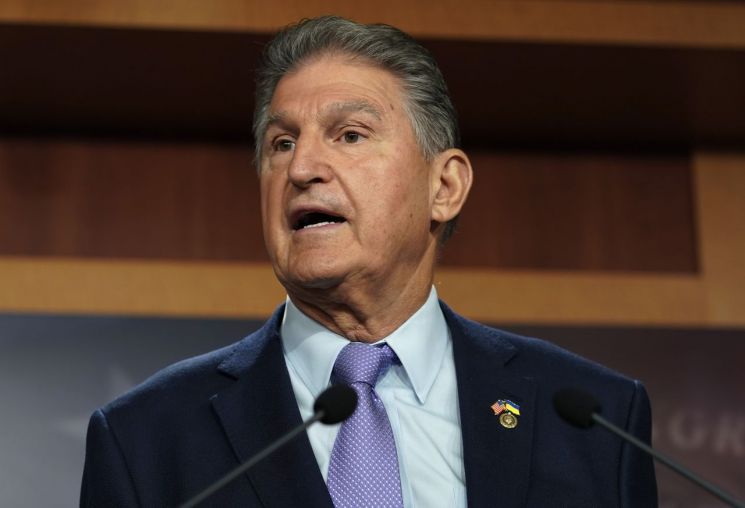
[Asia Economy Reporter Hyunwoo Lee] Senator Joe Manchin (Democrat, West Virginia), who played a decisive role in the enactment of the U.S. Inflation Reduction Act (IRA), has expressed opposition to the exclusion of Korean-made electric vehicles from subsidies under the IRA. His opposition, as the key figure leading the IRA legislation and effectively holding the casting vote in the U.S. Congress, raises concerns that resolving the IRA issue will face obstacles.
According to Bloomberg on the 13th (local time), Senator Manchin wrote in a letter to U.S. Treasury Secretary Janet Yellen, "Unfortunately, I have heard that some automakers and foreign governments have requested the Treasury Department to broadly interpret the regulations to allow subsidies for rental cars, leased vehicles, and shared vehicles (such as Uber), which make up a large portion of the U.S. auto market," adding, "This circumvents the strict regulations, and if allowed, companies will not increase investment in the North American region but will continue business as usual, exacerbating risks to the U.S. automotive industry."
Earlier this month, the Korean government and Hyundai Motor and Kia submitted a second government opinion letter to the U.S. administration, requesting that electric vehicles used as rental or leased vehicles be broadly recognized as commercial vehicles and be granted tax credit benefits. They also requested that when purchasing electric vehicles whose rental or lease period has ended, buyers receive tax benefits of up to $4,000 (approximately 5.18 million KRW), which apply to used cars.
According to the IRA, only electric vehicles finally assembled in North America (including Canada and Mexico) this year can receive subsidies in the form of tax credits of up to $7,500 per vehicle. In the future, additional conditions must be met, such as using a certain percentage or more of battery components and critical minerals produced in the U.S. and other countries. As a result, Korea and the European Union (EU), which are currently excluded from subsidy eligibility, have protested.
Senator Manchin, known as the "opposition within the ruling party" who holds the casting vote in the U.S. Congress, is the chairman of the Senate Energy and Natural Resources Committee. He has wielded his casting vote power by persistently opposing several policies promoted by the Biden administration, including the "Build Back Better (BBB) Act," which was President Joe Biden's top policy goal.
He ultimately played a decisive role in passing the IRA, which was a much-reduced version of the BBB. During this process, the subsidy provision in question was reportedly included in the bill reflecting Manchin's stance emphasizing domestic investment and job creation in the U.S.
© The Asia Business Daily(www.asiae.co.kr). All rights reserved.

![Clutching a Stolen Dior Bag, Saying "I Hate Being Poor but Real"... The Grotesque Con of a "Human Knockoff" [Slate]](https://cwcontent.asiae.co.kr/asiaresize/183/2026021902243444107_1771435474.jpg)















