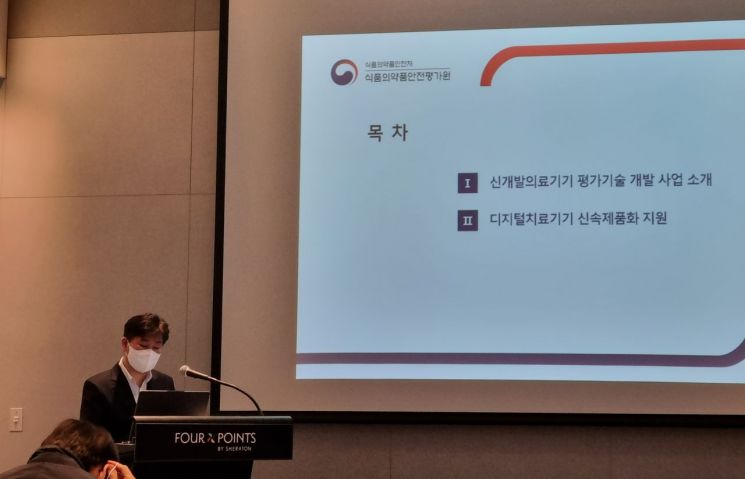
 Park Jong-ho, Researcher at the Advanced Medical Devices Division of the National Institute of Food and Drug Safety Evaluation, is presenting at the 'DTx Rapid Productization Support Achievements and Development Plan Forum' on the 14th.
[Asia Economy Reporter Kim Young-won] Guidelines containing the necessary information for the development and clinical trial preparation of digital therapeutics (DTx) devices for depression and panic disorder have been released.
On the 14th, the Ministry of Food and Drug Safety announced that it had published the "DTx Safety and Performance Evaluation and Clinical Trial Protocol Preparation Guide." This guide includes explanations of terms, disease status, domestic and international related standards and guidelines, safety and performance evaluation items, and considerations when preparing clinical trial protocols.
Previously, in August 2020, the Ministry published the "DTx Approval and Review Guide for Applicants," and last year released the "DTx Safety and Performance Evaluation and Clinical Trial Protocol Preparation Guidelines" for insomnia and alcohol and nicotine use disorders.
On the same day, the Ministry also held the "DTx Rapid Commercialization Support Achievements and Development Plan Forum" together with DTx researchers and related academic societies. At the forum, Park Jong-ho, a researcher at the Advanced Medical Device Division of the National Institute of Food and Drug Safety Evaluation, introduced, "Among the new medical device evaluation technology development projects, this year we promoted a project on DTx and plan to continue projects in the DTx field next year. From March to November, we conducted a project on DTx for improving panic disorder and depressive disorder, with a budget of 126 million KRW."
Researchers presenting at the forum elaborated on the clinical trial design of DTx for depressive disorder and panic disorder included in the guidelines. Professor Cho Cheol-hyun of Korea University Anam Hospital explained, "While depression shows various patterns, panic disorder presents quite clear and similar patterns, so it will be possible to accurately target and clearly measure the degree of improvement in clinical settings."
Regarding the DTx guidelines for improving depressive disorder, Professor Shin Jae-yong of Yonsei University’s Department of Preventive Medicine explained, "We confirmed whether the scale (BDI) used as the primary efficacy indicator is free for commercial use and added this information to the guidelines."
The Korean Society of Digital Therapeutics suggested improvements to the guidelines. Professor Jung Kyung-mi of Yonsei University’s Department of Psychology, who is the society’s education director, said, "Providing classification and definitions of DTx with specific items is an advantage, but the large number of guidelines causes confusion. It is necessary to review and organize them to ensure there are no conflicting parts."
Professor Jung also mentioned that as cognitive behavioral therapy becomes digitalized, considerations such as the number of treatment sessions and duration must be addressed. She added, "If an 8-session treatment period is recommended for DTx, evaluations should be conducted on how many hours are required and whether the essential manuals for cognitive behavioral therapy are included."
© The Asia Business Daily(www.asiae.co.kr). All rights reserved.

















