Government Finalizes 1st Basic Plan for Climate Change Response Technology Development
[Asia Economy Reporter Kim Bong-su] The government will launch an inter-ministerial organization in the first half of next year to review the development of climate change response technologies.
On the afternoon of the 14th, the government held a deliberation meeting of the National Science and Technology Advisory Council and finalized the "1st Basic Plan for Climate Change Response Technology Development."
The 1st Basic Plan for Climate Technology is the highest-level statutory plan related to climate change response technology development. It systematizes the research and development (R&D) policies and projects of relevant ministries over the next 10 years and presents the direction for implementation.
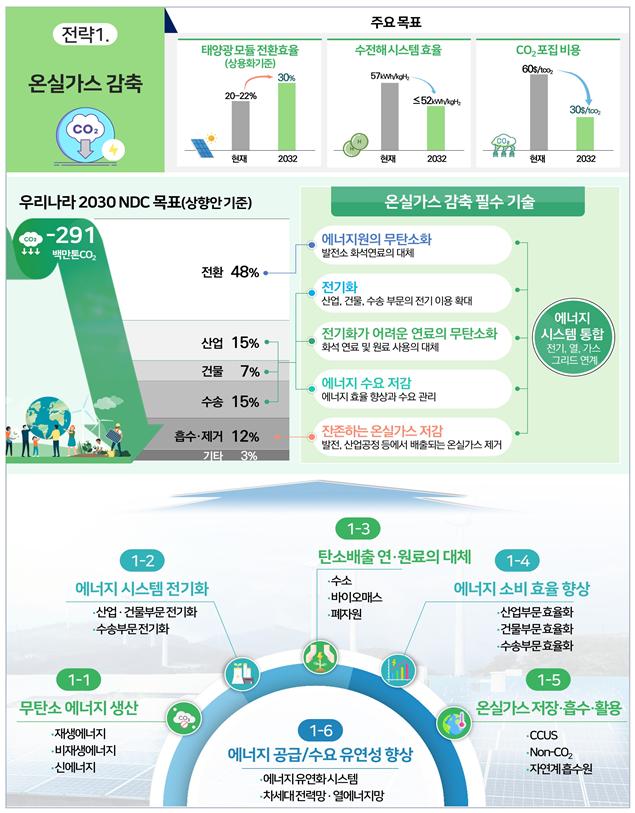
Specifically, under the vision of "Responding to the Climate Crisis and Securing New Markets through Scientific and Technological Innovation," it consists of three major strategies and 15 detailed strategies. First, to reduce greenhouse gases, essential reduction technologies were derived to effectively achieve the 2030 Nationally Determined Contribution (NDC) and sectoral reduction targets, and the goals and directions for technology development were presented. Regarding climate change adaptation, ministries have so far focused on R&D policies and projects for greenhouse gas reduction and carbon neutrality.
In addition, the content and scope of climate change adaptation technology development are systematized for the first time. To enhance adaptability in the era of climate change, R&D for reducing damage from climate disasters and strengthening resilience will be proactively pursued. Technology development will be promoted throughout the entire process, including climate change monitoring and prediction, impact and risk assessment, damage reduction and resilience enhancement, and adaptation effectiveness diagnosis, targeting △nature and ecosystems, △humans, and △assets and infrastructure affected by climate change.
The creation of an innovative ecosystem for climate change response will also be promoted. To establish a virtuous cycle structure among climate change response technologies, workforce, and related industries, the innovation ecosystem will focus on activating the climate industry, spreading tangible results to the public, workforce development, international cooperation, and governance establishment. In particular, since the climate technology sector can generate synergy effects through the participation and efforts of various stakeholders, various measures will be implemented to activate interaction and exchange among the government (central ministries-local governments), companies, the public, and overseas entities (international organizations, advanced countries, and developing countries).
A provisional inter-ministerial climate technology council will be launched and operated in the first half of 2023 to review the implementation of technology development by each ministry and local government. Based on the key technology development contents and next year's project plans secured through the implementation review system, an annual implementation plan for climate change response technology development will be established.
© The Asia Business Daily(www.asiae.co.kr). All rights reserved.
![Clutching a Stolen Dior Bag, Saying "I Hate Being Poor but Real"... The Grotesque Con of a "Human Knockoff" [Slate]](https://cwcontent.asiae.co.kr/asiaresize/183/2026021902243444107_1771435474.jpg)
















