BOJ May Conduct Comprehensive Evaluation of Monetary Policy
Review Results Expected in Second Half of Next Year
"If 3% Wage Increase Fails, Tightening Will Be Delayed"
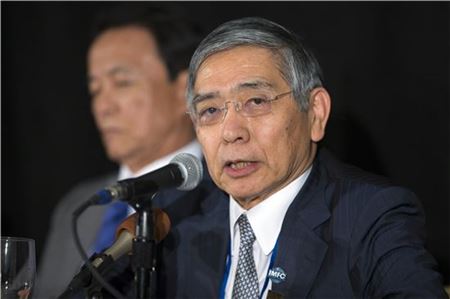 Haruhiko Kuroda, Governor of the Bank of Japan
 [Photo by AP]
[Asia Economy Reporter Lee Ji-eun] Will Japan's accommodative monetary policy direction change after 10 years?
Japanese economists predict that if the governor of the Bank of Japan (BOJ), the central bank, changes next year for the first time in 10 years, there will be a major reassessment of monetary policy. However, they do not expect this reassessment to trigger a shift in the direction of monetary policy.
On the 13th (local time), Bloomberg reported that a survey of 47 economists revealed such expectations. 68% of respondents forecast that the BOJ will comprehensively evaluate and review the results of its large-scale monetary easing policy pursued over the past 10 years sometime next year. Among them, 38% said the review results would be announced in the second half of next year.
However, experts believe it is unlikely that the BOJ will decide on additional measures to address inflation at monetary policy meetings in the near term. With Governor Kuroda's term ending in three months, it is highly likely that the current monetary policy stance will be maintained until the next governor takes office. Shigeto Nagai, director of the Japan Economic Research Institute, explained, "An evaluation of the BOJ's monetary policy is inevitable," but added, "Since wage growth momentum is not expected until 2024, it seems difficult for the BOJ to immediately review monetary policy right after the new governor's inauguration."
Regarding Japan's economic outlook for next year, the current sluggish wage growth trend is expected to continue. According to the Bloomberg survey, 81% of respondents said there is a very high possibility that negotiations between management and labor for a 3% base wage increase in next spring's wage talks will fail. Economists believe that to achieve the "stable 2% inflation rate" emphasized by Governor Kuroda, wages in Japan must grow by at least 3% next year.
Accordingly, there is analysis that even after the BOJ's monetary policy review, it will be difficult to shift toward a tightening stance. Kazuhiko Sano, chief investment strategist at Tokyo Securities, stated, "A global economic recession is expected next year," and added, "The BOJ's shift to a tightening monetary policy will be postponed until after 2025."
© The Asia Business Daily(www.asiae.co.kr). All rights reserved.
![Clutching a Stolen Dior Bag, Saying "I Hate Being Poor but Real"... The Grotesque Con of a "Human Knockoff" [Slate]](https://cwcontent.asiae.co.kr/asiaresize/183/2026021902243444107_1771435474.jpg)















