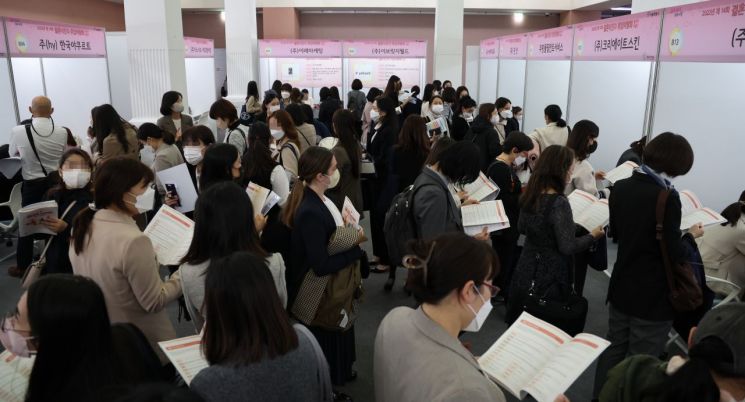
[Asia Economy Sejong=Reporter Son Seon-hee] Although the number of employed persons increased by more than 600,000 last month, the rate of increase has slowed for six consecutive months since May. Amid growing economic uncertainty in the second half of this year, this trend is gradually being reflected in employment indicators, which are considered representative lagging economic indicators.
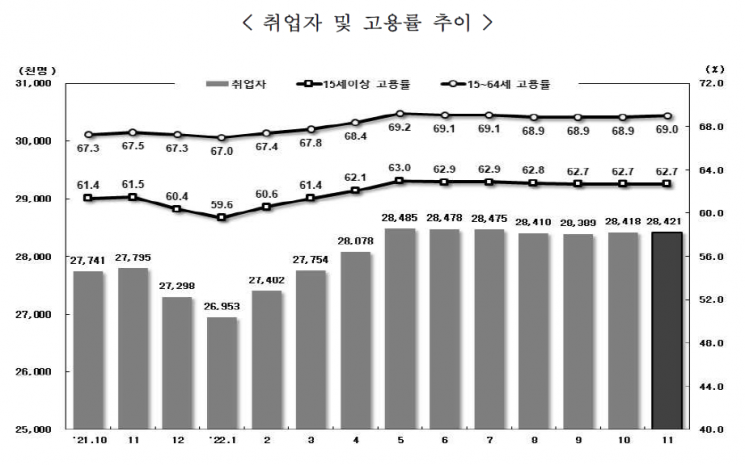
According to the 'November Employment Trends' released by Statistics Korea on the 14th, the total number of employed persons last month was 28,421,000, an increase of 626,000 compared to the same month last year. The absolute scale of the increase in employed persons is the largest for the same month since 1999 (an increase of 1,217,000), marking the biggest rise in 23 years. The employment rate for those aged 15 and over also rose by 1.2 percentage points from the same month last year to 62.7%, the highest for November since monthly statistics began in July 1982.
On the surface, last month's employment indicators appear favorable. The employment market, which deteriorated sharply during the COVID-19 pandemic, strongly rebounded since March last year, driven by base effects, and this trend continues.
However, looking at the trend, the recovery pace is gradually slowing compared to the 'employment boom' that lasted until early this year. The increase in the number of employed persons has slowed for six consecutive months since May, when it recorded 935,000. This is the first time in 14 years since the 2008 global financial crisis that the month-to-month increase in employed persons has shown a declining trend for six consecutive months.
Employment patterns varied significantly by age group. About three out of four (approximately 76%) of the increased employed persons last month were elderly aged 60 and over. The youth group (aged 15?29) actually decreased by 5,000, marking a decline for the first time in 21 months, indicating a challenging employment situation.
Gong Mi-sook, Director of the Social Statistics Bureau at Statistics Korea, explained, "The number of employed persons continues to increase, but the rate of increase has slowed, and both the number of unemployed and economically inactive population have decreased. By industry, manufacturing is declining, and the increase in employed persons in wholesale and retail trade and transportation and warehousing has also decreased."
Since employment indicators follow economic trends, this is analyzed as a delayed reflection of the economic slowdown that has continued since the second half of this year. The Ministry of Economy and Finance forecasted the future employment market, stating, "While the base effect is increasingly acting as a negative factor, downside risks such as high inflation, interest rate hikes, and export sluggishness persist. Next year, the slowdown in the increase of employed persons is expected to widen due to expanded economic uncertainty." They added, "We will closely monitor the impact of the economic slowdown on the employment market and focus policy efforts on supporting livelihoods and creating private-sector-led jobs."
© The Asia Business Daily(www.asiae.co.kr). All rights reserved.
![Clutching a Stolen Dior Bag, Saying "I Hate Being Poor but Real"... The Grotesque Con of a "Human Knockoff" [Slate]](https://cwcontent.asiae.co.kr/asiaresize/183/2026021902243444107_1771435474.jpg)












