[Asia Economy Sejong=Reporter Kim Hyewon] The government has set a goal to nurture 30 foodtech unicorns (large startups) by 2027 and increase foodtech export revenue to 2 billion dollars.
The Ministry of Agriculture, Food and Rural Affairs announced the "Foodtech Industry Development Plan" containing these details at the Emergency Economic Ministers' Meeting held at the Government Seoul Office on the 14th.
Foodtech is a compound word of Food and Technology, referring to a new industry that combines advanced technologies such as artificial intelligence (AI), Internet of Things (IoT), and biotechnology (BT) throughout food production, distribution, and consumption. Representative examples include plant-based alternative foods, food printing, online distribution platforms, unmanned ordering kiosks, and delivery, serving, and cooking robots. According to GS&J in 2020, the global foodtech market size is estimated at about 554.2 billion dollars (approximately 665 trillion won), and the domestic market is estimated at about 61 trillion won.
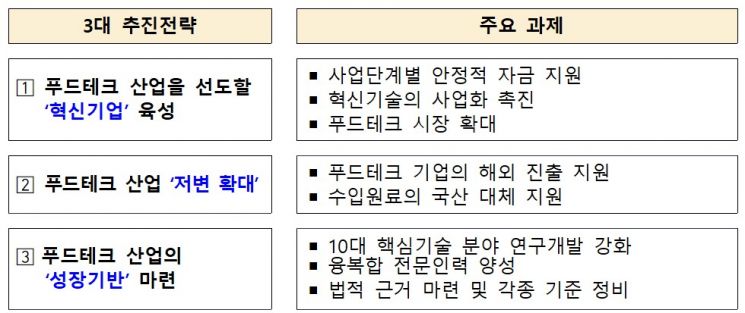
The Ministry plans to increase the number of foodtech unicorns from the current 2 (Kurly and Oasis) to 30 by 2027.
To this end, a dedicated foodtech fund worth 100 billion won will be established by 2027 to provide funding to each company according to their business stages. By June next year, a "Foodtech Investment Information Platform" will be built to provide investors with company information and support companies with business plan consulting and brokerage fees to attract angel investments and crowdfunding.
A "Foodtech Convergence Research Support Center" equipped with related facilities and equipment will be established to enable companies to develop materials and test products, and research and development of startups will be supported by utilizing the Bio Venture Campus.
The Ministry supports overseas market entry focusing on countries with large foodtech markets such as the United States and the European Union (EU). It provides companies with information on regulations such as food additives and labeling standards, certifications, and market trends of each country, and offers consulting on customs clearance, quarantine, and trademark labeling for each export country. Promotion of overseas online and offline distribution channels will be expanded, and consumer experience events will be activated.
To enable companies to replace imported raw materials with domestic ones, soybean production complexes will be expanded, and contract farming agreements between farms and foodtech companies will be supported. Information on major food raw materials such as soybeans, rice, and mushrooms will be accumulated in a database (DB) and provided to companies through a digital food information platform.
The Ministry aims to increase foodtech export revenue from 500 million dollars this year to 2 billion dollars by 2027 through these efforts.
Additionally, based on domestic and international technology trends and opinions from experts and companies, the Ministry will select "10 core technologies" to strengthen research and development (R&D). Candidates include cultured cell-based food production, smart manufacturing and distribution, food upcycling, eco-friendly packaging, and foodtech robots. The Ministry is also considering tax credit measures for companies' R&D expenses in the foodtech field.
Foodtech convergence talents combining AI and robot technology will also be nurtured. New educational programs for foodtech convergence talent development will be established at major universities, and the number of foodtech contract departments will be gradually expanded from the current 4 universities (Seoul National University, Korea University, Hanyang University, Kyung Hee University) to 12 universities by 2027. Furthermore, a "Special Act on Foodtech Industry Promotion" will be enacted to establish a legal basis for industry support, and related laws will be revised through consultations with relevant ministries to set labeling standards for plant-based alternative foods and allow robot sidewalk driving, among other institutional improvements.
© The Asia Business Daily(www.asiae.co.kr). All rights reserved.