Discussion on Introducing Additional Compensation Rights for Copyrights of National Assembly Video Content
Directors "Want to Reclaim Authors' Rights"
Media Industry Raises Concerns Over Double Copyright Payments and Violation of Contract Freedom Principles
Academia Also Points Out "Premature Legal Amendments"
[Asia Economy Reporter Cha Min-young] K-content delivered through online video services (OTT) has achieved great success in the global market, sparking heated debates among investors, directors, and platforms in the media industry over profit distribution issues. Directors want to reclaim their status as authors, but concerns have been raised about the risk of double payment of copyright fees and potential infringement of the principle of freedom of contract. The amendment’s stipulation that the media platform, which takes 30% rather than the production company that takes 70% of IPTV-based video sales, be the compensation subject has also been criticized as problematic.
On the 13th, the Media Platform Copyright Countermeasure Coalition and the Korea OTT Forum held a forum at the Broadcasting Hall in Mokdong, Seoul, to discuss the issues surrounding the introduction of additional copyright compensation rights for video content currently being promoted in the National Assembly. The controversy began with the success of the Netflix series Squid Game. After it was revealed that Squid Game, produced at a cost of 30 billion KRW last October, earned over 1 trillion KRW worldwide, calls grew louder for additional compensation to be paid to domestic production companies. Directors with over 10 million viewers such as Yoon Je-kyun, Park Chan-wook, and Kim Han-min also took the lead in this movement.
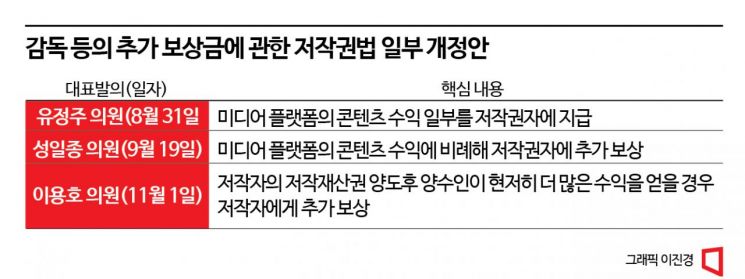
Legislative discussions have also begun in the National Assembly. Starting with Democratic Party lawmaker Yoo Jeong-ju of the Culture, Sports and Tourism Committee on August 31, and followed by People Power Party lawmakers Seong Il-jong and Lee Yong-ho, partial amendments to the Copyright Act were proposed to introduce additional compensation rights for film directors and others. Under current law, when an author transfers the copyright property rights of a work to a film production company without special agreements, it is presumed that all rights have been transferred. The proposed amendments argue that directors and writers should receive additional compensation.
The bills by Yoo Jeong-ju and Seong Il-jong specify the right to fair compensation for profits generated from video works by the final providers of video content. However, they designate the compensation subjects as OTTs, IPTV, broadcasters, and theaters. Lee Yong-ho’s bill includes provisions allowing authors to claim additional compensation from transferees when significant profit imbalances arise from the use of their works.
Media Industry Pushback: "Overseas, Profit Distribution Follows Production Company Earnings"
The media industry is pushing back against the claims of film directors. Kim Yong-hee, a professor at Dongguk University Graduate School of Film, agrees with the purpose of the amendment but points out controversy over whether the final provider of video content should be the subject of additional compensation. He explained, "Additional compensation rights in most countries such as France, Germany, and the United States follow contracts between creators and video producers (production companies), distributing profits according to the production company’s earnings."
According to the IPTV Association, when a viewer watches a video priced at 10,000 KRW, 70% of the revenue goes to the production and distribution companies, and the remaining 30% goes to the content video provider. Of the entire 70% pie earned, the production company takes the larger share of 40%, while the remaining 30% goes to the distributor. Therefore, the production company should be the subject of compensation.
Academia expresses concerns about rushed legislation. Lee Kyu-ho, a professor at Chung-Ang University Law School, pointed out, "Due to international private law issues (choice of law), the copyright amendment may have adverse effects that are more unfavorable to creators," adding, "It contains legal ambiguities that fail to properly reflect the unique characteristics of the domestic video production and distribution market." Professor Kwak Kyu-tae of Soonchunhyang University said, "For fair distribution, the contribution to creation and profit generation must be measurable," and warned, "If legislation proceeds without policy-based analysis, confusion will increase." Researcher Cheon Hye-seon of the Digital Industry Policy Institute also expressed concern, saying, "There is worry that the amendment is hastily preparing compensation measures without philosophical or economic discussion."
There were also opinions that the amendment’s unilateral compensation calculation method could undermine the principle of freedom of contract. KBS team leader Koo Chang-hoon pointed out, "Costs are paid through negotiations between parties under the Copyright Act, but the enforcement decree mandates compliance as stipulated, which has a high risk of being unconstitutional," adding, "The production company made a huge profit from ‘Extraordinary Attorney Woo,’ but now the platform operator is being told to pay money."
Government ministries have differing views. The Ministry of Culture, Sports and Tourism believes the current special provisions for video works could be undermined. The Ministry of Science and ICT is concerned about investment shrinkage due to the burden of compensation costs. The Ministry of Justice pointed out issues such as the lack of clarity in the relationship between contracts between video producers and final video content providers and compensation rights, and emphasized that exceptions to the principle of freedom of contract should be narrowly recognized.
© The Asia Business Daily(www.asiae.co.kr). All rights reserved.
![Clutching a Stolen Dior Bag, Saying "I Hate Being Poor but Real"... The Grotesque Con of a "Human Knockoff" [Slate]](https://cwcontent.asiae.co.kr/asiaresize/183/2026021902243444107_1771435474.jpg)
















