Kakao Brain Applies Massive AI Technology to Healthcare
Develops AI for Chest X-ray Interpretation and Antibody Drug Discovery
[Asia Economy Reporter Yuri Choi] Kakao Brain, which introduced the AI painter 'Karlo,' is now challenging the medical field. Following the launch of an AI that reads X-rays and drafts diagnostic reports next year, it is also venturing into new drug development. The plan is to actively enter the healthcare sector by leveraging ultra-large AI technology.
AI drafts preliminary chest X-ray reports to collaborate with doctors... Target release next year
According to the IT industry on the 13th, Kakao Brain is developing an AI model called 'AI CAD' that creates draft diagnostic reports from chest X-ray images. The goal is to release a research-use service in the first half of next year and apply it to actual medical diagnosis. In general imaging diagnostics such as X-rays and magnetic resonance imaging (MRI), initial data is generated through the examination and processed to create interpretable images. Radiologists then review these images and write diagnostic reports regarding the location and size of lesions. These reports serve as the basis for doctors' opinions and diagnoses of patients.
Kakao Brain is applying the AI model to chest X-rays, which are the most commonly taken but difficult to interpret. The AI analyzes the X-rays to assist doctors in creating diagnostic reports. Internal tests show that using AI approximately doubles the efficiency of doctors' image interpretation.
The development of AI CAD utilizes Kakao Brain's ultra-large AI technologies such as KoGPT, Koyo, and Karlo. KoGPT is a Korean language-trained version of GPT-3, which has world-class natural language processing capabilities; Koyo is a dataset consisting of 740 million image-text pairs; and Karlo is a technology that generates images from input prompts. Based on these, ultra-large AI is trained with medical data.
Kakao Brain has also collaborated closely with the medical community. It has signed joint research agreements with nine university hospitals, including Ajou University Hospital and Ewha Medical Center, to receive medical advice. They are working together to reduce the parts of the AI model that require doctors' manual data refinement and to naturally accumulate data during existing workflows.
Challenging new drug development... Increasing success rate from less than 10% to three times higher
Kakao Brain is also entering new drug development. They are creating a new drug development platform by training ultra-large AI with chemical molecules, genetic data, and physical and chemical theories. Developing new drugs requires finding combinations of compounds effective against specific diseases, which involves numerous experiments and enormous costs. Even after investing trillions of won over more than ten years, the success rate is less than 10%. This is why it is likened to finding a needle in a haystack. Kakao Brain aims to shorten the development period of antibody drugs, which are immune substances, by utilizing AI.
Kakao Brain is conducting joint research with the AI drug development company 'Galaxy.' Following a 5 billion won investment in Galaxy last year, they signed a joint research agreement in July this year. If promising candidate substances are discovered, they plan to conduct clinical trials for new drugs together.
Kim Il-doo, CEO of Kakao Brain, stated at the Kakao Developer Conference 'If Kakao' on the 9th, "If existing imaging diagnostic AI was an auxiliary device for autonomous driving, our model aims to enable full autonomous driving," adding, "In the case of the new drug development process, we will increase the success rate by more than three times compared to before."
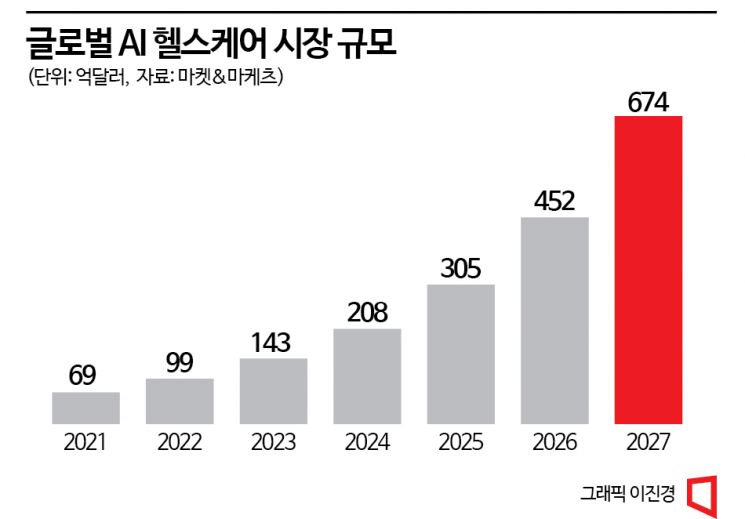
AI healthcare, which Kakao has entered, is a field where global big tech companies are fiercely competing. Alphabet, Google's parent company, established Isomorphic Labs in 2019 and is researching new drug development methods using DeepMind AI technology called 'AlphaFold.' Google has also established a research institute with global pharmaceutical company Sanofi to develop diabetes treatments. Microsoft (MS) is researching gene therapies and other treatments in collaboration with pharmaceutical company Novartis.
© The Asia Business Daily(www.asiae.co.kr). All rights reserved.

















