Growth to 20 Trillion Won in 5 Years
Increase Rate of Parts and Materials Purchases
China at 6.2%, Twice That of Korea
Mobile OLED Supply Chain Competitiveness
Impact on Finished Products Like TVs
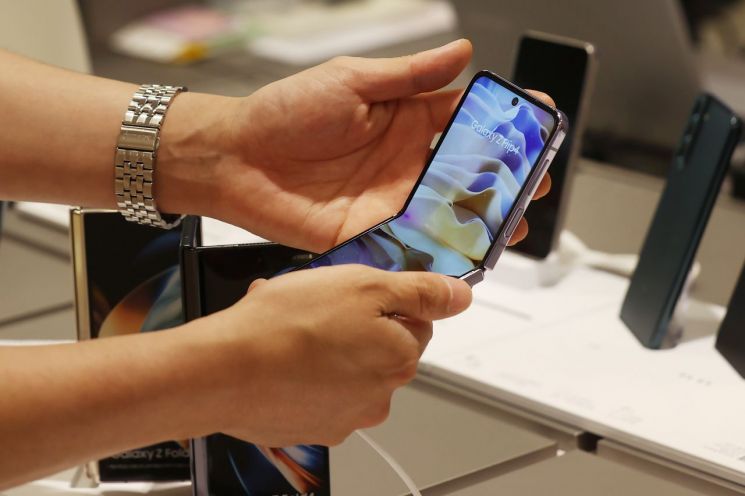
[Asia Economy Reporter Moon Chaeseok] The market for flexible mobile OLED (organic light-emitting diode) components and materials used in foldable phones such as the Galaxy Z Flip4 and Folder4 is expected to grow to around 20 trillion KRW in five years. However, concerns are rising as China's component and material purchase growth rate is expected to be about twice that of Korea. Narrowly speaking, mobile OLED accounts for about 90% of this market, and broadly, it is considered a 'base market' in the OLED industry transitioning from TV → mobile → tablet & laptop, making it an opportunity that should not be missed, according to industry consensus.
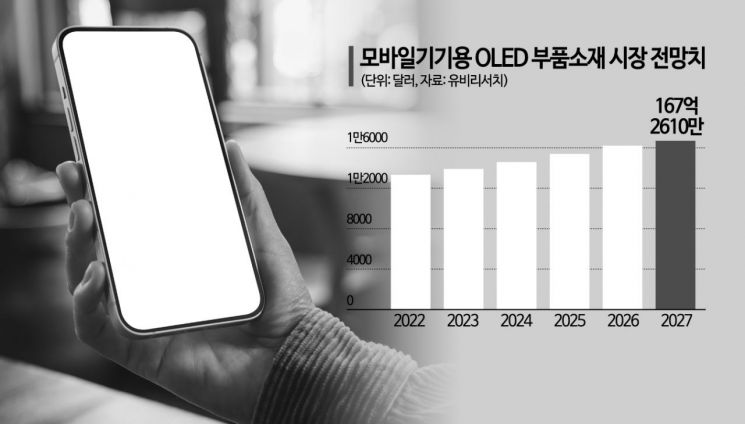
According to a survey by market research firm UBI Research on the 13th, the total mobile device OLED components and materials market is projected to grow to $13.91 billion (approximately 17.284 trillion KRW) next year and $16.73 billion (21.928 trillion KRW) by 2027, with an average annual growth rate forecast of 4.6%. From 2025, the flexible OLED market, including foldable OLEDs, is expected to account for about 90% of the total mobile OLED market. The market size is expected to grow from $12.02 billion (approximately 15.75 trillion KRW) next year to $15.66 billion (approximately 20.516 trillion KRW) in 2027, with an annual growth rate forecast of 7%.
Notably, the average annual growth rate of purchases for high-value-added flexible OLED components and materials in mobile OLED is significantly lagging behind China. China's growth rate is 6.2%, while Korea's is 3.2%, showing about a twofold difference. Korea is expected to grow from $7.5 billion (approximately 9.824 trillion KRW) next year to $8.79 billion (approximately 11.514 trillion KRW) in 2027, while China is projected to reach $7.94 billion (approximately 10.401 trillion KRW) in 2027, indicating that Korea cannot be complacent in terms of both growth rate and market size.
The materials for flexible OLED refer to liquids such as polyimide (PI), rather than the hard glass substrates mainly used in conventional 'rigid OLEDs.' The thin-film encapsulation (TFE), which protects the OLED elements, is also an ultra-fine material that is tens of times thinner than the hard glass encapsulation, making it highly important. Although PI and TFE are more expensive than traditional glass substrates and glass encapsulation, their flexible properties make them primarily used in premium (flagship) smartphones like foldable phones. As the proportion of flexible OLEDs for flagship phones is expected to increase compared to rigid OLEDs for mid-to-low-end smartphones in the mobile OLED market, the growth rate of material purchases in this sector can be interpreted as an indicator of 'supply chain dominance.'
According to the industry, mobile OLED is the battleground situated between the tablet and laptop OLED market, which is expected to grow significantly after 2024, and the existing TV OLED market. This is a point even LG, which holds technological leadership in TV OLEDs, acknowledges. During LG Display's Q3 earnings conference call on October 26, it stated, "While OLED penetration in mobile reaches 40%, it is only 5% in TVs," and added, "We expect IT OLED to be similar to mobile devices and will focus on this area."
If China gains competitiveness in the mobile OLED supply chain, it could negatively impact set manufacturers (such as TV makers) as well. Considering that set and component companies are struggling due to global consumer market contraction, price declines, and inventory increases, there is a growing call for drastic measures in the flexible mobile OLED sector. In this regard, the government designated four display industry technologies, including OLED, as part of the 15 'National Advanced Strategic Technology Fields' on the 4th of last month. However, no groundbreaking talent development plans like tax incentives under the Restriction of Special Taxation Act, inducement of facility investment, or semiconductor-style 'training of 150,000 personnel over 10 years' have been introduced.
© The Asia Business Daily(www.asiae.co.kr). All rights reserved.
![Clutching a Stolen Dior Bag, Saying "I Hate Being Poor but Real"... The Grotesque Con of a "Human Knockoff" [Slate]](https://cwcontent.asiae.co.kr/asiaresize/183/2026021902243444107_1771435474.jpg)

















