Additional Targets: 8 Individuals and 4 Organizations
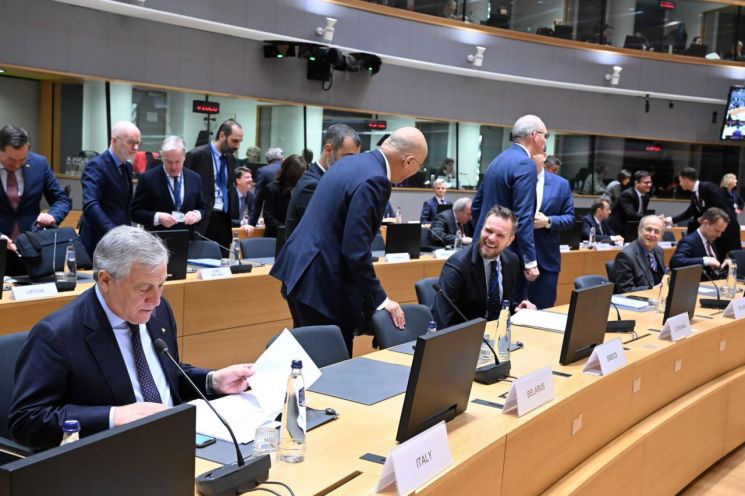
[Asia Economy Reporter Yujin Cho] The European Union (EU) has added North Korean individuals and entities involved in ballistic missile development to its list of independent sanctions targets. This is the EU's second independent sanction against North Korea this year, approximately eight months after the last one in April.
According to the EU Official Journal on the 12th (local time), the EU Foreign Affairs Council added eight North Korean nationals and four entities (including two vessels) to its independent sanctions list for directly engaging in or financing ballistic missile or weapons of mass destruction (WMD) development, in violation of United Nations Security Council (UNSC) resolutions.
The eight sanctioned individuals include Kim Su-il from the Military Industry Department under the Workers' Party, Park Kwang-hoon and Kim Ho-gyu from the Yonbong Trading Corporation under the Workers' Party, Kim Kwang-yeon and Gil Jong-hoon from the Korean Mining Development Trading Corporation (KOMID), North Korea's weapons export company, and Jeong Young-nam, Pyon Kwang-chol, and Oh Young-ho from the Second Academy of Natural Sciences (currently the National Defense Science Academy), North Korea's weapons development institution.
The Rocket Industry Department, which oversees North Korea's military industry and is suspected of involvement in sanction evasion and support for illegal weapons development, along with its subordinate Ro-eun-san Trading Company, and the vessels Unika and New Konk, were also added to the sanctions list.
The two vessels are suspected of transferring refined petroleum products to North Korea through illicit ship-to-ship transfers while operating in North Korean and Chinese waters. The EU Official Journal specified that Unika participated in supplying materials that could contribute to ballistic missile or WMD-related programs.
The EU also stated that Kim Kwang-yeon was directly involved in North Korea's nuclear, missile, and other WMD development programs by providing funding and support.
Regarding Kim Su-il, the EU pointed out that since 2016, he has acted as a military industry department officer stationed in Vietnam, involved in exporting North Korean products such as anthracite coal and titanium concentrate, and has been responsible for foreign currency earnings related to North Korea's nuclear and ballistic missile programs through the export and import of raw materials and the export of Vietnamese goods to China.
Oh Young-ho is described as having a direct connection with the Second Academy of Natural Sciences, known to lead North Korea's missile development, while operating in Moscow, Russia.
Earlier, the United States also included Oh Young-ho on its sanctions list earlier this year, stating that he cooperated with Russian companies and others to procure various products applicable to ballistic missiles.
Following the EU's independent sanctions against North Korea in April, this is the second round of sanctions this year. This additional sanction is interpreted as part of the U.S.'s sanction measures in response to North Korea's unprecedented military provocations this year.
Most of the newly added targets are already included in the independent sanctions lists of the United States and South Korea.
The EU pointed out, "North Korea launched at least 63 ballistic missiles between January 5 and November 18 this year, including multiple intercontinental ballistic missiles (ICBMs)."
It condemned "the sharp increase in North Korea's illegal missile launches and the continuous undermining of the global non-proliferation regime," and urged "North Korea to comply with its obligations under international law and to resume dialogue with relevant parties."
With the publication in the Official Journal, the sanctions take immediate effect in all 27 member states, freezing assets and imposing entry bans on the listed individuals within the EU's 27 member countries.
As a result, the number of individuals on the EU's independent North Korea sanctions list has risen to 73, and the number of entities to 17. Under the UN Security Council's North Korea sanctions resolutions, the EU has designated a total of 80 individuals and 75 entities as sanction targets.
The Economist Intelligence Unit (EIU), an information analysis agency under the British economic weekly The Economist, predicted that "North Korea will resume nuclear weapons testing next year after the conclusion of the Chinese Communist Party National Congress in October, which will trigger new international sanctions."
It also forecasted, "The Ukraine war and the resulting freeze in relations between Russia and the West have emboldened North Korean leadership. The relationship between Russia and North Korea has grown closer through the Ukraine war, which will help North Korea evade international sanctions and promote weapons development with Russia's assistance."
© The Asia Business Daily(www.asiae.co.kr). All rights reserved.

















