'2022 Convergence Physician-Scientist Training Project Performance Exchange'
Highlighting the Importance of Physician-Scientists Amid the COVID-19 Pandemic
Combining Medical Knowledge, Clinical Experience, and Basic Science & R&D Skills
Hospitals Prefer Clinicians...
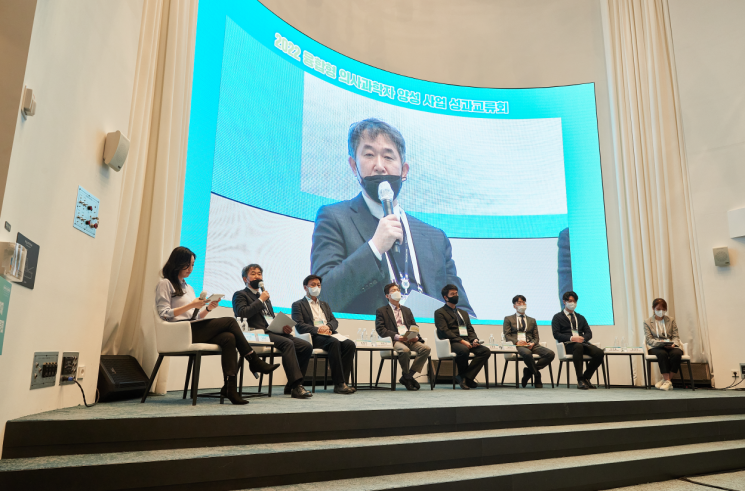 On the 9th, participants are having a panel discussion on the theme of "Training Physician-Scientists and Improving the Research Ecosystem" at the '2022 Convergent Physician-Scientist Training Project Performance Exchange Meeting' held at Seoul Dragon City.
"When I earn my degree and become a physician-scientist, will I be guaranteed career paths or research activities other than becoming a professor?" (Physician-scientist in doctoral program)
"Many physician-scientists want to combine clinical duties with research, but from the hospital's perspective, it is difficult to hire doctors whose clinical participation rate is significantly low. Long-term and comprehensive measures for training physician-scientists, including economic treatment issues, are needed to support continuous research." (Jong-Il Kim, Professor at Seoul National University College of Medicine)
At the '2022 Convergent Physician-Scientist Training Project Performance Exchange Meeting' held on the 9th by the Ministry of Health and Welfare and the Korea Health Industry Development Institute, senior physician-scientists sought solutions together for the practical difficulties and concerns faced by young researchers who have just embarked on the path of physician-scientists, urging active interest and support from the government and institutions.
A Full-Cycle Training Project Needed to Overcome an Uncertain Future
A physician-scientist (MD PhD) refers to a doctor who, after completing medical education, conducts research in basic science, engineering, etc., based on clinical experience, and contributes to healthcare industries such as disease treatment, new drug, and medical device development by utilizing the results. Recently, during the COVID-19 pandemic, physician-scientists led vaccine and therapeutic development, making the training of physician-scientists a more important national task than ever. Although many talents in Korea show interest in the role of physician-scientists, the environment where they can readily choose this career path has not yet been established.
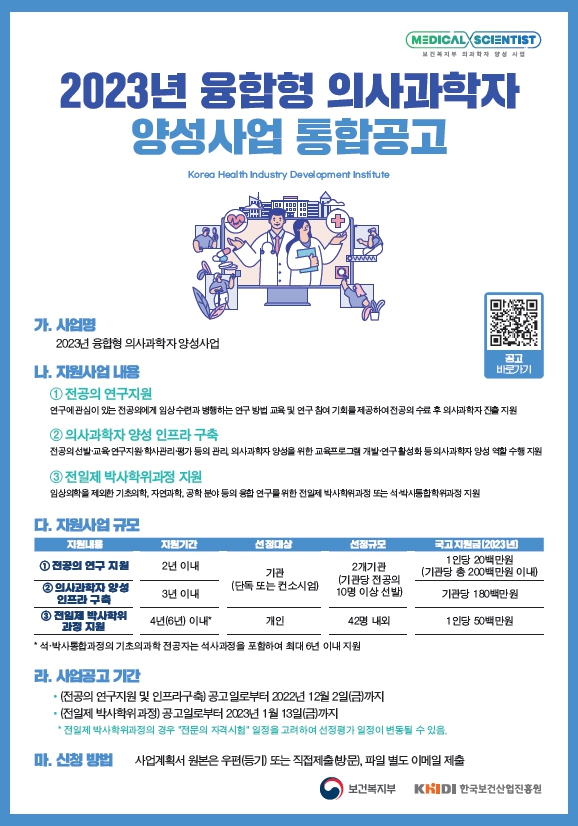
Our government has been promoting the 'Convergent Physician-Scientist Training Project' since 2019 to lead changes in medical schools, which have focused on training clinicians, and to build an ecosystem capable of producing excellent physician-scientists. Over four years, 20 out of 40 medical schools nationwide, along with two institutes of science and technology, participated in the project through 'resident research support' or 'full-time doctoral programs.' About 200 resident researchers and over 100 doctoral students have conducted medical research converged with basic medicine and engineering. From this year, support has expanded to nurture early-career physician-scientists through the 'K-Medi Convergent Talent Training Project.'
Participants at the event argued that a system should be established to stably train physician-scientists by supporting not only tuition but also research and living expenses for prospective physician-scientists, while simultaneously creating incentives to prevent physician-scientists from changing their career paths to clinical practice or other fields.
Professor Jong-Il Kim of Seoul National University College of Medicine emphasized, "Like in the U.S., we need individual research projects that provide salaries including the four major insurances from the junior faculty stage so that hospitals will not hesitate to hire them," adding, "Institutions (hospitals) responsible for the physician-scientist training project should prepare comprehensive measures that cover all stages from undergraduate research programs to resident recruitment."
Professor Min-Koo Lee of Yonsei University College of Medicine (representative of the Physician-Scientist Training Project Steering Committee) said, "The industry also needs many physician-scientists, but only about 10% of the physician-scientists produced domestically have entered bio-ventures or the pharmaceutical industry," adding, "It is necessary to connect them well and involve them early in joint research and other activities." He further stated, "Above all, physician-scientists who are balancing clinical practice and research to make significant contributions to medical advancement should be economically supported so they can focus on research."
Industry Matching and Bio-Cluster Formation Also Needed
There was also an opinion that medical students should be able to broaden their horizons and develop interest in the path of physician-scientists through various experiences and overseas training from the medical education stage.
Jae-Won Kim, a doctoral student at Gwangju Institute of Science and Technology (GIST), said, "When I visited the U.S. in 2017 through the Future Physician-Scientist Career Program, I saw that the research fields being conducted at Stanford University were recently gaining attention, realizing that they were already conducting advanced research," adding, "If residents or even earlier, during preclinical or basic medical courses, could experience such overseas institutions, they could naturally dream of becoming physician-scientists and later find research topics that lead the world."
Additionally, voices called for policy and institutional support such as widely promoting how physician-scientists contribute to our society, ensuring proper status and roles within hospitals, creating research synergy and startup ecosystems through academic medical networks like the Boston bio-cluster in the U.S., and expanding the number of research-focused residents.
Myunghwan Kim, Director of Future Policy Support at the Korea Health Industry Development Institute, said, "Physician-scientists have been produced not only because of financial support from the government and universities but also due to individual researchers' passion and curiosity for research and their willingness to pioneer the blue ocean in the biomedical field," adding, "We will spare no effort and support to actively promote physician-scientist training and the establishment of a research ecosystem."
Seong-Ho Eun, Advanced Medical Support Officer at the Ministry of Health and Welfare, promised, "We will strengthen the physician-scientist training support system that can proactively respond to future healthcare industry demands and further activate the inter-ministerial council for physician-scientist training launched last year to create first and second tracks for next-generation biomedical convergent research."
© The Asia Business Daily(www.asiae.co.kr). All rights reserved.
![Clutching a Stolen Dior Bag, Saying "I Hate Being Poor but Real"... The Grotesque Con of a "Human Knockoff" [Slate]](https://cwcontent.asiae.co.kr/asiaresize/183/2026021902243444107_1771435474.jpg)












