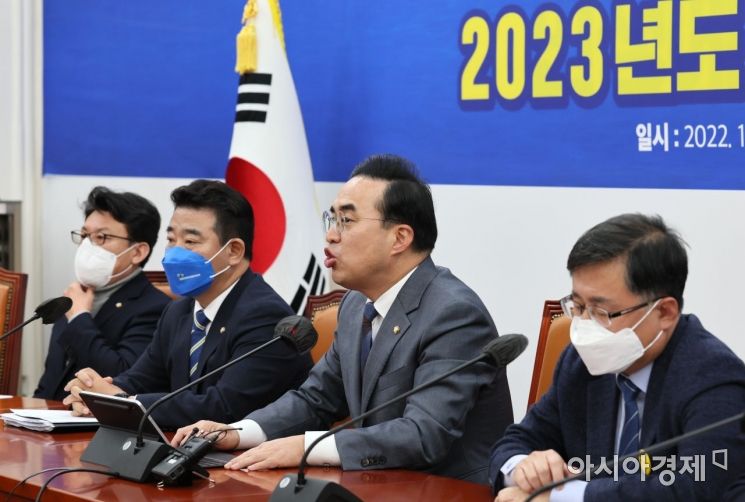
 Park Hong-geun, floor leader of the Democratic Party of Korea, holds a '2023 Budget Proposal Press Conference' at the National Assembly on the 8th. Photo by Yoon Dong-joo doso7@
[Asia Economy reporters Lee Ji-eun and Park Joon-yi] As the ruling and opposition parties continued their standoff over next year's budget bill and the motion to dismiss Minister of the Interior and Safety Lee Sang-min until the last day of the regular National Assembly session on the 9th, it has become virtually impossible to pass the budget bill by that day. This is the first time since the enactment of the National Assembly Advancement Act (2014) that the budget bill has not been passed within the regular session.
Oh Young-hwan, the floor spokesperson for the Democratic Party of Korea, said in front of the Speaker's office on the afternoon of the 9th, "Regarding the 2023 budget bill, considering the physical time required, it has become virtually difficult to prepare a revised bill through additional negotiations between the ruling and opposition parties and pass it today," adding, "The only way for the budget bill to pass within the regular session is to process either the government proposal or a (Democratic Party's sole) revised bill."
The "physical time" mentioned by Spokesperson Oh refers to the government's sheet work (adjustment of figures). It usually takes about 10 hours, so even if the ruling and opposition parties reach a dramatic compromise late in the afternoon, considering this time, it is impossible to process the bill within the 9th. Accordingly, next year's budget bill has not only missed the legal deadline but also faces difficulty being passed within the regular session. This is the first time since the National Assembly Advancement Act that the budget bill has not been passed within the regular session.
While the Democratic Party intends to submit a sole revised bill, Speaker Kim Jin-pyo stated, "I cannot accept a revised bill. Submit it to the legislative affairs office according to the National Assembly Act procedures," showing that he will not accept it unless it is a bipartisan agreement.
The failure of the ruling and opposition parties to reach an agreement until the last moment stems from their inability to narrow differences over one of the key points of the Yoon Seok-yeol administration's tax reform plan, the "corporate tax cut." The floor leaders and policy chiefs of both parties held negotiations with Deputy Prime Minister and Minister of Economy and Finance Choo Kyung-ho in the morning, but ultimately failed to reach an agreement. During the negotiations, voices were raised.
After the talks, Floor Leader Joo said, "We tried to reach a final agreement on the corporate tax cut, but despite Speaker Kim's mediation proposal (to reduce corporate tax but apply a two-year grace period), the Democratic Party firmly opposes lowering the top corporate tax rate," adding, "If this issue is not resolved, passing the budget will be very difficult." Consequently, the plenary session scheduled for 2 p.m. that day was postponed.
Deputy Prime Minister Choo, who participated in the ruling-opposition-government talks that day, said, "The government did its best by proposing a compromise that it could concede, but the opposition party's stance is firm," adding, "Now it is the National Assembly's time." Deputy Prime Minister Choo is scheduled to hold a press briefing at the Seoul Government Complex in the afternoon to express his position on next year's budget bill.
© The Asia Business Daily(www.asiae.co.kr). All rights reserved.
![Clutching a Stolen Dior Bag, Saying "I Hate Being Poor but Real"... The Grotesque Con of a "Human Knockoff" [Slate]](https://cwcontent.asiae.co.kr/asiaresize/183/2026021902243444107_1771435474.jpg)
















