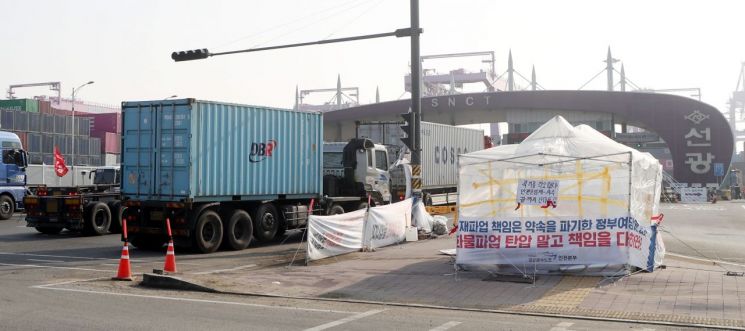
[Asia Economy Reporter Kim Min-young] The Cargo Solidarity Headquarters of the Korean Public Service and Transport Workers' Union (KPTU) is returning to the field after 16 days of strike. This decision appears to have been made as the number of truck owners returning to work increased following two government orders to resume work, and as the Democratic Party of Korea suddenly accepted the three-year extension plan for the Safe Freight Rate System, leading most union members to see the strike momentum weaken. Additionally, there was a judgment that if the strike continued, the Safe Freight Rate System would inevitably expire.
◆ 62% of all union members in favor... Strike withdrawn after 16 days = The Cargo Solidarity announced, "The vote among union members on the termination of the general strike held on the 9th passed with a majority in favor of ending the strike and returning to work."
The Cargo Solidarity Headquarters held an emergency central executive committee meeting on the previous day (the 8th) and decided to put the continuation of the strike to a union-wide vote. Accordingly, from 9:00 a.m. to 11:10 a.m. that day, a vote on whether to withdraw the general strike was conducted among all union members at 16 regional headquarters. Out of 26,144 union members, 3,574 (13.67%) voted, with 2,211 (61.82%) supporting the end of the strike and 1,343 (37.55%) opposing it.
In a statement that day, the Cargo Solidarity said, "The Cargo Solidarity Headquarters decided to return to work through the union-wide vote on the 9th. This is a resolution to protect the Safe Freight Rate System, which is at risk of expiration, and simultaneously signifies the beginning of the second act of the struggle for the proper continuation and expansion of the Safe Freight Rate System."
The Cargo Solidarity began a general strike on the 24th of last month, demanding the permanent establishment of the Safe Freight Rate System and the expansion of applicable items. As logistics disruptions accumulated due to the prolonged strike, the government issued a first work commencement order on the 29th of last month targeting cement transporters and delivered orders to those subject to return after on-site investigations. Although some truck owners returned to work, the Cargo Solidarity continued to hold out without ending the strike. Instead, they repeatedly criticized the government's work commencement orders as unconstitutional oppression and vowed to hold the government accountable through the International Labour Organization (ILO).
As a result of the work commencement order in the cement sector, cement transport volume showed signs of recovery, but due to transport disruptions related to petroleum, out-of-stock gas stations expanded nationwide, and damages in the steel and petrochemical sectors reached 2.6 trillion won due to prolonged transport refusal. Consequently, on the 8th, the government issued additional work commencement orders targeting the petrochemical and steel sectors.
During this process, the number of truck owners returning to work increased, and with signs of recovery in nationwide port container storage rates and cement transport volumes, the strike momentum of the Cargo Solidarity also weakened. Public opinion worsened as it became known that the KPTU obstructed truck owners who resumed transport after receiving orders from the government by throwing steel balls and threatening with banners.
Minister of Land, Infrastructure and Transport Won Hee-ryong expressed anger after releasing a video showing an unidentified person shooting steel balls at trucks refusing to strike, saying, "It's truly cruel. Shooting steel balls at colleagues. Does the Cargo Solidarity not care about the lives of their colleagues as long as they protect their own livelihoods?"
Until the day before, the Cargo Solidarity had consistently taken a hardline stance against the government's additional work commencement orders, but suddenly changed its position, judging that if the strike continued, the Safe Freight Rate System would inevitably expire.
Lee Bong-ju, Chairman of the Cargo Solidarity, said about the union-wide vote the previous day, "The Cargo Solidarity made a magnanimous decision to prevent the expiration of the system," and emphasized, "The government and ruling party should also keep their promise to extend the Safe Freight Rate System for three years, which was announced through government-party consultations."
Furthermore, the Democratic Party of Korea's decision to accept the government's plan to extend the Safe Freight Rate System for three years without expanding applicable items reportedly caused internal unrest. A Cargo Solidarity official said, "There was no agreement with the Democratic Party, but independently of this, the Democratic Party accepted the government and ruling party's plan, causing union members to waver and prompting the leadership to make a decision."
◆ The key issue is whether the Safe Freight Rate System will be extended for three years = Although the strong confrontation between labor and government ended with the Cargo Solidarity's withdrawal of the strike, conflicts surrounding the Safe Freight Rate System have not yet been resolved. The Cargo Solidarity urged the government to keep the promise of a three-year extension of the Safe Freight Rate System in exchange for ending the strike. However, the Ministry of Land, Infrastructure and Transport stated that "the three-year extension of the Safe Freight Rate System needs to be reconsidered."
Regarding the Cargo Solidarity's vote to decide whether to withdraw the collective transport refusal, the Ministry said, "It is regrettable that serious damage to the national economy and public inconvenience lasted for 16 days, and only after two work commencement orders were issued was the return to work discussed belatedly."
The Ministry added, "The 'three-year extension of the Safe Freight Rate System' claimed by the Cargo Solidarity was proposed by the government and ruling party on November 22 to prevent national damage caused by the collective transport refusal. Since the Cargo Solidarity rejected this and started the collective transport refusal on November 24, causing enormous national damage, reconsideration is necessary." This aligns with Minister Won Hee-ryong's Facebook statement that the three-year extension of the Safe Freight Rate System is invalid due to the Cargo Solidarity's collective transport refusal.
The Ministry also made it clear that expansion of applicable items under the Safe Freight Rate System is unacceptable. It stated, "The Cargo Solidarity demands discussions on expanding applicable items, but the government and ruling party's consistent position is that item expansion is not possible."
Meanwhile, on the 10th at 2 p.m., the Cargo Solidarity plans to hold a rally in front of the Korea Development Bank in Yeouido, Seoul, where public, transport, and social service workers will gather to urge proper amendments to the Freight Transport Business Act.
The Cargo Solidarity explained the reason for holding the rally, saying, "The National Assembly, which should check the irrational executive branch and correct it through proper legislation, is only playing tug-of-war over the 'three-year sunset extension,' forgetting the essence of the Safe Freight Rate System, which includes public safety and the rights of freight workers."
© The Asia Business Daily(www.asiae.co.kr). All rights reserved.
![Clutching a Stolen Dior Bag, Saying "I Hate Being Poor but Real"... The Grotesque Con of a "Human Knockoff" [Slate]](https://cwcontent.asiae.co.kr/asiaresize/183/2026021902243444107_1771435474.jpg)
















