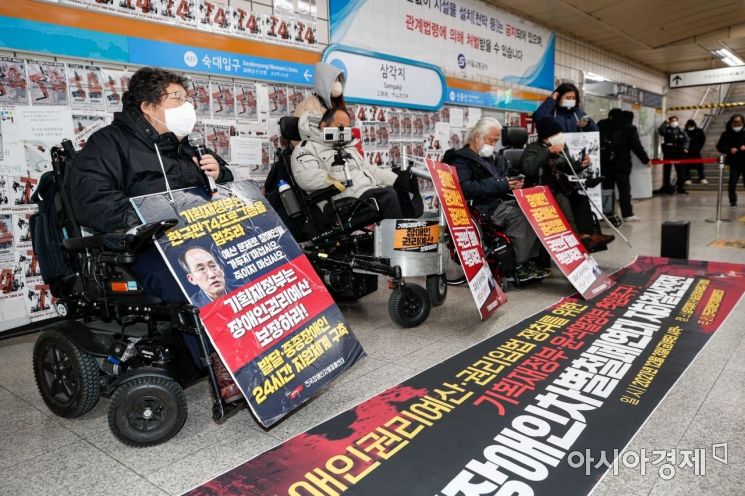
 Members of the National Solidarity for the Elimination of Discrimination against Persons with Disabilities held a press conference on the 5th at Samgak Station on Subway Line 4 in Yongsan-gu, Seoul, urging the expansion of the budget for disability rights. Photo by Kang Jin-hyung aymsdream@
[Asia Economy Reporter Kang Juhee] The Seoul Metropolitan Government has decided to implement non-stop subway passage at stations where the nationwide coalition for the elimination of discrimination against persons with disabilities (Jeonjangyeon) holds morning protests. This measure was taken as citizen inconvenience increased due to the year-long protests. However, Jeonjangyeon has stated that it will continue to hold surprise protests. There are also criticisms that non-stop passage will not be a fundamental solution to the conflict.
Seoul City Announces 'Non-Stop Passage' Plan... Jeonjangyeon: "We Have Passed Non-Stop Until Now"
On the 8th, Seoul City announced that it would implement a plan to have subways pass through relevant stations without stopping when necessary to minimize citizen inconvenience caused by Jeonjangyeon's protests. A city official said on the day, "It seems there was an inquiry from the Presidential Office regarding non-stop passage," adding, "The city also reported this to Mayor Oh Se-hoon today." He continued, "Although the specific method and timing of non-stop passage have not been decided, the city and Seoul Metro Corporation have reviewed the related matters and plan to start as soon as possible."
Jeonjangyeon's morning subway protests, demanding the guarantee of budgets for disability rights, began on December 3 last year, coinciding with the International Day of Persons with Disabilities. Since then, the protests have continued for a year on certain sections of subway lines 2, 3, 4, and 5, with participants boarding and alighting subways using electric wheelchairs. Jeonjangyeon temporarily suspended protests for about 20 days after meeting with the Presidential Transition Committee at the end of March this year, before President Yoon Suk-yeol's inauguration. However, they resumed protests on April 21, claiming that their demands were not sufficiently reflected in the national agenda announced by the Transition Committee.
Specifically, Jeonjangyeon demands include ▲ the allocation of 2.9 trillion won for the 2023 budget for disability activity support ▲ the establishment of a rights-based activity support policy ▲ the allocation of 80.7 billion won for the 2023 pilot project budget for deinstitutionalization and independent living support ▲ the reallocation of existing residential facility budgets to deinstitutionalization budgets ▲ improvement of budgets and systems for disability mobility rights ▲ and the guarantee of activity support rights for disabled elderly under 65 registered in long-term care.
Jeonjangyeon strongly opposed Seoul City and Seoul Metro Corporation's non-stop passage policy. In a statement, Jeonjangyeon said, "The city's decision is interpreted as following the Yoon Suk-yeol administration's policy to strictly respond to illegal strikes according to law and principles," adding, "If Mayor Oh Se-hoon's decision is true, Seoul City should first acknowledge and apologize for discriminating against persons with disabilities by not guaranteeing their basic rights according to law and principles."
Jeonjangyeon said, "Disabled people in South Korea have already been unable to board trains used by non-disabled people. Haven't they been passing non-stop until now anyway?" and criticized, "Now they are mentioning this shameful measure as if it is something new." Jeonjangyeon plans to continue protests. On the 9th, they held a publicity campaign at Samgakji Station on subway line 4, where the Yongsan Presidential Office is located.
Jeonjangyeon Protests Divided... "No Political Role Seen to Find Compromise or Agreement"
Since the protests began, opinions on Jeonjangyeon's protest methods have been sharply divided. While some criticize them as illegal protests that hinder citizens' commutes, others understand, saying, "They must have come out to the streets because of desperation." However, as train delays caused by the protests have repeated for a year, public opinion toward Jeonjangyeon has worsened.
Some criticize the absence of political roles to mediate the conflict. Over the past year, the government and National Assembly have effectively taken no action regarding Jeonjangyeon's protests. Park Kyung-seok, Jeonjangyeon's representative, said in a June 6 interview with MBC Radio, "We sent several official letters and tried to contact the Ministry of Economy and Finance through various channels to request at least working-level consultations and opportunities to explain our demands, but received no response."
The ruling party, the People Power Party, has shown a stance that it cannot practically compromise with Jeonjangyeon. On the 8th, Representative Kwon Seong-dong wrote on Facebook, "The government and the people have endured Jeonjangyeon's protests so far," adding, "If this continues, Jeonjangyeon will hold subway protests whenever they have demands, and the government will have to comply. The government must firmly respond to subway protests now. The only thing that can be gained through illegality is punishment."
Professor Lee Jun-han of the Department of Political Science and Diplomacy at Incheon National University emphasized, "The political role to compromise, negotiate, dialogue, and find common ground is not visible," adding, "A hardline, punitive, and zero-tolerance approach may help consolidate the ruling party's support base, but it causes the state to retreat and social conflicts to deepen. Since the government does not represent or listen to the socially vulnerable, protesters find it difficult to back down. The government should create a venue to take a step back and seek compromise."
© The Asia Business Daily(www.asiae.co.kr). All rights reserved.

















