[Asia Economy Yeongnam Reporting Headquarters Reporter Dongguk Lee] Ulsan City will hold the “Ulsan (U)-2030 Battery Industry Re-Leap Alliance Launch Ceremony” at 3 p.m. on the 9th in the main auditorium of Ulsan Technopark to leap forward as a global hub city for secondary batteries by 2030.
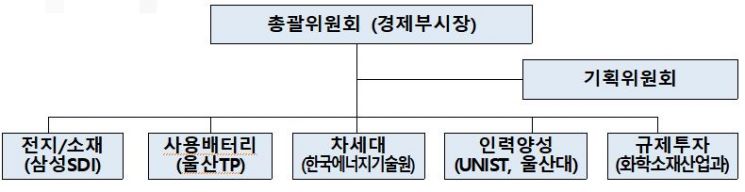
The industry-academia-research-government alliance includes 57 companies such as Samsung SDI, Korea Zinc, Hwasung, and Isu Chemical; 4 universities including Ulsan National Institute of Science and Technology and University of Ulsan; 11 secondary battery research and support institutions including Ulsan Technopark and Korea Institute of Energy Technology; and the City Council’s Industry and Construction Committee.
The launch ceremony will be attended by about 130 representatives from over 50 industry-academia-research-government organizations, including Mayor Kim Doo-gyeom, City Council Chairman Kim Ki-hwan, and Samsung SDI Ulsan Plant Head Jeong Hoon, who will pledge to join the vigorous leap toward the development of Ulsan’s battery industry and becoming a global leading city in secondary batteries.
In connection with the government’s “Secondary Battery Industry Innovation Strategy” announced last November, the city will announce the “Ulsan (U)-2030 Battery Industry Re-Leap Strategy Plan,” consisting of 4 major strategies and 14 core tasks for the re-leap of Ulsan’s battery industry by 2030.
The city plans to establish the “Ulsan (U)-2030 Battery Industry Re-Leap Strategy,” which concretizes the 14 core tasks by January next year, and strengthen its position to re-leap as a hub city for the battery industry.
Through this, Ulsan plans to participate in the designation of the “Secondary Battery Advanced Strategic Industry Specialized Complex,” which the Ministry of Trade, Industry and Energy plans to designate through a public contest in the first half of next year, forming a central district that concentrates the human and material infrastructure of Ulsan’s battery industry based on the advantage of having production and demand companies located within the region.
Ulsan City has laid the groundwork to leap forward as a secondary battery hub city by announcing the “Ulsan Battery Industry Promotion Strategy” last October, aiming to foster the battery industry as a new growth engine linked to the advancement of the main industry from general-purpose products to a high value-added product production system.
Ulsan is the only city nationwide to establish the “Next-Generation Secondary Battery Commercialization Support Center” linked to the government’s “Next-Generation Battery Park Creation Project,” and is advancing the future-type next-generation battery industry together with Samsung SDI, which is building the “world’s first all-solid-state battery pilot production line” targeting next year.
Ulsan National Institute of Science and Technology, which has excellent research capabilities; Korea Institute of Energy Technology, the largest in scale nationwide, providing foundational technology research support infrastructure; and Ulsan Technopark, which boasts the highest utilization rate of corporate support equipment nationwide, provide a unique full-cycle corporate support infrastructure including small and medium-sized (electric vehicle) secondary battery demonstration, evaluation, and post-use battery industrialization support.
Corporate investment attraction is also active, with Ulsan successfully attracting 1.3 trillion KRW in investments this year alone, including signing memorandums of understanding with Korea Zinc and Hwasung consecutively.
Korea Zinc plans to expand its electrolytic copper foil production plant used as a cathode material for secondary batteries and establish a precursor production plant by 2023, while Hwasung plans to double the size of its secondary battery electrolyte production plant by 2023.
However, in response to recent global supply chain risk expansion, the expected surge in used battery generation, and intensified technological competition, Ulsan plans to overcome the crisis surrounding the secondary battery industry and create a new turning point for re-leap, turning it into an opportunity for new growth.
Mayor Kim Doo-gyeom of Ulsan said, “If designated as a Secondary Battery Advanced Strategic Industry Specialized Complex, we expect to maximize corporate support and investment expansion by linking with the already established infrastructure,” adding, “Through the establishment of this alliance, we will concentrate the capabilities of local industry, academia, research, and government to ensure that Ulsan is designated as the ‘Secondary Battery Advanced Strategic Industry Specialized Complex’ and rise as a leading city in the secondary battery industry.”
© The Asia Business Daily(www.asiae.co.kr). All rights reserved.

















