Da Vinci SP Enables Deep Organ Access and Precise Surgery
with a Single 2.5cm Incision
Minimizes Scarring...Reduces Surgery Time
Actively Used in Various Cancer Surgeries
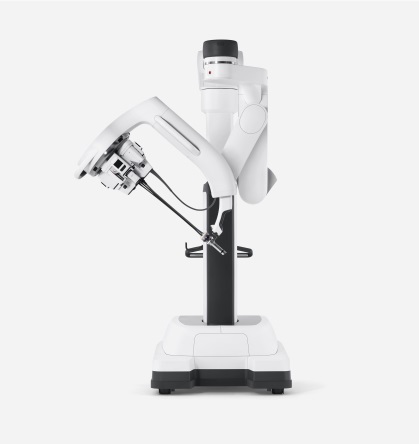
[Asia Economy Reporter Lee Gwan-ju] The 'single-port robotic surgery,' which performs robotic surgery through a single incision, is evolving. While traditional robotic surgeries required 3 to 4 incision sites for access, single-port robotic surgery allows access to deep internal organs with minimal incisions, offering advantages in improving patient prognosis and quality of life. Initially utilized mainly in urology, obstetrics and gynecology, otolaryngology, and endocrine surgery, single-port robotic surgery is now actively applied in various cancer surgeries, expanding its scope of application.
Single-Port Robotic Surgery Driven by Technological Advances
The greatest advantage of robotic surgery lies in the surgeon's ability to secure a surgical field easily with three-dimensional (3D) high-definition imaging and perform precise surgery safely through robotic arms. It enables access to areas difficult for human hands to reach with minimal incisions, reducing risks of bleeding and infection, which leads to faster postoperative recovery for patients.
However, existing robotic surgical systems such as the da Vinci Si and da Vinci Xi required 3 to 4 incisions due to insufficient traction force needed for surgery, making single-port surgery challenging. The single-port robotic surgery began in earnest with the release of the da Vinci SP in 2018. The system increased the number of robotic arms from two to three on a single camera and can reach up to 24 cm inside the body. This allows precise robotic surgery on deeper organs through a single incision of about 2.5 cm. The growth in South Korea has also been rapid; two years after its introduction, in 2020, Severance Hospital achieved 1,000 da Vinci SP robotic surgeries?the first in the world?and the same year, Ewha Womans University Seoul Hospital reached 500 cases.
Active Surgical Research... Expansion of Indications
Research and new attempts in the medical community regarding single-port robotic surgery are also active. A research team led by Professors Kang Sang-wook and Lee In-ah from the Thyroid and Endocrine Surgery Department at Severance Hospital recently published findings showing that adrenal gland surgery time using the da Vinci SP was reduced by more than half compared to conventional robotic surgery.
The adrenal glands are located deep within the abdomen and have numerous tiny blood vessels, making tumor surgery challenging and one of the effective targets for robotic surgery. The team compared and evaluated adrenal surgeries performed on 8 patients using the da Vinci SP and 11 patients using the da Vinci Xi. The average surgery time using the da Vinci SP was 82.8 minutes, which is more than 50% shorter than the 172.6 minutes required with the da Vinci Xi. Blood loss was also reduced by 28.7 ml, shortening patient hospitalization by more than 2.5 days. Professor Kang explained, "Using the da Vinci SP for adrenal surgeries deep inside the body has significantly improved surgical outcomes."
The first case of gastric tumor resection using single-port robotic surgery has also been reported. Professor Seo Ho-seok of the Gastrointestinal Surgery Department at Seoul St. Mary's Hospital successfully operated on two patients with gastric tumors using the da Vinci SP. Both patients had tumors located in difficult-to-access areas such as the gastroesophageal junction, the lesser curvature (short part of the stomach), and the posterior wall, with challenges in preserving stomach function due to shape changes after resection. Professor Seo performed wedge gastrectomy (wedge-shaped full-thickness resection of the stomach) and tumor excision (removal of only the tumor area followed by stomach wall suturing) using the da Vinci SP, aiming to preserve stomach function as much as possible with minimal gastric resection according to the tumor's location and shape.
Professor Seo stated, "Recently, single-port robotic surgery has been expanding to hernia, rectal cancer, prostate cancer, breast cancer, and gynecological surgeries," adding, "It is meaningful that benign gastric tumors located in difficult-to-resect areas were treated with single-port robotic surgery, leaving minimal scars while preserving stomach function to the greatest extent."
© The Asia Business Daily(www.asiae.co.kr). All rights reserved.

















