Limited Insurance Coverage for Musculoskeletal Ultrasound and MRI
Public Policy Fees Introduced for Emergency and Essential Medical Care
Simultaneous Promotion of Medical Workforce Attraction and Supply Expansion
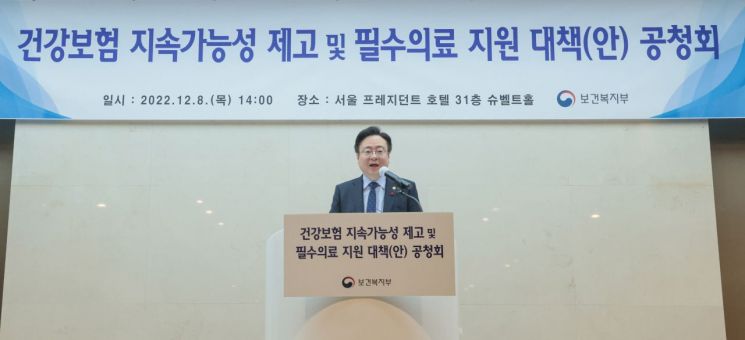
[Asia Economy Reporter Kim Young-won] The government has decided to reexamine the expanded coverage criteria for medical services such as magnetic resonance imaging (MRI) and ultrasound based on medical necessity. Measures to prevent 'medical shopping,' where health insurance benefits are exploited by inbound travelers from overseas, have also been introduced. The funds saved through these measures will be invested in essential medical care and catastrophic medical expenses.
On the 8th, the Ministry of Health and Welfare held a public hearing at the President Hotel in Jung-gu, Seoul, to announce the 'Measures to Enhance the Sustainability of Health Insurance and Support Essential Medical Care.' The ministry evaluated that the extensive health insurance coverage expansion policy, known as the 'Moon Jae-in Care,' has had the positive effect of improving medical accessibility but also triggered over-treatment, posing a threat to the financial soundness of health insurance. The medical fees for ultrasound and MRI, which were previously non-covered services, increased tenfold from 189.1 billion KRW in 2018, when coverage began, to 1.8476 trillion KRW in 2021. Over the past five years, the health insurance premium growth rate was 2.7%, increasing the burden on insured individuals.
Preventing Excessive MRI and Foreign Medical Shopping... Major Surgery on 'Moon Care'
First, the government plans to reexamine the coverage criteria for items that have seen excessive medical use due to uniform coverage policies. For high-cost items such as brain and cerebrovascular MRI and ultrasound, coverage will be limited only to cases where medical necessity is recognized. Musculoskeletal ultrasound and MRI, which were scheduled for coverage, will undergo limited coverage after analyzing medical necessity and usage volume. To this end, the government will clarify and improve coverage criteria such as medical necessity by gathering expert opinions and forming a committee.
To prevent medical abuse, the government is considering raising the health insurance co-payment rate, which is currently about 20% on average, up to 90% for cases where outpatient medical visits exceed 365 times in one year. According to the Ministry of Health and Welfare, about 2,500 people exceeded 365 outpatient visits last year. Exceptions will be established to ensure that patients who genuinely need medical services, such as those with severe conditions, are not adversely affected by these measures.
The government will also strengthen eligibility requirements for foreigners and overseas Koreans to prevent 'medical shopping' for medical purposes upon entry. Currently, foreign regional subscribers can enroll in health insurance after six months of residence, but dependents have no residence requirement and can receive expensive treatments immediately after entry. Overseas Koreans who do not report overseas migration can also use benefits immediately upon entry, even if they are long-term residents with foreign permanent residency. To prevent this, the government plans to apply health insurance only after six months of residence for foreign dependents and overseas Koreans who have not reported overseas migration.
Im In-taek, Director of Health and Medical Policy at the Ministry of Health and Welfare, explained, "This measure is not a rollback of coverage but aims to clearly present medically necessary criteria and ensure that coverage is provided according to those principles."
Public Fee Compensation and Expansion of Physician Supply... Support for Essential Medical Care
The funds secured will be used to support essential medical care such as severe cases, emergencies, and childbirth. Minister of Health and Welfare Cho Kyu-hong stated in his keynote speech, "The brain hemorrhage death of a nurse at a major hospital in Seoul last July clearly exposed the accumulated problems of the essential medical care system. We aim to secure the sustainability of health insurance and focus on strengthening support for essential medical care directly linked to the lives of the people and catastrophic medical expenses that impose a heavy burden on the public."
The government plans to introduce a public policy fee system to provide appropriate compensation for essential medical care. The public policy fee system is a system that assigns separate fees to institutions responsible for public medical functions to strengthen the compensation system. Initially, the fee increase rate for emergency surgeries and procedures such as brain aneurysms and severe trauma during nights and holidays will be raised by 1.5 to 2 times, and a new 'Emergency Room Dedicated Inpatient Management Fee' will be established to expand compensation for emergency care. Additionally, the fee criteria will be subdivided to provide additional compensation for high-difficulty and high-risk medical procedures. Additional compensation will be given when advanced surgical methods are applied.
To maintain essential medical care bases such as childbirth and pediatrics in medically vulnerable areas, additional fees for vulnerable areas, personnel, and safety policy fees will be provided. In cities, counties, and districts excluding metropolitan cities, an additional 'vulnerable area fee' equivalent to 100% of the current childbirth fee will be paid. Furthermore, an additional 100% personnel and safety fee and a 100% 'infectious disease policy fee' during infectious disease crises will be provided as additional compensation.
To provide 'regionally comprehensive essential medical care,' the government plans to reorganize 40 regional emergency medical centers into severe emergency medical centers equipped with final treatment capabilities such as surgeries and procedures and expand the number of severe emergency medical centers to around 50 by 2025.
The government also emphasized its intention to secure sufficient medical personnel. Considering that it takes more than 10 years to train new specialists, the government plans to induce personnel inflow through improved working conditions and balanced distribution while expanding the total number of specialists to increase supply. However, regarding the expansion of physician supply, the government only stated that it will 'continue discussions' in consideration of the 2020 medical agreement. In September 2020, medical organizations and the government agreed to discuss the expansion of medical school quotas after the stabilization of COVID-19. Minister Cho said, "We will consult with the medical community on expanding medical school quotas as soon as possible according to the medical agreement."
"Detailed Measures Need Supplementation"... Criticism of 'Coverage Rollback'
Experts attending the public hearing agreed on the need for financial efficiency in health insurance but pointed out that the detailed measures are insufficient. Professor Jung Hyung-sun of Yonsei University's Department of Health Administration said, "The fundamental cause of the shortage in essential medical care provision lies in the fixed medical school quotas," and argued, "It is necessary to focus on practical progress to resolve this issue." Kang Jung-hwa, president of the Korea Consumer Federation, who attended as a panel representing subscribers, also said, "I hope a long-term plan for the supply and demand of residents, one of the most important elements in the national medical system, will be prepared," and added, "Discussions on expanding medical school quotas and regional doctor systems should be conducted as soon as possible."
There were also opinions that a longer-term perspective on financial efficiency is needed. Yoon Seok-jun, dean of Korea University's Graduate School of Public Health, pointed out, "Specific messages linked to appropriate burden should be included." He said, "The impact of aging is severe, and the baby boomer generation will mostly enter old age in a few years. Their medical usage inevitably leads to financial burdens, direct premium increases, and public burden. While considering coverage for nursing care costs, we need to treat this as a constant and discuss how to efficiently manage overall health insurance finances."
The Federation of Health and Medical Organizations criticized in a statement, "Despite Korea's medical coverage being the lowest among OECD countries, the government is attempting a regression by reducing coverage under the pretext of financial soundness," and said, "The reexamination of MRI and ultrasound coverage is the beginning of a rollback of coverage that even the insufficient Moon Jae-in Care tried to achieve."
© The Asia Business Daily(www.asiae.co.kr). All rights reserved.
![Clutching a Stolen Dior Bag, Saying "I Hate Being Poor but Real"... The Grotesque Con of a "Human Knockoff" [Slate]](https://cwcontent.asiae.co.kr/asiaresize/183/2026021902243444107_1771435474.jpg)
















