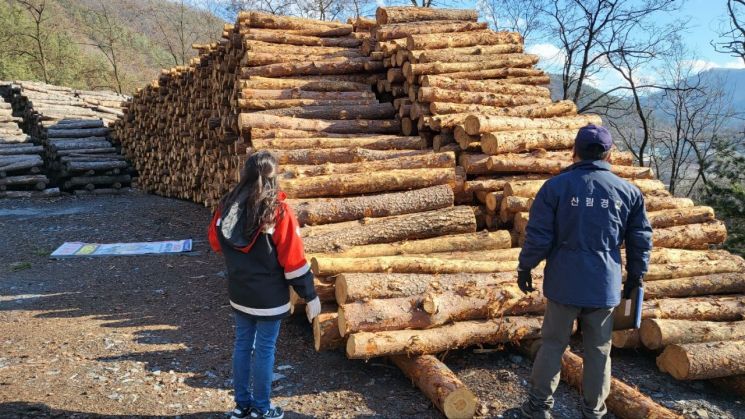
 Forest police are inspecting pine tree handling companies' work sites for any violations. Photo by Korea Forest Service
[Asia Economy (Daejeon) Reporter Jeong Il-woong] The Korea Forest Service is strengthening crackdowns on the unauthorized movement of pine species to prevent the spread of pine wilt disease caused by pine wood nematodes.
On the 8th, the Korea Forest Service announced that it will install 105 checkpoints nationwide to monitor the artificial movement of pine species.
In particular, the Forest Service explained that it will enhance the effectiveness of crackdowns by quickly verifying on-site via smartphones the authenticity of uninfected (production) certificates required for moving pine species, checking for forgery or alteration.
The strengthened crackdown on unauthorized movement of pine species is a measure taken in response to the recent increase in pine wilt disease-damaged trees.
Previously, from May last year to April this year, the Korea Forest Service discovered 380,000 damaged pine trees caused by pine wilt disease in 135 cities, counties, and districts nationwide and removed them all.
During this period, the number of pine wilt disease outbreak sites increased from 131 in April 2021 to 135 this year, and the number of damaged trees rose by 22.6%, from 310,000 to 380,000.
Notably, the number of damaged pine trees had been decreasing annually since peaking at 2.18 million in 2014, but has increased again this year.
Accordingly, before the crackdown this month, the Forest Service conducted two rounds of inspections targeting pine species handling businesses in spring (March) and autumn (November to December) to check whether they handled, used, or sold pine landscaping trees or logs that were moved without authorization.
Unauthorized movement of pine species is a major cause of the spread of pine wilt disease.
For the same reason, under the “Special Act on the Control of Pine Wilt Disease,” anyone who moves pine species without authorization from a restricted area faces imprisonment of up to one year or a fine of up to 10 million won.
Additionally, those who do not obtain a production certificate in areas outside the restricted zones face fines of up to 2 million won, and those who fail to prepare or keep records related to the production and distribution of pine species or violate movement procedures are subject to administrative fines of up to 2 million won each.
Kim Yong-gwan, Director of Forest Protection at the Korea Forest Service, said, “When moving pine species, please consult the local government and follow the proper procedures,” and urged, “We ask for cooperation in refraining from unauthorized movement of pine species to prevent the spread of pine wilt disease.”
© The Asia Business Daily(www.asiae.co.kr). All rights reserved.

















