Forbes Korea Data Analysis Company TDI and Category Selections
Leading Positions for Fitness App 'Kwat' and Food Commerce 'Wingit'
[Asia Economy Reporter Kwak Minjae] Forbes Korea analyzed the mobile applications (apps) most frequently used by domestic users from January to October this year, revealing that well-known apps such as YouTube and KakaoTalk dominated the list. However, in practical categories like fitness and food & beverage, many rapidly growing startup apps ranked highly.
On the 8th, Forbes Korea announced that, together with data analytics company TDI, they extracted data on eight metrics including device installations, new installations, deletions, active users, average number of launches, average usage time per launch, total average usage time, and ratings based on Google Play Store and other sources. They shortlisted 150 top apps from each of the 10 categories, totaling 1,500 apps, and ultimately selected the top 10 in each category.
In this year’s evaluation, YouTube ranked first as the most used app by Koreans, continuing from last year. KakaoTalk came in second, followed by Instagram in third, Coupang fourth, Danggeun Market fifth, SnoreLab sixth, Naver Maps & Navigation seventh, Netflix eighth, T Map ninth, and Coupang Play tenth. In category-specific rankings, popular apps such as Toss, Today’s House, Baedal Minjok, and Musinsa also secured leading positions.
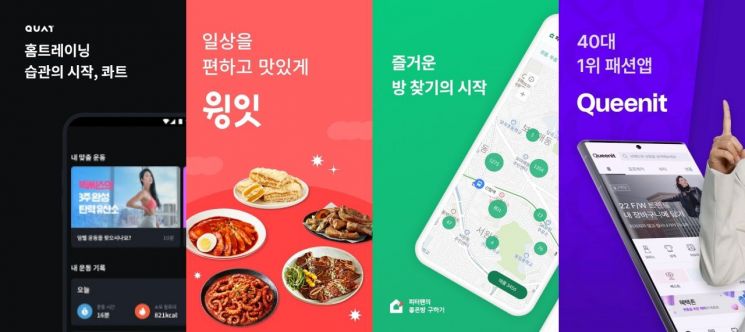
In the health and fitness category, Enrise’s ‘Quat’ service ranked fourth. Quat focuses on building exercise habits and allows users to easily start personalized workouts and light stretching. Recently, Quat secured 12.5 billion KRW in Series B funding.
In the food & beverage (F&B) category, the food vertical commerce platform ‘Wingit’ achieved 10th place. Wingit sells over 2,500 high-quality ready meals by leveraging data analytics and its own brand. Since its founding in 2015, it has recorded a cumulative transaction volume of 80 billion KRW over seven years. Recently, Wingit expanded into the B2B sector, supplying major restaurants and meal kit specialty stores, surpassing 300 SMB (small and medium business) merchant customers. The company aims to enter the food manufacturing and wholesale market, worth 126 trillion KRW annually, to cover the entire food business spectrum.
In the real estate category, ‘Peterpan’s Good Room Search (Peterpan)’ ranked 10th. It started as Korea’s largest real estate direct transaction community and later launched an app version. ‘Dukkeobi Sesang,’ the company behind Peterpan, was established in 2013 and recently acquired subsidiaries such as Apartner and Asil, becoming a leading player in the proptech sector.
Additionally, in the education category, Riiid’s AI-based TOEIC education app ‘Santa’ ranked 18th, and in the social category, the audio live broadcasting platform ‘Spoon’ also ranked 18th. In the shopping category, ‘Queenit,’ a fashion app for people in their 40s chosen by 4 million users, was ranked 19th. Despite changing trends and competitive landscapes, startup apps closely connected to daily life and frequently used have made their mark.
A startup industry insider commented, “Besides major platforms, it is notable that many apps targeting segmented areas have been spotlighted for their practicality. Next year, rankings could change significantly depending on how much these apps can provide concrete information and enhance convenience for actual consumers through ‘advancement.’”
© The Asia Business Daily(www.asiae.co.kr). All rights reserved.

















