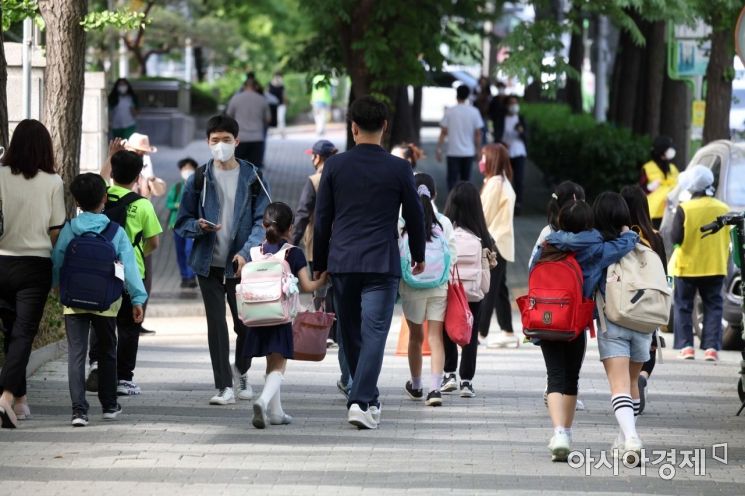
[Asia Economy Reporter Kang Juhee] "An average of 12.6 to 1." This was the competition ratio faced by parents trying to enroll their children in private elementary schools in Seoul for the 2023 academic year. While the number of school-age children is rapidly decreasing, the popularity of private elementary schools remains steadfast. Despite the considerable burden of annual tuition fees reaching 10 million KRW, their popularity has surged since the COVID-19 pandemic.
Competition Ratio Was Around 2 to 1... Soared After Remote Multiple Applications Became Possible
According to the Seoul Metropolitan Office of Education on the 8th, a total of 45,569 applicants applied for 3,630 openings in 38 private elementary schools in Seoul for the 2023 academic year lottery admission. The average competition ratio was 12.6 to 1, an increase from last year's 11.7 to 1. Compared to 6.8 to 1 in the 2021 academic year, it nearly doubled.
Before the 2020 academic year, the admission competition ratio for private elementary schools in Seoul was around 2 to 1. The ratio was 1.9 to 1 in 2016, then ▲2.0 to 1 in 2017 ▲1.8 to 1 in 2018 ▲2.0 to 1 in 2019 ▲2.05 to 1 in 2020, showing little change.
The surge in competition ratios began after the COVID-19 pandemic in 2020. Previously, the lottery for private elementary school admissions was conducted on-site, but starting from the 2021 academic year, remote multiple applications became possible due to COVID-19, which is analyzed as the cause of the increased competition ratio.
Annual tuition fees for private elementary schools reach around 10 million KRW. According to the "2018 Tuition Status of Private Elementary Schools in Seoul," all private elementary schools in Seoul charged over 5 million KRW annually. The most expensive tuition was at Hanyang Elementary School in Seongdong-gu, at 8,376,000 KRW. Following were Uchon Elementary School (8,004,000 KRW), Yeonghun Elementary School (7,650,000 KRW), Gyeongbok Elementary School (7,614,000 KRW), and Lira Elementary School (7,596,000 KRW). In addition to tuition, most private elementary schools charge an admission fee of 1 million KRW. Considering additional costs such as school bus fees, meal fees, and school operation support fees, the actual annual financial burden far exceeds 10 million KRW.
"Better Response to COVID-19 Than Public Schools"... Concerns Over Widening Educational Gaps
Despite this burden, the increased popularity of private elementary schools is attributed not only to changes in the lottery system but also to the perception that private schools responded better to the COVID-19 situation than public schools, leading to higher parental preference. Public elementary schools were criticized for their slow response to switching to remote classes during the COVID-19 outbreak. Remote class operations were not smooth, and the quality of classes was often criticized as inferior to in-person classes.
In contrast, private elementary schools were evaluated as having strengthened quarantine measures while effectively preventing gaps in attendance during the COVID-19 pandemic. According to data disclosed during the 2020 National Assembly audit, private elementary schools had more than twice the average number of in-person school days per week compared to public elementary schools during the COVID-19 outbreak that year. Professor Park Namgi of Gwangju National University of Education analyzed, "Before COVID-19, private elementary schools were at risk of closure, but since then, their ability to minimize educational gaps and adaptability has become noticeably recognized by parents, and the perception that they are worth the investment has spread."
However, concerns have also been raised that educational and academic disparities based on parents' economic status will deepen. Professor Park advised, "COVID-19 revealed unsatisfactory aspects of the quality of public school classes. It is necessary to create a motivation system for teachers to improve class quality and grant schools more authority to address shortcomings."
© The Asia Business Daily(www.asiae.co.kr). All rights reserved.
![Clutching a Stolen Dior Bag, Saying "I Hate Being Poor but Real"... The Grotesque Con of a "Human Knockoff" [Slate]](https://cwcontent.asiae.co.kr/asiaresize/183/2026021902243444107_1771435474.jpg)
















