Government to Implement Revised Enforcement Decree on 'Private Space Development Activation' Regulations from the 11th
Public R&D Facilities Actively Opened to Private Sector
Compensation for New Technology Delays Reduced to One-Third
Private Launch Vehicles Also Included in Safety Measures
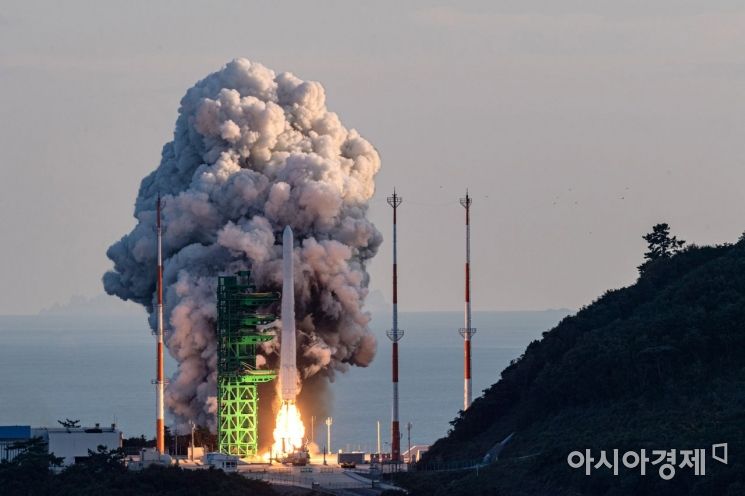 The Korean launch vehicle Nuriho (KSLV-II) is soaring powerfully, emitting flames at the second launch pad of Naro Space Center in Goheung-gun on the 21st. Nuriho is a three-stage launch vehicle designed to deploy a 1.5-ton class practical satellite into low Earth orbit (600?800 km). It is the first domestically produced launch vehicle completed entirely with domestic technology, from engine design to manufacturing, testing, and launch operation.
 /Goheung=Photo by Joint Press Corps
[Asia Economy Reporter Kim Bong-su] "Naro Space Center launch pad available for rent." The government is encouraging private investment in space development by easing unnecessary regulations and strengthening necessary support.
The Ministry of Science and ICT announced on the 8th that partial amendments to the Space Development Promotion Act and its Enforcement Decree, aimed at promoting private space development in preparation for the space economy era, will take effect from the 11th.
First, small launch vehicles being developed by private startups will also be included in safety management, just like Nuriho. The scope of suborbital launch vehicles delegated by law is defined as "artificial space objects propelled by their own propulsion systems, designed and manufactured to have the capability to ascend and descend, reaching an altitude of 100 km or higher above sea level." Accordingly, small launch vehicles developed by domestic private companies such as Innospace and Perigee Aerospace will be subject to safety management measures necessary for launches, including flight and navigation restrictions and traffic limitations within certain areas.
The scope and details of space development infrastructure open to the private sector have also been defined. To support the space industry, which is in its early stages of development, the government plans to disclose information on the types, locations, usage conditions, and opening procedures of space development infrastructure owned by public institutions such as the Korea Aerospace Research Institute (KARI), and to monitor the utilization performance to maximize infrastructure use. The government intends to actively encourage private companies to utilize these resources by providing information through a dedicated portal on facilities such as the second launch pad exclusively for small launch vehicles to be established at Naro Space Center, as well as space environment testing facilities owned by public and university research institutions.
The limit on liquidated damages applied when promoting space development project contracts will also be relaxed. Currently, when the delivery of components such as satellites and launch vehicles is delayed, liquidated damages of up to 30% of the total contract amount are imposed under the existing National Contract Act. However, for contracts involving new technologies?specifically, contracts for manufacturing prototypes and the first complete products?only 10% will be imposed.
The amendments also include detailed administrative procedures required for designating new space technologies and for the designation and cancellation of space industry clusters.
© The Asia Business Daily(www.asiae.co.kr). All rights reserved.

















