Expansion of Government's Command Scope to Steel and Petrochemical Sectors
Over 3.5 Trillion Won Loss Due to Cargo Solidarity Strike
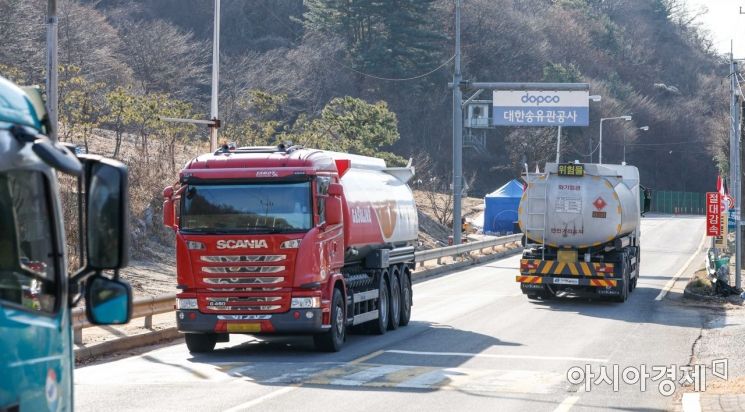 On the 8th, when the government issued an order to resume work to the Cargo Solidarity in the steel and petrochemical sectors, tanker trucks were operating on the road in front of the Seoul branch of Daehan Oil Pipeline Corporation in Seongnam, Gyeonggi Province. / Seongnam = Photo by Kang Jin-hyung aymsdream@
[Asia Economy Reporter Kiho Sung] As the Cargo Solidarity strike enters its fifteenth day, the government has expanded the scope of work commencement orders to include the steel and petrochemical sectors. Following the issuance of a work commencement order in the cement sector on the 29th of last month, the order was initially expected to cover the refining sector, but the scope has been further broadened. This reflects the significant damage caused by the strike. The industrial sector estimates that losses due to the strike have already exceeded 3.5 trillion won.
On the 8th, the government held an extraordinary Cabinet meeting to deliberate and approve the issuance of work commencement orders for those in the steel and petrochemical industries who collectively refuse transportation. Although the work commencement order was initially expected to target the refining (tank lorry) sector, refining was excluded this time as supply and demand conditions and work resumption status have been improving relatively quickly.
On the 29th of last month, the government issued the first-ever work commencement order for the cement transportation sector at a Cabinet meeting. According to the Motor Truck Transportation Business Act, if transport operators or workers collectively refuse freight transportation without just cause, causing significant disruption, the Minister of Land, Infrastructure and Transport may issue a work commencement order after Cabinet approval. Once the order is issued, refusal to return to work is punishable by up to three years imprisonment or a fine of up to 30 million won under the Motor Truck Transportation Business Act.
The reason the government is expanding the work commencement orders to the steel and petrochemical sectors is due to the severe damage caused by the Cargo Solidarity's transportation refusal. An assessment of the industrial damage caused by the collective transportation refusal shows that the petrochemical and steel industries are the most severely affected. As of the morning of the previous day, the Ministry of Land, Infrastructure and Transport reported that petrochemical export shipment volumes are only about 5% of normal levels. Domestic shipment volumes remain at about 65% of normal levels depending on the company. Consequently, some companies are considering production cuts starting this weekend. Steel product shipment volumes are also only about 47% of normal levels, raising concerns about production disruptions within this week.
On this day, the Korea International Trade Association disclosed that the cumulative number of reported difficulties related to the Cargo Solidarity's collective transportation refusal reached 153 cases across 90 companies. According to data compiled by the government over the 12 days of the strike until the 6th, shipment disruptions in five sectors?steel, petrochemical, refining, cement, and automotive?amount to approximately 3.5 trillion won.
Meanwhile, in the cement sector, following the first-ever work commencement order issued last month, transportation volumes have reportedly recovered to 88% of normal levels as of the previous day. Additionally, the Ministry of Land, Infrastructure and Transport has increased pressure by filing complaints with the police and local governments against one truck driver who ultimately refused to comply with the work commencement order.
However, unlike cement, truck drivers in the petrochemical and steel sectors are not clearly distinguishable from those in other sectors, which poses a problem. Koo Heon-sang, Director of Logistics Policy at the Ministry of Land, Infrastructure and Transport, stated, "In the case of cement, it is clearly identifiable by Bulk Cement Trailer (BCT) vehicles, but for steel and petrochemical sectors, the vehicle type is not defined as tank lorries, so the scope of application is broad."
The additional work commencement order is expected to target about 10,000 people, and including those in the cement sector, the total across three sectors is about 13,000 people. The Ministry of Land, Infrastructure and Transport plans to increase field personnel to conduct on-site investigations and deliver the orders.
© The Asia Business Daily(www.asiae.co.kr). All rights reserved.
![Clutching a Stolen Dior Bag, Saying "I Hate Being Poor but Real"... The Grotesque Con of a "Human Knockoff" [Slate]](https://cwcontent.asiae.co.kr/asiaresize/183/2026021902243444107_1771435474.jpg)











