Estimated 6,000 Steel Workers and 4,500 Petrochemical Workers
On-site Investigation from Afternoon
Choo Kyung-ho: "Strong Criminal Charges and Administrative Actions if Work Commencement Orders Are Not Complied With"
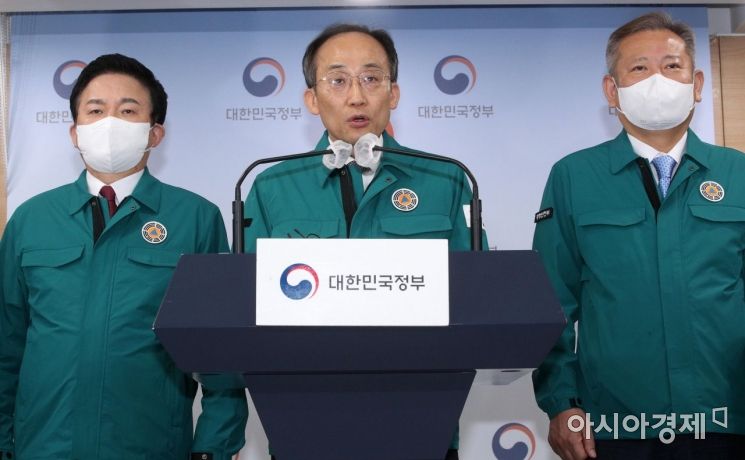 Deputy Prime Minister and Minister of Economy and Finance Choo Kyung-ho and ministers of related departments are holding a joint government briefing on the Cargo Solidarity collective transport refusal at the Government Seoul Office in Jongno-gu, Seoul on the 8th. Photo by Kim Hyun-min kimhyun81@
[Asia Economy Reporter Kim Min-young] The government has decided to issue additional work commencement orders targeting the steel and petrochemical sectors, where logistics normalization is deemed urgent. With the Cargo Solidarity strike entering its 15th day and the expected damage in the steel and petrochemical sectors reaching trillions of won, the government appears to have proactively issued work commencement orders before the industrial damage worsens. Additionally, as the number of cargo truck drivers returning to work increased following the work commencement order against those refusing cement transportation, and cement transport volumes showed signs of normalization, the government judged that the work commencement orders are proving effective.
On the 8th, the Ministry of Land, Infrastructure and Transport announced that, following a temporary Cabinet meeting review, it would issue work commencement orders under the “Cargo Truck Transportation Business Act” against those refusing transportation in the steel and petrochemical sectors.
Deputy Prime Minister and Minister of Economy and Finance Choo Kyung-ho said at a briefing held at the Government Seoul Office immediately after the Cabinet meeting, "Starting today, we will begin on-site investigations of transportation status and swiftly implement follow-up measures related to the work commencement orders."
The targets of this work commencement order are estimated to include about 6,000 transport workers in the steel sector and 4,500 in the petrochemical sector, totaling around 10,000 people. The related transport companies number approximately 240 combined for steel and petrochemicals. Compared to the 2,500 transport workers in the cement sector, the scale of the targets is much larger.
The government has completed practical preparations for the rapid issuance of work commencement orders and plans to deploy 86 joint investigation teams composed of the Ministry of Land, Infrastructure and Transport, local governments, and police to the field starting this afternoon to immediately carry out follow-up actions such as delivering the work commencement orders.
Transport companies and cargo truck drivers who receive the order must withdraw their collective transportation refusal and return to transportation duties by 24:00 the day after receiving the order. Failure to comply without justifiable reasons will result in administrative penalties such as suspension of operation or qualification, as well as criminal penalties including imprisonment of up to three years or fines up to 30 million won.
Deputy Prime Minister Choo stated, "Under the principle of strict response based on law and principles, we will hold those responsible accountable to the end by enforcing strong criminal prosecution and administrative sanctions if the work commencement orders are not followed."
He urged the Cargo Solidarity, saying, "We hope you withdraw the unjustified collective transportation refusal and promptly return to transportation duties to participate in normalizing the national economy and revitalizing people’s livelihoods."
This measure was taken just nine days after the work commencement order was issued against those refusing collective transportation in the cement sector on the 29th of last month. The government explained that the decision was made due to the enormous damage to industry and the economy caused by disruptions in cargo transportation in the steel and petrochemical sectors, with the damage spreading to related industries.
According to precise monitoring of the damage situation in the steel and petrochemical industries caused by the Cargo Solidarity’s collective transportation refusal, as of the 6th, steel shipments remained at about 48% of normal levels, resulting in shipment disruptions worth approximately 1.3154 trillion won. Some companies have already halted or reduced production lines, raising concerns that if the situation continues, damage could spread to the automobile and shipbuilding industries.
The petrochemical products sector is similarly affected. Petrochemical product shipments are at about 20% of normal levels, causing shipment disruptions worth approximately 1.2833 trillion won. The accumulated shipment disruptions could soon lead to a complete shutdown of all production plants. This would inevitably cause a chain reaction of damage to related industries such as exports and automobiles. It is expected to take at least 15 days to restart the plants, with estimated daily production losses of 123.8 billion won until operations resume.
Deputy Prime Minister Choo Kyung-ho expressed concern, saying, "This will deal a fatal blow to the global competitiveness of the steel industry, which is already struggling due to typhoon damage in September and global demand slowdown, and the petrochemical industry, which is facing a crisis due to global oversupply. Furthermore, it is highly likely to cause production disruptions in key demand industries such as automobiles, shipbuilding, and semiconductors, leading to a serious crisis for the national economy."
© The Asia Business Daily(www.asiae.co.kr). All rights reserved.
![Clutching a Stolen Dior Bag, Saying "I Hate Being Poor but Real"... The Grotesque Con of a "Human Knockoff" [Slate]](https://cwcontent.asiae.co.kr/asiaresize/183/2026021902243444107_1771435474.jpg)
















