Team Cook: "Only Use Made in America" at TSMC Arizona Factory
Strengthened US-TSMC 'Semiconductor Alliance'
Red Light for Samsung Customer Poaching
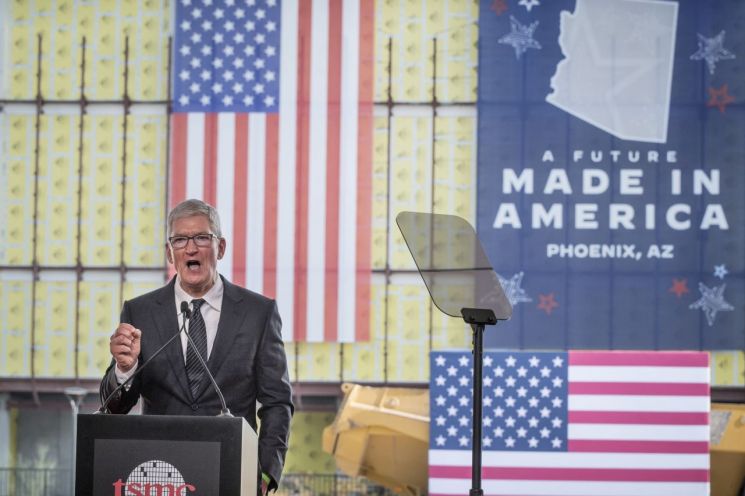
[Asia Economy Reporter Han Yeju] Apple CEO Tim Cook’s announcement that the company will use only TSMC semiconductors made in the United States in its products has stirred a sense of crisis in the domestic semiconductor industry. Samsung Electronics, which had planned to operate a new local factory in the U.S. to attract major clients from TSMC, is reportedly struggling as it has fallen behind in the speed race.
According to industry sources on the 8th, Cook attended the equipment installation ceremony at TSMC’s Arizona plant on the 6th (local time) and said, “Thanks to the efforts of many people, these chips (made at the TSMC plant) now proudly bear the label ‘Made in America.’ This is an incredibly important moment.” He added, “From now on, Apple will use only semiconductors made at TSMC’s Arizona plant.” He further stated, “Apple had to purchase all cutting-edge chips from overseas until now. But we will now bring more of our supply chain to the U.S. As TSMC establishes new and deeper roots in the U.S., we look forward to expanding our partnership.”
TSMC is building a new factory in Arizona, U.S., with an investment of $12 billion (approximately 15.8 trillion KRW). Starting from the end of 2023, it plans to begin mass production of 4-nanometer (1 nm = one billionth of a meter) process products, classified as ultra-fine processes, at a scale of 20,000 wafers per month. This is the first time TSMC is establishing a production base overseas for processes below 5 nanometers.
The foundry leader TSMC and the U.S. semiconductor alliance are strengthening their ties. Through the Arizona plant, TSMC is actively participating in the U.S.-led semiconductor supply chain restructuring and securing U.S. semiconductor companies, the leaders in fabless design, as customers. The first customers of TSMC’s Arizona plant include U.S. semiconductor companies such as Apple, Nvidia, and AMD.
Additionally, TSMC has decided to invest an additional $40 billion (approximately 52.8 trillion KRW) to establish a second plant in Arizona. The second plant, scheduled to begin operations in 2026, will manufacture chips based on the 3-nanometer process that TSMC is preparing for mass production. Once both plants are completed, the combined annual production capacity will reach approximately 600,000 wafers.
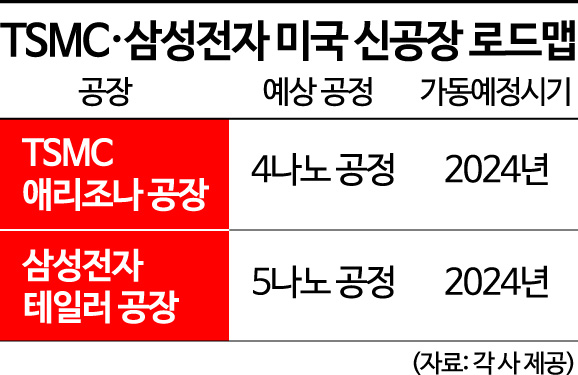
This development complicates Samsung Electronics’ calculations as it competes with TSMC for foundry market share. Samsung had planned to introduce new advanced processes in 2024 and operate a new local factory in the U.S. to attract major clients back to Samsung, but it appears TSMC has taken the lead.
Currently, Samsung Electronics is investing about $17 billion (22.14 trillion KRW) in Taylor, Texas, to build a foundry plant aimed for operation in 2024. It has been a year since the investment was confirmed in November last year, and the building framework is reportedly underway. Once construction is completed next year, equipment installation is expected to begin in the second half of the year. The groundbreaking ceremony is anticipated in the first quarter of next year.
Samsung Electronics now has no choice but to compete on technological prowess. This year, Samsung began mass production of nanoscale chips by introducing the new GAA (Gate-All-Around) technology, replacing the existing FinFET technology. While the FinFET process controls current flow with shark-fin-shaped gates, GAA surrounds the current channel on all four sides, allowing for more precise control of current flow. This is why Samsung’s technology is considered ahead of TSMC, which still adheres to the FinFET method. Samsung plans to start mass production of the second-generation 3-nanometer process upgrade in 2024.
An industry insider said, “A local factory in the U.S. means narrowing the physical distance to major fabless companies and gaining an advantage in high-level technological exchanges. It will be important for Samsung not only to have the latest technology but also to expand local production capacity to regain orders from customers.”
© The Asia Business Daily(www.asiae.co.kr). All rights reserved.
![Clutching a Stolen Dior Bag, Saying "I Hate Being Poor but Real"... The Grotesque Con of a "Human Knockoff" [Slate]](https://cwcontent.asiae.co.kr/asiaresize/183/2026021902243444107_1771435474.jpg)

















